 I love pink, evidently anyone can see that by my blog/site. Before 1955 I hated pink. I am not sure why, just felt no affinity for it. But after immersing myself in vintage magazines and books and movies, pink just pushed itself into the forefront of my favorites. It has many uses and can go from the softest almost sandy tan pink of a seashell to the shocking brights of the 80’s to the deeper greyer undertone pink of the 1950’s. READ MORE
.

Showing posts with label home and garden. Show all posts
Showing posts with label home and garden. Show all posts
Tuesday, May 17, 2011
17 May 1957 “Pink and Green: What a Combination and How To Make A Dressing Table Skirt”
I love pink, evidently anyone can see that by my blog/site. Before 1955 I hated pink. I am not sure why, just felt no affinity for it. But after immersing myself in vintage magazines and books and movies, pink just pushed itself into the forefront of my favorites. It has many uses and can go from the softest almost sandy tan pink of a seashell to the shocking brights of the 80’s to the deeper greyer undertone pink of the 1950’s. READ MORE

Monday, May 16, 2011
16 May 1957 “Some Photos From ‘Round The Farm”
 We have had some new additions to our little ‘farm’ here. My broody hen, though I should have chased her off the nest, is such a good mother, I couldn’t resist. As we have a rooster our eggs our fertilized, so I simply collected up a clutch and let her get to work.
 I love this photo I got of she and her little golden baby. This one, for some reason, really likes to snuggle in the wings of the hen. READ MORE
Thursday, May 5, 2011
5 May 1957 “Espalier Fruit Trees: Beauty and Function”
I had a comment asking about espalier fruit trees. I have mentioned espalier trees in the past. This is a very old form of keeping fruit and also displaying line and form in purely ornamental trees and shrubs.
Espalier :A tree or shrub that is trained to grow in a flat plane against a wall, often in a symmetrical pattern. (French, from Italian spalliera, shoulder support, from spalla, shoulder, from Late Latin spatula, shoulder blade)
I thought I would start with some images showing the various shapes of espalier.
 (READ MORE)
Espalier :A tree or shrub that is trained to grow in a flat plane against a wall, often in a symmetrical pattern. (French, from Italian spalliera, shoulder support, from spalla, shoulder, from Late Latin spatula, shoulder blade)
I thought I would start with some images showing the various shapes of espalier.
 (READ MORE)
Wednesday, May 4, 2011
4 May 1957 “Growing Chickens, Budding Fruit Trees, Stone Walls, and No-Rise Bread”
 I haven’t shared any chicken news with any of you lately. If you recall, back in January I ordered a dozen fertile French Copper Maran eggs. You can see what a lovely chocolate brown they are. I put a few in my incubator and a few under my broody hen. What I learned is I should have put them ALL under the hen. The three I gave here all hatched, while only one in the incubator did so. Obviously Nature over Machine won out this time.
 As I have also mentioned my dogs LOVE chicks. Here you can see my little Chi, Monty, happily snuggling with the little grey chick. She is one of my own chickens fertile eggs. A purebred Blue Orpington from my rooster. The sad tale with Monty’s love affair with the chicks, is once they become full sized hens, they no longer love him, often chase him and he runs squealing away. Yes, my chickens can beat up my dogs, what can one say? READ MORE
Sunday, January 16, 2011
16 January 1957 “Q & A Sunday: The Laundry”
I thought we could talk about laundry on this Q & A Sunday. We have come a long way from the days of our great grandmothers.
 This copper set in a stone or brick fire heated stove was once part of the Monday Wash day. Water was put in the copper and a fire set under it until the water was boiling hot. The clothes were put in and you used your own power to get the clothes clean.
  Here is a similar set up with a washing sink and a place for ‘spot cleaning’.
As oil and gasoline was once a new fangled item and not everyone had cars, the stuff was often used in odd ways. This information is from my book “Household Discoveries and Mrs. Curtis’s cook book” which was published in 1908. You can purchase a copy HERE if you are interested.

 This section in the Laundry tells you how to clean with Gasoline. It advises such cleaning to be performed out of doors. A good idea, when one considers the flammability of the stuff.
 By the 1920’s and 30’s this would have been a normal scene. The wringer be a wonderful aid, but good old elbow grease is still a main feature.
  This lady may have the advantage of a powered washer, though it has to be hand filled and wrung out by hand.
There were also gas powered machines, which though noisy, must have increased productivity immensely.
This Maytag, most likely from the late 1930’s into the 1940’s, shows the move towards electricity. This machine must have seemed a wonder after Granny’s old Gas Powered machine, which worked on the same principal, but was louder and not quite as effective. None the less, it was better than hand churning in great boiling pots or fire heated wash basins. I love how you can adjust the amount of pressure on the wringer wheels for either a heavier piece or a more delicate like mother’s negligee or fathers embroidered pocket handkerchiefs.
Yet, even here in 1957, they are still making and selling the washer/separate ringer models, such as this one.
I wonder if an older homemaker would just be used to this system from their childhood on, so the idea of getting a new machine that felt familiar was prevalent enough to have these type of washers continue to be produced here into the late 1950’s.
An interesting point, from water use, is that a typical modern washing machine uses 40 gallons for wash and 40 for rinse. So, when the wringer was used, you saved 40 gallons by simply not needing it to rinse out the clothes.
 Here in 1957 they have thought of every contingency to entice sales of new washers. This ad for RIT dye shows how it works even better in a special dye reservoir in this model of washing machine.
 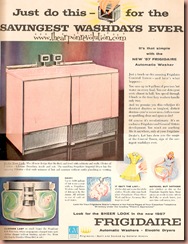 The decadent 1950’s in me makes me lust after a set like this. The color (which I am willing to bet probably also came in my favorite blue) is wonderful and the sleek yet appealing design makes me covetous. I love the little foot step on the bottom of the dryer to open the door. Why does this not exist on my dryer!
Yet, the part of me that has been growing over these past year’s in the 1950’s has been away from consumerism and materialism. And, in a way, I think there is a precedent here in the 1950s. Especially for a woman of my age. I would have been a War bride. I would have worried after hubby and others while away at war. I most likely would have had a war job and been a part of growing more, canning, doing without. This was a time when we had to rest on our laurels, “make do and mend” , Victory Garden, and just come together to make it all work out. This was pretty much tossed out the window in the increasing consumerism of the 1950s.
I honestly think there would be moments when I, such a War bride, would be in my clean packed Super market, driven in my own new second car, buying prepared foods and all the little plastic novelties that I would stop, remember and think, “Is this why we did it all?” “Is this the freedom we fought for, to buy cheap things made in Japan (that’s where they were made then and Taiwan) and buy and want?” “What of the freedom we made for ourselves when we used less, made more of our own, and had to work together to make do?” There had to be those moments then.
As I begin my adventure into the latter part of that Golden Age of the 1950’s, I am finding myself wondering more and more about my own current time. The more I learn to cook and can and sew and garden and make do with what we have, the more I look about at our mass consumption and almost feel sick. It almost feels like a blight or a mass hysteria of sorts. Perhaps it is just par for the course with my own growing disconnect from the modern world BECAUSE of my project. I mean I am disconnected from the world more, yet I continually find myself happier and better equipped to live the MORE I disconnect and the more I depend on myself.
Therefore, in some way, I do feel genuine in my late 50’s homemaker status that such feelings would surface. I wouldn’t wonder if it all would last, it was all to new to even consider then, but I would wonder if we were making a mistake. If all the effort to fight a war for freedom only to give up our personal freedom of creativity and ingenuity to simple want, greed, and avarice. This would continue to be apparent were I to have an older life child, as I would here in 1957. I would see that child growing up in the early 60’s with so many toys and so much plastic, soda, cereals, candy want want need. This would be compared to my own 1920’s and Depression childhood. The contrasts would be great.
I understand now why those older housewives of the time would wring out their paper towels and let them dry in the sink. They couldn’t do it, they couldn’t use it once and toss it away. They HAD to use it until it was unusable. IT was unthinkable of them to waste. I am beginning to be that person more and more.
I find it so interesting to me that someone of my generation who chose to travel to the time when all the consumerism and desire really began somehow now finds herself wanting, nay desiring more and more to do more myself with less. It is an odd combination, perhaps the two negatives have cancelled one another out and made the positive. And in many ways, I feel it IS a positive, how I have become. Who knows, if there ever is a lessening of oil and we HAVE to return to an older way of life, I will already be half way there. I live most of my days without setting foot in a car. I make most things from scratch and sew my own clothes. I suppose I could just as easily learn to use an old treadle sewing machine with no electricity since I learned to use the electric 1950’s model I now use.
Maybe one day I will find myself using this type of washing machine. Though, I would probably have purchased an unloved old machine with a ringer like this anyway, but the same principal.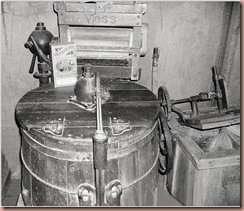

No matter where our future takes us, we certainly can see how quickly washing changed in a matter of generations for the homemaker of the 20th century.
Happy Laundry Day and Happy Homemaking.
 This copper set in a stone or brick fire heated stove was once part of the Monday Wash day. Water was put in the copper and a fire set under it until the water was boiling hot. The clothes were put in and you used your own power to get the clothes clean.
  Here is a similar set up with a washing sink and a place for ‘spot cleaning’.
 As oil and gasoline was once a new fangled item and not everyone had cars, the stuff was often used in odd ways. This information is from my book “Household Discoveries and Mrs. Curtis’s cook book” which was published in 1908. You can purchase a copy HERE if you are interested.

 This section in the Laundry tells you how to clean with Gasoline. It advises such cleaning to be performed out of doors. A good idea, when one considers the flammability of the stuff.
 By the 1920’s and 30’s this would have been a normal scene. The wringer be a wonderful aid, but good old elbow grease is still a main feature.
  This lady may have the advantage of a powered washer, though it has to be hand filled and wrung out by hand.
There were also gas powered machines, which though noisy, must have increased productivity immensely.
This Maytag, most likely from the late 1930’s into the 1940’s, shows the move towards electricity. This machine must have seemed a wonder after Granny’s old Gas Powered machine, which worked on the same principal, but was louder and not quite as effective. None the less, it was better than hand churning in great boiling pots or fire heated wash basins. I love how you can adjust the amount of pressure on the wringer wheels for either a heavier piece or a more delicate like mother’s negligee or fathers embroidered pocket handkerchiefs.
Yet, even here in 1957, they are still making and selling the washer/separate ringer models, such as this one.
I wonder if an older homemaker would just be used to this system from their childhood on, so the idea of getting a new machine that felt familiar was prevalent enough to have these type of washers continue to be produced here into the late 1950’s.
An interesting point, from water use, is that a typical modern washing machine uses 40 gallons for wash and 40 for rinse. So, when the wringer was used, you saved 40 gallons by simply not needing it to rinse out the clothes.
 Here in 1957 they have thought of every contingency to entice sales of new washers. This ad for RIT dye shows how it works even better in a special dye reservoir in this model of washing machine.
  The decadent 1950’s in me makes me lust after a set like this. The color (which I am willing to bet probably also came in my favorite blue) is wonderful and the sleek yet appealing design makes me covetous. I love the little foot step on the bottom of the dryer to open the door. Why does this not exist on my dryer!
Yet, the part of me that has been growing over these past year’s in the 1950’s has been away from consumerism and materialism. And, in a way, I think there is a precedent here in the 1950s. Especially for a woman of my age. I would have been a War bride. I would have worried after hubby and others while away at war. I most likely would have had a war job and been a part of growing more, canning, doing without. This was a time when we had to rest on our laurels, “make do and mend” , Victory Garden, and just come together to make it all work out. This was pretty much tossed out the window in the increasing consumerism of the 1950s.
I honestly think there would be moments when I, such a War bride, would be in my clean packed Super market, driven in my own new second car, buying prepared foods and all the little plastic novelties that I would stop, remember and think, “Is this why we did it all?” “Is this the freedom we fought for, to buy cheap things made in Japan (that’s where they were made then and Taiwan) and buy and want?” “What of the freedom we made for ourselves when we used less, made more of our own, and had to work together to make do?” There had to be those moments then.
As I begin my adventure into the latter part of that Golden Age of the 1950’s, I am finding myself wondering more and more about my own current time. The more I learn to cook and can and sew and garden and make do with what we have, the more I look about at our mass consumption and almost feel sick. It almost feels like a blight or a mass hysteria of sorts. Perhaps it is just par for the course with my own growing disconnect from the modern world BECAUSE of my project. I mean I am disconnected from the world more, yet I continually find myself happier and better equipped to live the MORE I disconnect and the more I depend on myself.
Therefore, in some way, I do feel genuine in my late 50’s homemaker status that such feelings would surface. I wouldn’t wonder if it all would last, it was all to new to even consider then, but I would wonder if we were making a mistake. If all the effort to fight a war for freedom only to give up our personal freedom of creativity and ingenuity to simple want, greed, and avarice. This would continue to be apparent were I to have an older life child, as I would here in 1957. I would see that child growing up in the early 60’s with so many toys and so much plastic, soda, cereals, candy want want need. This would be compared to my own 1920’s and Depression childhood. The contrasts would be great.
I understand now why those older housewives of the time would wring out their paper towels and let them dry in the sink. They couldn’t do it, they couldn’t use it once and toss it away. They HAD to use it until it was unusable. IT was unthinkable of them to waste. I am beginning to be that person more and more.
I find it so interesting to me that someone of my generation who chose to travel to the time when all the consumerism and desire really began somehow now finds herself wanting, nay desiring more and more to do more myself with less. It is an odd combination, perhaps the two negatives have cancelled one another out and made the positive. And in many ways, I feel it IS a positive, how I have become. Who knows, if there ever is a lessening of oil and we HAVE to return to an older way of life, I will already be half way there. I live most of my days without setting foot in a car. I make most things from scratch and sew my own clothes. I suppose I could just as easily learn to use an old treadle sewing machine with no electricity since I learned to use the electric 1950’s model I now use.
Maybe one day I will find myself using this type of washing machine.
 Though, I would probably have purchased an unloved old machine with a ringer like this anyway, but the same principal.

No matter where our future takes us, we certainly can see how quickly washing changed in a matter of generations for the homemaker of the 20th century.
Happy Laundry Day and Happy Homemaking.
Thursday, January 13, 2011
13 January 1957 “A Do It Yourself Coffee Table and Clowns:Once The Darling of The 1950’s”
 I thought I would share this lovely little ‘Do-it-yourself’ idea from one of my magazines. It is a very clever mid-century modern design for a coffee table, utilizing a door. I think it could also be made more Early American by some clever painting or decoupage techniques. Or, simply paint it a solid color. I think it would be fun to attach some metal office baskets underneath (you could do this easily when it is turned upside down) so you could store magazines and things underneath out of sight, but easy to get to.
In the 1950’s and earlier, the clown was seen as an endearing character. Usually funny and jovial, though sometimes a sad clown, it represented the fun and excitement of the circus.
Here is a kid’s show featuring a Clown from the early 1950’s:


 These battery operated toys were very popular during the 1950’s. And of course, the clown played a major role here as well.
 The fear of clowns must have come after the 1970’s because I recall, as a small child in the late 70’s, having one of these type of Jack in the box with the clown face.
  These Hazel Atlas Milk Glass tumblers and Cookie jars are Kitsch today, but the bright colors exemplify the 1950’s kitchen palete of red/pinks, soft blue/teal, yellow and red.
  They show that the clown was not meant only for children. Many a homemaker would have been proud to have these in her kitchen.
 These, to my modern sensibilities, are a bit more menacing.
 Before Ronald, Clowns were still considered good fodder to sell food.
 And toy clowns abound during this decade. This McCall’s pattern features one as part of this sew your own toy collection. To my old modern sensibilities he almost has a sinister grin, but I think this is due to my modern view of clowns.
 Certainly Clowns played a major role as a ‘go-to character’ in arts and crafts. (This thanks to Kitschy Kitschy Koo)
 And toys such as these would have been happily received and possibly wrapped in papers such as this.
Today, many of us have a very different view of the clown. We often view them as kitsch or sometimes even menacing and evil. That is probably due to the Poltergeist films where a toy clown attacks the family. There is also the horror writer Stephen King to thank for menacing clowns as well. I am not sure why they recieved that eventual position in the collection of frightening creatures. That is of course unless those children of the 1950’s (who King and Spielberg certainly were) had nightmarish moments as children with toys or bedroom furniture.
Though this looks darling to me
 it might have frigtened King or Speilberg late at night, with the long shadows cutting across it. Or perhaps the moonlight hit this
 just so, and nightmares ensued.
We do know that the Clown was one of the major choices for children’s Halloween costumes, both in the happy variety

 and the clown’s wayward cousin, the HOBO
  .
.Even the art world was subject to these characters as we see in this 1955 painting by the artist Bernard Buffet.
 He was a French Expressionist and was a member of the anti-abstract group "L 'homme Témoin”. I suppose the irreverence of representational art in the form of the clown was their way to counter the growing popularity of Abstraction in the 1950’s.
Since that time, the clown has made many appearances in art, often with much irony or again with the ability to menace either out of fear or fear of good taste.
Any way you slice it, the clown elicits some response. There is no middle ground for these bright characters. You either coil in fear, raise your nose in disgust of Kitsch, or hold out your arms in a ‘Gimme Gimme’ stance, wanting to take them home with you.
I have a love hate relationship now after living two years in the 1950’s. My once clean cut hatred has become a see saw response of joy and disgust. Again, a response for sure, no hum-drum indifference.
How do clowns make you feel?
Monday, January 10, 2011
10 January 1957 “Gay Little Dots, Spritz Cookies, and The Art of the Book Continues”
 I thought I would start today with this lovely ad from my 1956 Better Homes and Gardens. It is for an Armstrong floor. First of all, to some it might see a bit ‘icky’ perhaps like something someone grew up with and loathed. To me it has a very Doris Day movie set feel.
 There are two things I love about this ad: First I really adore that floor! A lovely 50’s Grey (not the bland darkened sad sea gray we see so often today. I believe Pam at Retrorenovation.com calls it Graige-which it is!) I am sure this is that grey I often see if fabrics, lampshades, upholstery on vintage items, somewhere between a fine men’s flannel suiting (think The Man in the Grey Flannel Suit) and a soft bunny. Now add to this good background pink and blue and white dots and you are in heaven. Well, at least I would be in Heaven. I was thinking how lovely this would be with robins egg blue (as pictured) but still punctuated with Reds and Butter yellows. It could be a dream. And those swirly brackets might seem rather Three’s company (decade’s away) I think they are rather fun. If we decorate with things that might not seem ‘in’ but are joyous to us, then we never have to change them or feel we aren’t quite ‘keeping up’. There is much to be said about consistency and constancy. Particularly in today’s rapid changing world where even our phones are not expected to live out the year!
Now, the second think I love about this ad is the word ‘gay’. I have tried, here and there, to incorporate more 50’s words into daily usage. My favorite is the word, “fine”. If you pay attention to speech in movies from the 30’s to the 50’s you will often hear things such as:“Well, fine, just fine” for something being good, or alright or ‘cool’.
Therefore, the use of the word ‘Gay’ to mean fun, happy, darling I am trying to bring back. When I was young the term “Gay” meant two things, one being a person with that life choice OR mostly to young kids, dumb or stupid. Such as, “Those pink legwarmers are so Gay, you should get the neon green” or some such. You get the idea.
Now when I read in my books, magazines or see on my TV (which is no tv at all but simply old shows sometimes played or old commercials) the word “gay” it means the polar opposite. It is fun, wonderful.
“What a lovely gay print that fabric is, won’t it make darling curtains?” And so on.
So, to all you vintage lovers out there, why not try to re-introduce the word for its original meaning and see how many people join you after awhile.
 These don’t look that amazing, but they were rather good. Yesterday I used one of my Christmas gifts, my cookie press, and made some spritz cookies.
 I love these cookies and always have. My own mother used to make these in every concievable shape and style and had them dipped in chocolate or coated in bright sugars. They were the perfect tea cookie for bridge parties, teas and holidays. I recall getting to help turn the dial on the press when I was young. Of course, I never learned to make the cookies, as I never learned any Homemaking skills. I believe my mother just thought it was a different time (the 80’s) and I didn’t need to know. So, I never bothered.
I am glad to say they are rather easy to make and a joy to create. My head is spinning with the ideas of ways to make these cookies. There is a thin and ridged disc that makes long thin cookies great for dipping or for halves to sandwich cream frosting in between. I imagine gay little pistachio flavored green cookies (ah ha, see ‘gay’ meaning darling, I told you…)and robins egg blue half dipped in dark chocolate. Oh, the cookies I shall make.
Here is the Recipe I used from my Betty Crocker's Picture Cook Book.

 Now, as you may or may not know, a big part of this year for me is Art & Craft. This month and next I have set myself the task to create, write, and illustrate a children’s book. I showed a few sketches before. This is a sample page. It is not done, by any means, but you can see the various layers. The little girl, Imogen, needs more layers as does the background. This scene will have flowers, fence, building and of course, the Hen, Buttons. I was excited to find the font I would like to use, as you can see here in the sample text, as it is a very classic children’s book text.
I cannot help but be influenced by the art and children’s illustrations of the 1950’s. In fact, I want to be, my only fear is that I am so immersed into it, it will only seem derivative of that time rather than original work. We shall see what we shall see. But, I really enjoy the process and style and I love working with colors. So, all round for me, it is fun but VERY challenging. There is much that goes into a book such as this, but since I have made sure that some part of each day goes to it, I hope to follow through with this first big Art & Craft task.
Again, let me know what you think. This is not a finished page by any means. It needs many more layers but I know some of you have wanted to see the process of build up of how I work, so there you go.
I hope all are having a lovely day and Happy Homemaking.
Friday, October 15, 2010
15 October 1956 “1930’s Decorating Class”
I thought it might be fun today to look at some 1930’s interior design images. As I have mentioned before, my 1956 homemaker would have been a young lady or teen in the 1930’s. And in my study of home economics, I would probably have seen many of these types of styles and interiors and furniture.
I have a few wonderful 1930’s interior design books as well as cookery books. I am hoping to increase this collection as I begin to look further into what would have made me, a 1950’s homemaker, esthetically and from early teen age training.(all images can be enlarged by clicking on them and those I borrowed from other sites have links by clicking the image, thank you.)
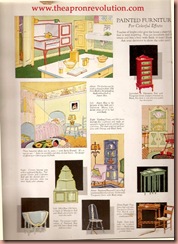 I think this illustration from one of my books shows the fashion for painted furniture. As one can tell, many of these pieces are actually older late Victorian or even Colonial inspired pieces (these colonial pieces began being reproduced in the 1930’s as well) and are enlivened and made modern with paint. I rather like the color tones of this era of reds, greens, yellows, soft blues and all grounded with some form of black. I think these pieces, as well, work very well in a 1950’s kitchen.
I most likely would have some pieces from my mothers own 1930’s kitchen that I would still use in my modern 1956 kitchen. Certainly the colors could and would harmonize.
 Even the lines of the modern chairs of the 1930’s show that the similar angles and lower position to the floor had begun in the 1930’s. These drawings by the 30’s furniture maker Ernst Kauffman demonstrate that. And the Eames work, as this famous chair
  and these Herman Miller Eames chairs
 exhibit similar lines.
The color palette, especially in baths, were much softer and more muted in the 1930’s. This lovely frieze of wallpaper above the tiles from a 1930’s wallpaper book I have, are really beautiful. The design is more more enchanted almost fairy book in its organic movement. While a 1950’s paper would be more stylized and patterned as this 50’s bath shows.
The 1950’s has the ‘new’ plastic tile. It was an easy application a Do-it-yourselfer could manage for less effort and money than actual tile. In the 1930’s linoleum was still very popular. Here we see a bath with what looks like a papered top and a tiled lower wall.
 Yet, the lower wall was actually a product called lin-o-wall, also found in my 30’s wallpaper design book. Here are more examples of the 3-d style it came in.
 I have to say, I am rather enamored of these looks. The stone and the brick, but especially the lower left images would look so good painted in a turn of the century home. And, what is lovely for today is linoleum is a very ‘green’ product in that it is made literally from wood/cork pulp mixed with linseed all and is very renewable. I wonder if any such things are being made currently?
Here are some fun wallpaper examples from the 1930’s.
 I think some of these would be great in a traditional home, but some of the more modern patterns would be fun in a kitchen or bath. The sample on the right with the kitchen breakfast room is geometric and organic combined. I think the top paper on the right ad which looks like blue and white delft tiles would be so lovely in an all blue and white breakfast nook. White painted furniture and woodwork. Soft white sheer drapes with blue and white seat cushions. And little punches of yellow in some framed prints of daffodils or ladies in yellow dresses. It would be such a bright way to start your morning.
 How adorable is this little bedroom? I love the mixture of both the very glamorous skirted dressing table and the stoic ladder back colonial chair. The wall paper is very traditional and yet look at the whimsy of the rug under the chair? The mixture of both old and ‘new’ is done white great affect here, I think. I can’t imagine even needing to change the dressing table for the 1950’s although you might use that wonderful little side chair as your dressing table chair and cover that and the table skirt in the same fabric. A room I certainly would enjoy greeting the day with, how about you?
I think I shall close with this video of a 1930’s fashion show (of course fashion and interiors always played off one another). It is quite fun and taken from the 1930’s movie “The Life of the Party”.
Well, that was just some fun interiors from the 1930’s. As my project begins to come upon the beginning of its third year, I am left wondering where to go next. And, I really think in understanding myself in 1950’s, as the decade wanes, is to understand myself in the 30’s and 40’s both politically, and through the design and food. So, I may do more ‘between the war’ posts, if that would be of interest to any of you.
Have a lovely day and Happy Homemaking.
I have a few wonderful 1930’s interior design books as well as cookery books. I am hoping to increase this collection as I begin to look further into what would have made me, a 1950’s homemaker, esthetically and from early teen age training.(all images can be enlarged by clicking on them and those I borrowed from other sites have links by clicking the image, thank you.)
 I think this illustration from one of my books shows the fashion for painted furniture. As one can tell, many of these pieces are actually older late Victorian or even Colonial inspired pieces (these colonial pieces began being reproduced in the 1930’s as well) and are enlivened and made modern with paint. I rather like the color tones of this era of reds, greens, yellows, soft blues and all grounded with some form of black. I think these pieces, as well, work very well in a 1950’s kitchen.
I most likely would have some pieces from my mothers own 1930’s kitchen that I would still use in my modern 1956 kitchen. Certainly the colors could and would harmonize.
Even the lines of the modern chairs of the 1930’s show that the similar angles and lower position to the floor had begun in the 1930’s. These drawings by the 30’s furniture maker Ernst Kauffman demonstrate that. And the Eames work, as this famous chair  and these Herman Miller Eames chairs
 exhibit similar lines.
The color palette, especially in baths, were much softer and more muted in the 1930’s.
 This lovely frieze of wallpaper above the tiles from a 1930’s wallpaper book I have, are really beautiful. The design is more more enchanted almost fairy book in its organic movement. While a 1950’s paper would be more stylized and patterned as this 50’s bath shows.
 The 1950’s has the ‘new’ plastic tile. It was an easy application a Do-it-yourselfer could manage for less effort and money than actual tile. In the 1930’s linoleum was still very popular. Here we see a bath with what looks like a papered top and a tiled lower wall.
 Yet, the lower wall was actually a product called lin-o-wall, also found in my 30’s wallpaper design book. Here are more examples of the 3-d style it came in.
 I have to say, I am rather enamored of these looks. The stone and the brick, but especially the lower left images would look so good painted in a turn of the century home. And, what is lovely for today is linoleum is a very ‘green’ product in that it is made literally from wood/cork pulp mixed with linseed all and is very renewable. I wonder if any such things are being made currently?
Here are some fun wallpaper examples from the 1930’s.

 I think some of these would be great in a traditional home, but some of the more modern patterns would be fun in a kitchen or bath. The sample on the right with the kitchen breakfast room is geometric and organic combined. I think the top paper on the right ad which looks like blue and white delft tiles would be so lovely in an all blue and white breakfast nook. White painted furniture and woodwork. Soft white sheer drapes with blue and white seat cushions. And little punches of yellow in some framed prints of daffodils or ladies in yellow dresses. It would be such a bright way to start your morning.
 How adorable is this little bedroom? I love the mixture of both the very glamorous skirted dressing table and the stoic ladder back colonial chair. The wall paper is very traditional and yet look at the whimsy of the rug under the chair? The mixture of both old and ‘new’ is done white great affect here, I think. I can’t imagine even needing to change the dressing table for the 1950’s although you might use that wonderful little side chair as your dressing table chair and cover that and the table skirt in the same fabric. A room I certainly would enjoy greeting the day with, how about you?
I think I shall close with this video of a 1930’s fashion show (of course fashion and interiors always played off one another). It is quite fun and taken from the 1930’s movie “The Life of the Party”.
Have a lovely day and Happy Homemaking.
Subscribe to:
Posts (Atom)