Friday, July 24, 2009

24 July 1955 “Fashion, Poetry, and Music”

dior summer 55 I believe I have shown this image before. It is Dior’s Summer 1955 look. You can see it is the beginning of the turn away from the New Look. The skirt is shorter and the cut and fabric is more severe and of men's wear suiting. It is said, this is the where the later 60’s A-line silhouette began.

When I looked at this image again today, having not seen it since back in the beginning of my project, I really felt differently toward it. Back then, in the heightened excitement of the project, the 1950s was all frills and petticoats and fluff. I saw it then, but somehow did not really see it as I now do. It is very modern looking to me now and it has stirred something in me. It has made me feel the need to ‘reach out to the future’ that the inevitability of living in the past will surely do. I am not going to fly back into the 21st century tomorrow, but it makes me somehow feel a need to find a way to make the 1950s somehow become more real and modern in 2010. Though, I am still not sure what time I will actually be living in then?

Perhaps my research will be enough and the past will live in my writing and research and ‘home skills’ but the future will be in my fashion? Who can tell?

shoes 55 Here is a great photo from summer 1955 of shoes by Sir Edward Rayne.  A British shoemaker. This shot is of the workers inspecting the details done on shoes prepared by them for the 55 spring/summer collection. What great shoes and the shot is very grounding in that not all were model/magazine perfect in the 1950s any more than they are today, but I do like the hair and casual cloths of the workers, don’t you?

paris review 1955 Here is the Paris Review from Summer 1955. One of the poets in this issue was Louis Simpson. This poem of his from 1955 makes me think of the woman in the poem as the 1950s woman. She has been it all to me for surely, “…when I think of her, and other faces fade”. Here is the poem:

A Woman Too Well Remembered

Having put on new fashions, she demands

New friends. She trades her beauty and her humor

In anybody’s eyes. If diamonds

Were dark, they’d sparkle so. Her aura is

The glance of scandal and the speed of rumor.


One day, as I recall, when we conversed

In kisses, it amused her to transmit

“What hath God wrought!”-the message that was first

Sent under the Atlantic. Nonsense, yet

It pleases me sometimes to think of it.


Noli me tangere was not her sign.

Her pilgrim trembled with the softest awe.

She was the only daughter of a line

That sleeps in poetry and silences.

She might have sat upon the Sphinx’s paw.


Then is she simply false, and falsely fair?

(The promise she would break she never made)

I cannot say, but truly can compare,

For when the stars move like a steady fire

I think of her, and other faces fade.


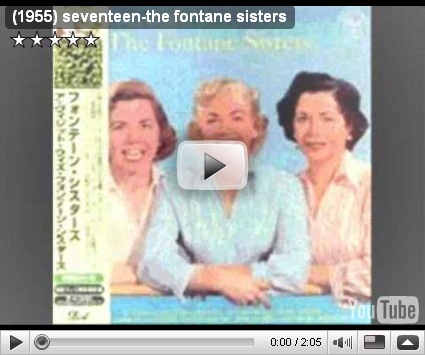
This is an interesting song that came out this year, 1955, by the Fontane sisters about a seventeen year old girl. Interesting how the teenage concept is becoming an ideal to even sing about. “Sloppy jeans old shirt” sounds like the future is on our heels.


I suppose I should stop with the excuses, as I feel my posts have not been very educational lately, but the task of packing up one house and preparing the new one is taking up more time that I had thought. I do hope all of you will bear with me over the next month as I settle into the new place. We have to be packed up and moved out of here by the 1st of Sept, but my house I am moving to will have summer tenants until the 7th, so we have to put things in storage and then take a week long break.

I will keep posting what I can and you keep commenting. I feel like we need to revive our old discussions. Although, I am sure as it is summer for most you, you are also busy as well. Perhaps the computer does not have the same pull as sunny days and beaches?!

Tuesday, July 21, 2009

21 July 1955 “Disneyland Opens, A Movie and A Thought”

17 July 1955: Disney Land Opens:
“Back in the early 1950s, Anaheim was a sleepy little town, and the area around it was nothing more than acres and acres of orange groves. Enter Walt Disney, the original Imagineer. Disney's initial idea was to build a park near his Burbank studio for his employees and their families, but those plans changed over time and his dream grew.
disneland areial He bought over 160 acres of those sleepy orange groves around Anaheim and set about, in 1954, building his "Magic Kingdom." Original plans called for a 9 million dollar 45-acre park, but by opening day the park covered 160 acres and had cost 17 million. Opening day was a gala affair: The ceremonies were broadcast live on ABC with Art Linkletter and Robert (Bob) Cummings as hosts, with celebrities like Ronald Reagan, and VIPs like the Governor of California also in attendance.
giant_squid_1955a The park was turning a profit by its second year of operation, and new rides were soon planned. The Viewliner train in 1957 whisked visitors between Fantasyland and Tomorrowland. The Matterhorn, Submarine Voyage, and the Monorail opened in 1959.
Today Disney Inc. is global, with theme parks in Florida, Paris, and Tokyo, a cruise line in the Bahamas, a cable and network TV presence.”

july life This life cover features the young Susan Strasburg who stars in the movie Picnic with William Holden and Kim Novak that comes out this summer, 1955.
I really liked the movie. It was a different way, for me, to see Kim Novak. I always loved her in Bell, Book, and Candle (that doesn't come  out for another three years I think).
I don’t want to appear a prude nor to wish stifling on any art form or restrictions placed upon the creative arts, but with that said, I love that a movie, such as this, can convey so much passion, anger, love, lust etc. The human condition is all here in this film without illicit sex scenes or gory fights or even swearing. As I said, I am not a prude and I would not want to restrict creativity, what I want is for the newer generations to want to break from the easy way now to simply swear, show sex, and cut off a head graphically, to the more pure representational way to represent the human condition. I don’t want to stifle but to encourage a new growth of expressionism in film that leads away from the flagrant obvious photographic and pornographic showing of the obvious. It would be stunning to see how it could be done. It would be a great study in a film class to put to the students to make a horror film, a love story, a film exposing the illicit and bad qualities of the human animal without the obvious use of couple having sex, man with head chopped off etc.
It is almost easy now to just show everything. I think some of the art is lost in needing to veil it in a way. I know I find more beauty and joy in things that can be subtle and leave me thinking and wondering, but it seems we need everything just handed to us today. Another example of our lazy society. It is as if we are saying to the viewers, “You don’t have to wonder or imagine if the couple making love did so, or if the monster is eating its victim or any subtle ideas whatsoever”  Again, I am not a prude, but maybe I am just a romantic or a crazy time-traveler. I think we have broken everything down and revealed all, that has been done. Now, the real challenge: to hold the attention of our generations of mindless TV watchers who take entertainment as a oxygen, it is always there. We are always plugged in, tuned on etc. We have a sort of numb approach to all of it and I really think a new movement of subtlety and more artful expression really could be well received. Perhaps we could even allow new generations to get a bit of their own imagination and wonder back. I know, I am from the cynical and ironic generations. Nothing can be too serious or too real, or we cannot trust it and scoff at it. There is something envious in me when I look to these simpler more naive generations. I want to look at a simple love story and this, “oh how sweet”, but we are the ironic crowds. Perhaps, because we cannot or do not want to feel to intently, we cannot let anything be serious, I am not sure.
I realize this rant is not very vintage, but it feels very much how I am beginning to react in my own skin to the modern world, one in which I felt very much a part, and am now wondering where my place in it could be? If it can be changed? Should it be changed? And can we change it? Do any of you out there feel this way or does what I have said make any sense? I feel, sometimes, I am merely becoming a walking anachronism.
I promise, next post will have recipes, cleaning tips and tangible ideas, but today, perhaps due to the rain, I am introspective. Now, I have a pile of ironing calling my name and I have to do more packing and labeling of boxes for my move.

Saturday, July 18, 2009

18 July 1955 “The Fashion Journey Continues:What Lies Beneath and My Decision Revealed”

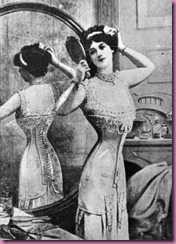
I talked about fashion from 1905-1955 in my last post and I thought to look deeper at what was going on underneath that would be enlightening and interesting.corset cartoonObviously, this characterization from the early 19th century sort of represents what most of us do think of corsetry, but really the underpinnings of garments still exist today.   The ‘girdle’ of the mid 20th century is making a comeback in the guise of Spanx. Call it what you will, if it pulls you in and smoothes you out, you are dealing in corsetry of some sort.
1905: “The S Curve”:
Here we see what is going on underneath the women of fashion of the day to make their lovely shape. Obviously if you were a middleclass wife you may have a more paired down version of this for day wear, but certainly on your ‘at home’ days or your afternoon teas with the ladies, you would need to cut as close a figure to this as possible.
corset 1905 1905 corset2 One of the reasons behind this new “S-Curve” silhouette was health and naturalness. There had been much debate since early in the Victorian period about the health and restrictive qualities of the corsets, but fashion and modesty (for one to be ‘straight-laced’ comes from this very act of wearing a corset like a lady) won out.
Yet the world is changing and women are asking for the vote and attending university, so fashion must follow suit. Thus, at this time, the best health benefits in a corset was the “S” curve. This image shows how the new corsets followed the more natural line of a woman's form than the older style of lacing as seen on the left figure. s curve corsetFollowing this natural curve, however, fashion then needed to take it to the next step with padding out and exaggerating that “S” shape and making the finished look of a lady of high  fashion more exaggerated. 1905 high fashionHere you see the fuller area over the stomach. It is as if there are no breasts or they are one great lump. Padding and such were used to fill out this area and the focus was on the natural line of the waist from this low point up to its natural position at the back. This would have been a great time to have a chubby tummy and got away with it, I think, as the front is so forgiving.
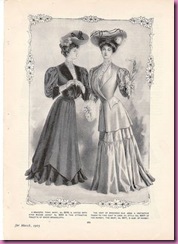
One wonders, in the restriction of these clothes is there  a certain ‘comfort’ in hiding not your best assets? Today one has nothing to hide in only to reveal and if you do not do Pilates seven days a week and sculpt your body into that of a straight hip-less form of a 12 year old boy, you are not fashionable. So, though I am sure we do not want to wear tight corsets, why can we not have fashion that does create a sort of safe haven, a portable home to carry about with you that you can feel safe in?
We expose so much now it is also not very sanitary. I would rather my skirt hem get the germs from the subway than my ankles as I can was the clothes when I get home and they protect me until that time. In this period to have many clothes clean was mainly for the wealthy, but today we COULD really wear more things for sanitary protection and create a sort ‘hide all’ safe feeling that one could embellish and feel fanciful and fashionable and still have the modern means to care for them. Could there be a modern silhouette that is fashionable and ladylike but comfortable with room for embellishment and felling pretty? Could yardage of material mix with ease of its care into a new 21st century silhouette that would be more 19th century? I do wonder.
I find myself more and more realizing that some of the the old things, including such fashion, could be practical when applied to our lives now with the conveniences of washing machines, sewing machines and inexpensive fabrics. What say you, am I just slipping more crazily into my ‘past living’?
Well, onto 1915. War time. Changes in fashion Because of the war is inevitable as now wars are very much fought by women as well on the home front. The shape of a woman needs to be more practical and less decorative. The corset still exits, but the waist has risen and the low front of the “S” curve has been pulled up but sill is very full, almost fat by today's standards.1915 corset Again a comfortable yet lovely look. Men certainly still found women beautiful even if they did not have to have 6 pack abs showing over their low-rise jeans. I think these last days of the corsets were probably the longest they have been, as they need to smooth out to almost the knees. 
 1915 corsets2 A
An odd movement in 1915 that would seem contrary to the war effort was the ‘war crinoline trend’.1915 war crinolin trend This look is almost a blend of the 1850s and the future 1950s. I wonder how much this odd wartime look inspired Dior’s new look? Here is something I found on this odd 1915 wartime trend:
In the spring of 1915, however, fashion changed radically with the introduction of an outline known at the time as the 'war crinoline.' Hemlines crept upward and the skirt was now very full and bell-shaped, with wide collars and sloping shoulders.
Isn’t it strange that before this sudden appearance of full skirts, women had embraced the hobble skirt which restricted movement, but certainly saved on fabric. The hobble skirt would have made more sense in fabric savings for the war effort, but less sense in woman's movement as she began to take over male roles. We were not to see the severity of line and shortness of skirt that would represent fashion and fabric saving in WWII. It almost feels, in some respect, the last ditch effort to hold onto the full frilly femininity that had reigned so long before the inevitable was to happen after WWI and the world was to change forever. It has an odd ominous feel to it.
So, 1925, the reign of the flapper.1925 corset1925 corset2 Certainly we think of the freedom from the corset during this time, but think of today’s body baring fashions and the stick women we are shown in today's fashion magazines. I imagine that is much what the women of 1925 felt if they were not blessed with a thin rail of a body. So, to achieve this ‘free look’ one needed a corset to flatten the hips and many even bound their breasts to create the straight silhouette. It seems we are moving to the freedom of fashion but only to lead us to needing to restrict our bodies more.
This was really, I think, the first time that fashion became about being young. I know young women were always the desirable, but the fashions did not necessarily embrace their underdeveloped figures, but the 1920’s seems to be very modern in that sense. Today even women in their fsixties will wear torn jeans and ‘cool clothes’ that might really only be appropriate for teens. I am sad to think that we are all forced to dress and aspire to a small point in all our lives, our teens, and not celebrate age, which we have more of as our life progresses.
I do think that now after this project it really speaks to me about how our country and our world view “us” as a demographic ripe for consumerism. “Hit them while they are young, mold them and they will keep on buying and the older people will need to fit in, thus they need even MORE to appear young.” But, I digress.
We now view the 1920’s probably the most relatable as a whole today, as it is a time whose attitude of ‘in your face’ poo pooing societies norms and the celebration of youth, fast cars, booze and illegal fun seem more modern in their bent. I don’t want to sound an old fuddy duddy, but how many people really got to experience this lifestyle? Even today, we celebrate the celebrity and the uncouth rich, but how many of us could really strive for such a life? Does that invalidate all the other options we have for living? Does it mean only fashion and fun can be in their hands  while we the masses must be happy with just living vicariously through them by watching them on TV and computer and caring what they have to say? Why is it that we cannot celebrate our own simple lives?
Fashion and fun can be had for all and I just feel today many people feel they don’t deserve to be fashionable or to dictate to themselves and those around them what fashion can be for them! Why can’t they wear a petticoat and full dress and hat and gloves to the grocery store or the local mall? Is their life or their actions not important? Do only red carpet events and Hollywood parties DESERVE nice clothes and happy people? Again, I think the apron revolution needs to be about taking back our lives for ourselves and celebrating fashion, skill, happiness within the sphere of what is deemed ordinary or hum-drum. Don’t settle for scraps, live your life, be it small by comparison to societies norms, to the fullest!
Now, I don’t want to seem to say that I don’t like the fashions of the 1920’s and indeed I adore much of it. And in some sense, one could have a feeling of happy hiding with a dropped waist, but it is not always flattering on a fuller figured person. I just really think it was the first time that very deliberate pre-pubescent bodies were celebrated. This, most likely, was in large part due to the feeling of enjoying and celebrating youth considering all who were lost during the War.
It is interesting, then, that after WWII the female form became very mature and very motherly. Even the swing coats of the fifties served the purpose as practicality to a woman who may find herself pregnant more often than not. That shape did in a way represent the beauty of the pregnant woman. Fuller bosoms and fuller hips were celebrated in a very ‘child bearing’ look. It is very interesting how fashion, much like art, mirrors societies wishes or aims. That is why we can look to it as a definition or explanation of our own society. When we view what we have today, does it show what we all would like to aspire to and become or is it for just a few? I wonder. Could this be the time when we say fashion for the masses doesn't have to only be the liberating tshirt and jeans, but the self made or local made embellished dress that is fun to wear? I think the masses should take fashion back from the over producing tshirted jean and jersyknit clothes sewn by children in communist countries. It serves only a few and gives us the false sense that to be slovenly and lazy is to be free and happy.
I will leave off here and continue with undergarments into the 30s-50s next. I fear if I get too far gone, I may not post and I am trying to be more diligent in posting more regularly.
I found it easier as time went on to make posting a part of my busy day. I do not think I have lost that, only I have had another larger element thrown into my life. I have been as yet silent about it as I was not certain of its outcome.
I have mentioned before that my husband and I own another home that we rent out. It is an antique house built in 1718. It has had a love/hate relationship with us. I have mentioned, as well, in previous posts, how it has haunted me at times when I was left sitting in its empty rooms recalling my mother in her Alzheimer state and my family being there and their sudden departure. It has proved hard to rent sometimes due to its age and the upkeep required. It has served for countless happy holidays of laughter and fun. We had our best Christmas there a few years back in the Victorian style and we dressed in full costume and ate a true Victorian meal from the goose down to the plum pudding.
I have of late come to think upon this house as a member of my family. In my love hate with the house it has proven itself to be very like a dear friend or a family member. Sometimes you are enamored with it and it makes you smile or feel safe. At other times, it makes you feel so angry you could slap it across the face or turn tail on it never to see it again. But, the main element it always has had for me was that emotion.
Perhaps when a thing has been around for so long it does sort of take on a sort of life. I know the house does not breath and feel, but it has seen so much through the years. It was built strong against nature before our country even was a country. It saw so much pass its little red door over centuries and so much of what was good and bad about my own life it has viewed.
We have been trying to find tenants for it lately. At the beginning of summer we lost our tenant who left in a bad state. The house sat empty, sadly for our pocketbooks, for a month or so. I was unable to find anyone suitable as a tenant and if I did find someone, they would inexorably suddenly back out at the last minute. So, I made the decision to let it as a summer rental.
This only set the problem aside and did not solve it. Here on Cape Cod, people do flock in the summer. Our small island connected by a bridge triples in size during the summer months, so finding people to take your house for the summer months is not hard to do, so I did it. That left me with the chore and decision of what was to be the fate of our little house come fall.
Well, after much soul searching and thought and discussion, we have decided to pack up our little family (hubby Gussie and I ) and move back there ourselves come fall. There is a little cottage on the property that will serve Gussies needs. The main house is small but the oldest part and hold so much joy and grief sometimes I am struck by it as I enter the little kitchen door. I really feel it is where we need to be. We have had endless discussions and have changed our mind many times, but now we are set upon the plan. So, come September, we shall reinstate ourselves into the house.
This, of course, means much of my decorating and gardening has had to be set aside and I apologize for not covering it more in the last month or so, but I did know then we may be moving and I didn’t like to say anything as of yet.
I really feel this move is really a move towards my future and this project. I have become enamored with the past and its study both intellectually as well as in the very practice of my living. I think the remainder of my year going to this almost 300 year old house is very fitting. Where will it lead me in the coming year, I do not know. But, I do feel as if I want it to become a part of my project and to take all of you along with me. I honestly feel as if I am packing all of you up and taking you along for the move. I hope that you will enjoy it along with me.
So, now in the future endeavors of homemaking I can add the element of real history. The style and consideration of our American colonial period to decisions in furnishings and fabrics and how we live. I shall be a 1955 homemaker in a 1700’s homemakers dwelling. I shall actually feel rather modern.

Thursday, July 16, 2009

16 July 1955 “A time travel experiment from 1905-1955”

Since beginning this project I have found myself slipping in and out of time. Though the original intention was and still is to focus on the day to day of 1955, I have of late begun to stop in the middle of a 1955 decision and think ten years back, twenty and so on. It has left me, though focusing on 1955, beginning to really feel the elasticity of time. The past can be a living thing in which we can, on some level, hone and make malleable. There is a lesson in it. The past is a sort of free university waiting for our attendance. We can go into it as deeply as we choose and there are a myriad of ‘subjects’ to study, but whatever that choice may be you come out the wiser, I think.
A big part of understanding the specific role of a middle class woman in the role of homemaker in 1955 America has led me down a path I could not have understood at the beginning of the journey. There are forks in the road and hidden foot paths to take or glens in which to peer and wonder or a soft sun-dappled glade to rest your weary modern eyes for a moment. I know I am not, in any way, close to what a true and honest 1955 homemaker truly was. I do not even claim to have their strength or complete understanding of the framework of their time, but I have tried to give my year 1955 a solid framework.
As I have mentioned before, I did not want to feel as if I was just dropped into 1955 straight out of 2008. I also did not want to wander in “Hollywood Movie” style, as if I travelled, Alice in Wonderland style, into a 1950’s sitcom. I did not want it to be a joke. I thought it to be fun and maybe a but silly of a project, but I never went in with any intention to make fun and I hope I have not done so.
The relevance of who I would be in 1955 at my current age could only truly be felt if I also took moments of my day or weeks to ‘look back’ to my fictional past of childhood and teens in the 1920’s and 30’s, my war-time bride era of the 1940’s to really understand what I am doing here, a stay at home homemaker in 1955. That relevance was to come about with trying (and still to try) may hand at skills and ideas that I would have had before the conveniences of 1955. Much of what I, a staunchly middle class woman in 1955 America, would have in the way of conveniences is not that dissimilar to today. I would not be sitting here on my computer, but I would most certainly be washing and drying my clothes in automatic machines, my dishes would be washed in their dishwasher, there would be endless prepared food items available for me to ‘save time’ and endless gadgets from toasters, blenders, waffle irons, steam irons. These things would be new to me. There would be days, no doubt, when I would look at my life and recall my early married days in the war time era or my own ‘help at home’ life in the Depression and wonder and be thankful. I would also worry about my family’s safety, with the cold war and threat of the ‘A-Bomb’, but this fear would not be new to me. I would have grown up on it. It would have been the very fabric of my rearing, the wonder of food and money in the Depression, the worry of safety of life and death, they would have been a constant companion, so I would have dealt with them with a quiet confidence and strong shoulders to carry it off. These realizations have come to make me appreciate this generation to such a great extent.
When I think of how I pictured the 1950’s, and how much of it is now portrayed, before I started this project I cringe. We would look with the lazy casual snobbery of the modern world at the sad little woman in the puffy dress holding the martini and slippers for her domineering husband. Certainly, this may have existed and may still today, but I think when we view the past with only the eyes of the present, we learn nothing and scoff at a great learning opportunity. When we realize that ‘woman at home’ most likely ran the world while the men were away protecting it seems in a different light. To know that that same woman probably worked along her ailing family through the Depression to eek out a life and still smiled and dressed up prettily when she could, laughed and danced and cried, it no longer becomes a funny iconic image to either put neatly up as high art on a wall or as silly magnets upon the fridge. The very strength of character of these people could serve us today if we only took the chance to learn and listen.
Sadly, many of this generation is gone. Those who remain are probably quietly set aside in nursing homes. They can use their strength there as well. They labored and struggled through a life and raised children so that their children could have the freedom to ‘rebel’ and ‘experiment’ with their lives. To selfishly use up the worlds resources for their fun and amusement and constant need to be entertained and feed and satiated to only set aside those who made it all possible in the cold sterile hand that is the nursing home world. This might sound harsh, but it really hits me some days that when I think of those who would have done what I am trying to recreate now are gone and may have been easily shuffled away, hidden, rather than treasured, it makes me sad. But, I digress.
The point of this post was the malleability of time and the past. Its power as a learning and entertaining tool.
I figured in this post I would, with some images and video, show a little cross section of ten year leaps starting in 1905 through to 1955. I hope you enjoy it:
Let’s start with fashion, as it is fun and great to see in a timeline.
1905: the Gibson Girl hair and the flowing skirt. The décolletage on the bolero tops. The “S” curve of the woman's overall shape. The very end of the ‘flamboyant times’ and certainly the Belle Epoch. Of course these are most likely upper class or upper middle class women.
1905 fashion3 1905 fashion1 1905 fashion2 There were also those who were at the bottom of the class ladder immigrants 1905such as these in Stieglitz photo “steerage”stieglitz_steerage and of course, the growing middle classes as these women out shopping1905 middle class
Now 1915: Here you can see a pattern for a ‘well-cut chemise’ that would have served the middle class woman. The next would also be more middle class fashion while the last drawing, which I live the life and style of, certainly shows a more modish turned out upper class woman. These are the First World War years and you can see the raised hemline and more functionality of the clothes, though still very similar in one defined line to which fashion would be interpreted through fabric and various accessories.
1915 fashion3 1915 fashion1 1915 fashion2 That seems to hold true until probably the late 1960’s early 1970s that fashion seemed to dictate a certain silhouette and then was interpreted in different fabrics and accessories, while today, really, anything goes. There is no ‘specific hemline’ nor ‘style’ that the clothes for that year fall into. I think once the complete care free attitude of jeans and t-shirts arrived, it seems to change our way of thinking in how we look. It certainly opened up the world to mass production. It is cheaper to print out dozens of t-shirts with a picture on it and sell it for a fast buck then to have a well made shirt waist.
Now onto 1925:1925 fashion2 1925 fashion1
There certainly for many 1925 was probably indistinguishable from 1905 in terms of women's freedom and even clothing freedom, particularly in rural America where even electricity and plumbing did not arrive until FDR’s New Deal plans, this cartoon certainly shows the great divide beginning to form between the generations.flapper Again, though, after WWI a sort of world party and celebration wanted to start but then after WWII a more staid almost Victorian rule of home and roles returned, as we were not sure of our futures anymore.
The 1925 older upper classes as seen here in Mr. and Mrs. Calvin Coolidge, still had a bit of 19th century about them.1925 calvin coolidge While the youth were more ‘free’ in their attire, though still more dressier than we see today, for sure, they seem to have an almost childlike quality to them for the first time. 1925 cople
1935: The skirt is getting longer, but we really begin to see what was most like today’s model body type, not unlike the Twiggy body of the 1960s.
1935 fashioin1935 fashion21935 uppermiddle class This photo of this young couple looks SO modern as opposed to say a 1955 photo. It also has a very 1970s YSL look to it. This pair were certainly upper or upper middle class. Some young ladies out shopping, most likely middle class 1935 middle class women and of course we cannot address the image of 1935 without the famous Dorothea Lange’s photograph, “Migrant Mother” that spoke volumes about the Great Depression.stieglitz 'steerage' Certainly amongst the happy Hollywood days and the bright young things flying about in sports cars, the worse economic depression rocked our country. You certainly couldn’t, unless you were unfeeling, not feel it somehow. As I had said before, my Maternal Grandfather still bought a new car every year during the Depression, but my mother had told me how they used to buy fruit and things for local poor and let kids have ‘fun rides’ on the running boards of the cars. You could not, perhaps more so if you were staunchly middle class, not feel for the wretched poor. For certainly, you were but a few missed payments away from slipping down your class rung to the lowers starving masses.
1945:1945 simplicity pattern you can see the skirt is higher than it has been. It was to this height in 1925 and then quickly dropped as the 20’s lead into the 30’s. Much of this fashion was based on utility and amount of available fabric as well as fashion. There was a definite military feel as the shoulder pad appeared on women. Here some young ladies, could be either middle or upper classes in a city, appear to be ‘knitting for the cause’.1945 middle class
and finally 1955:
1955 fashin And of course the role of mother was even important in the fashion world. 1955 fashion mother daughter And in many ways the silhouette 1955 fashion of 1955 was not unlike that of 1855.1855 fashion As I said, after WWI there was a sort of free for all party atmosphere with the ‘war to end all wars’, while WWII left us reeling and returning to home to rebuild and re-grow. But, the genie had been let out of the bottle and the children of this generation would not have it.
There are so many other aspects of this fashion timeline that I will address it more in my next blogs, I think I might do bathing costumes next.
Now, onto film:
Yes, there was film in 1905. This little French piece I think really shows a sort of lighthearted theatre perfect for the time that was the Edwardian Period. The last big party before the world was to change for ever in the remainder of the 20th century.
1905 film
1915 film “The Tramp” was a piece of art. There was another film to come out this year about the Civil War that made quite a stir. Though many felt it was unpatriotic, dealt with the civil war in its very real sense of death and destruction. The use of cinema had a moment of seriousness as the world was torn apart in WWI
1925 film. Rudolph Valentino was the first great leading man in the modern sense, I believe. He was such a legend that woman actually killed themselves when he died in 1926. So begins the great ‘fictional mystery’ of film and its power over the masses. Little did they know to what extent ‘celebrities’ and ‘movie stars’ were to play in the future world.
Here is a bit about the introduction of sound to film:
The first commercial screening of movies with fully synchronized sound took place in New York City in April 1923. In the early years after the introduction of sound, films incorporating synchronized dialogue were known as "talking pictures," or "talkies." The first feature-length movie originally presented as a talkie was The Jazz Singer, released in October 1927.
By the early 1930s, the talkies were a global phenomenon. In the United States, they helped secure Hollywood's position as one of the world's most powerful cultural/commercial systems. In Europe (and, to a lesser degree, elsewhere) the new development was treated with suspicion by many filmmakers and critics, who worried that a focus on dialogue would subvert the unique aesthetic virtues of soundless cinema.
So, 1935: I think Shirley Temple really represents an escape needed during the days of the Depression. Often overcoming obstacles and hard times and ending up wealthy. Her plucky youth gave a promise to a very scary time. She also really is the first white female to have as close to an African-American co-star as was possible at the time.
1945: I think this clip from the film “Twice Blessed” really typifies what we think of as the 1940’s as well as showing a light hearted need during the tough war years.
1955: James Dean first film “East of Eden” based on Steinbeck's book comes out.
And of course you can’t mention the 1950s with out the musical. Here is Guys and Dolls.
So, by looking at things this way, from 1905-1955, has been very interesting. I will share more of these findings in the next blogs. It is really an interesting way to ‘time-travel’.
Let me know if you would be interested to see more posts like this showing such a cross section. I think showing the kitchen from 1905-1955 is rather interesting as well. Of course, I am still going to post my home-buying economic post, but I just needed a light break. I hope you enjoy.

Wednesday, July 15, 2009

15 July “Busy and Apologetic”

I promised myself to at least post a small blog every day, but when I sit down to do so I began writing and expounding on things and then find myself with little time to make it cohesive, so then it goes un-posted.

I am still working on my post about home buying then and now. My research into FDR Depression era New Deal legislation is so fascinating and really needs to be addressed to get to where we were with home buying in 1955. The Depression Era is becoming rather interesting. What FDR faced when he came to the white house seems to make what our current president’s problems small in comparison and makes our current economic crunch seem less frightening. 

1935 woman porch The more I look into it the more I begin to think of my own 1955 self and her life during that time. I would have been old enough to have recalled the Depression. I wonder, being a teen at the time, would it have seemed different to me, as WWII was often recalled fondly by very young children in London who got free reign and had an entire city as a playground and no parental supervision? Certainly, if we were effected economically, which I don’t know how you could not be, would I have worked? Would a young daughter of a middle class family be sent out to earn, or would I have needed to ‘keep up appearances’ maybe taking over more housework to cover the fact that the family maid had to be let go? It is all very interesting.

I have done some research and magazine and book reading of the 1940s for this project, as I would have been a young wife then. But, to really begin to think of my formative years, looking at the 1930s is almost imperative. But, I digress.

1935 treens Perhaps it is just the hairstyles, but these 1935 seniors at a High School some how look older or more mature than their 1955 senior counterparts.1955 seniors Maybe it’s just me. Yet these seniors, from 55, had the fear of the A-bomb, but they were at the tail end of the horror that had been. The 1935 seniors had to live in the sad Depression and then to fell the fear of war in the air. I wonder what it felt like in 39 and the early war years before our country got involved in the war?

I have been very busy, as we always seem to find ourselves in summer, and am apologetic for not having posted more. I am also sorry for this meager post, but wish to ‘stay in’ my community and not feel I am letting anyone down.

Maybe until I get up another post, we should discuss what we think the 1930’s would have been for our ‘counterparts’. If you were the age you are now in 1955 count back and see what your age would be in 1935 and then wonder how it would affect you. I think it could make for a lively discussion.

I will be checking in, so if you have not all forgot about me in my lax ways, then we can have a good ‘comment discussion’. So, again, excuse my lax behavior I will try to rectify it.

Thursday, July 9, 2009

9 July 1955 “Some News, Some Music, Some Food, and is it Easier Now or Then?with a little Rant thrown in for good measure.”

jack lalane Jack Lalanne of Oakland, California
swims two miles from a point off Alcatraz
Island Prison to the San Francisco shore,
with his wrists handcuffed together.
Lalanne started from a boat, because
Warden Paul Madigan refused him
permission to leave from the Island.
Madigan still maintains that Alcatraz is
virtually escape-proof for prisoners
because “the water is too cold and the
currents too swift.”

disney_castle_may1955 Last minute preparations to get the
nearly completed Disneyland ready for
dedication ceremonies will be shown on
a special this Sunday night at 8 on ABC. I know some people may get mad at me, but I have never been a Disney fan. Particularly now it sort of represents to me all that I find abhorrent in our American culture. The false overbuilt idea of ‘history’. The plastic overpriced trumped up representation of old classic fairy tales. Even the modern day affect on copyright law and all the ridiculousness that entails is mainly from the Disney’s forcing the copyright law to be extended 100 years. I find this particularly odd, since they want to protect the copyright on stories in which they were not the originator, the old fairy tales. I have to say, if I had a child, I would not even introduce them to any Disney except perhaps the old Snow White. I just see it as the beginning of the packaging and selling of youth and childhood for a fast buck.

Pop music this week in 1955 -

“Rock Around The Clock” - Bill Haley,

“Cherry
Pink And Apple Blossom” - Perez Prado,

“A Blossom Fell” - Nat King Cole,

“Something’s Gotta Give” - The McGuire Sisters,

“Learnin’ The Blues” - Frank
Sinatra,

“Sweet And Gentile” - Alan Dale,

“Experience Unnecessary” - Sarah
Vaughan,

“Honey-Babe” - Art Mooney.

At the movies this week : “Lady And The Tramp”


“The Seven
Little Foys” - Bob Hope and Milly Vitale.

“The Cobweb”
- Richard Widmark, Gloria Grahame, Lauren Bacall,
Charles Boyer.

We see Marilyn is on many magazine covers at the height of her career, including this “Liberty” magazine which is a Canadian Magazine of which I had never heard.

   july mag marilyn monroephotoplay july 55 marilyn

There is something telling about this July cover for the New Yorker. The old Brownstones of old New York, the pre-war buildings becoming shadowed by the increasing growth and building of the post WWII era. The skyscraper has arrived.

 new yorker july 9 1955

Last nights dinner included a new recipe for beets. I really like beets and this very classic recipe is easy and yummy. I really love the color, don’t you?

harvard beets HARVARD BEETS
Serves 4-5
1 lb can diced beets, drained, 1/3 C liquid reserved
2 Tbsp sugar
1 Tbsp corn starch
¼ tsp salt
¼ C vinegar
2 Tbsp butter
In a saucepan, combine sugar, corn starch, and salt. Stir in reserved beet liquid, vinegar, and butter, and cook, stirring, until mixture thickens and bubbles. Add beets and heat through.

Along with this dinner was a rare pot roast with roasted potatoes fresh herbs from the garden. I realized, afterwards, that I did a vintage no-no and left the skins on. I am used to doing this in the modern world as we are told that is where much of the nutrient lies, but I think from now on I will peel my potatoes instead.pot roast Of course, being good middle class 1955 folk we love our martinis dry and our steak very rare.pot roast on plate

I was thinking about some comments we had back and forth on my last post. And it does seem that there is still a considerable amount for a homemaker to do despite the modern conveniences. However, baking bread and canning and keeping a stove lit with coal or wood is no longer a necessity, yet the time at home is gone. It seems, however, that if we begin to return to the 'work at home' and embrace the modern conveniences at the level we feel comfortable we can work backwards as much as we like to simpler times. That is to say, if someone were “into it” enough, they could return to baking and canning all their own things, making all their own clothes, etc. Or, if someone wanted only to stop at mending but still buying clothes but more affordably and still buying bread but locally to support their community, that also seems a great place to go with our apron revolution.

What I do believe we all seem to WANT to do away with is the sort of DISCONNECT we seem to all share within our communities and our own families. We may all be home but separately on computers or eating at different times in different rooms or talking or texting while around our family. We are MORE connected electronically to strangers than we are to those closest to us. I feel, for example, a great connection to all of you and you are scattered all around, but I don't want to lose that and want to foster it more, yet I also WANT the connection within my community and family. Just think how much we could change our lives and community by embracing BOTH of these aspects and relegating time and energy to them, say the time and energy we spend on watching TV or being passively entertained. Then we could form communities digitally and locally and reinforce and share our homemaking ideals and concepts. I think we may truly be on the brink of a wonderful and great revolution here. WE have the power of the modern age, now to only reach to the past and grasp what they had and wonder, "what could THEY have done with what WE have" and go for it! Think on it, we are really now given the chance to ‘time-travel’ in our minds to our fore-mothers and see what they saw and learn what they knew and then in a flash be back into the modern world and use the technology and the modern world and STOP letting it USE US! No more passivity. We don’t have to hide from our modern world, we need to remake it in a new vein that celebrates the past and revives those sage skills of homemaking and combine it, frugally, with technology, so that we can make a better home and therefore happy selves and family and community. So, try it at levels, say no to the Gap shirt and buy locally or thrift or make your own. Use your computer, but don’t just use it as a means to replace the TV, research and find ways to mend and sew and cook and share your skills and then, here is the trick, turn it off for part of the day and DO. That seems to be the main element we need in our modern society: ACTION. What wouldn’t our predecessors given for our modern devices, but would they want it to free up time to sit and watch more tv? No. So, let us build up our new vintage world, raise the flags of our Apron Revolution and march into the future proud and accomplished women. We don’t NEED everything easier, we can use the ease when we do NEED to to further our own growth along, but not to be lazy. Onward, sisters, onward!

Well, that’s my rant for today, now I have to get up and away from the computer and get to Action, myself.

Happy Homemaking.

 Search The Apron Revolution