Thursday, February 10, 2011

10 February 1957 “Cleaning 1907, The Divided Skirt, and More Weed Recipes”

The past week I have been thinking about the past. Now, one must remember that the past to me, here in 1957, might not be the past to most. I am simply looking back a mere 50 years to 1907.

That year, well 1908 to be exact, is the year my Household Discoveries book was published. mrscurtisbook I had one of these in the Corner store but there is now only one available and it is going for $60. And any on eBay are similarly priced. So, a bit pricey. And, anyway, I occasionally share information from it. Though, it is worth having in a good ‘homemaker’s library’.

I am not sure what has brought me to contemplating the past more this week. You would think living in the past would be enough to get a handle on, but I suppose my natural curiosity of the past simply kicks in no matter where I am ‘living’. Were it “My Year 1907 I would probably be considering 1857! So, you can see how one can rather go a bit overboard.

Back to the book at hand and the time period. The early 20th century would have been one I was familiar with through my fictional mother and grandmother. Most likely my fictional grandmother would have had this book on her shelf and referred to it often or perhaps gave it as a gift to a much loved housekeeper. Either way, it would be to we 1950’s women as the 1950’s is to we 21st century. It would have its cute little idiosyncrasies and we would have Ooh-ed and Ah-ed over the lovely dresses but been thankful to be in girdles, not corsets, and have washing machines and dishwashers.

Today I was having a glance through the chapter on House cleaning. I have read through this many times, but somehow missed this bit about what to wear while cleaning:

While house cleaning, dress appropriately for the work. Some housekeepers wear a divided skirt of bloomers made of four widths of heavy dark skirting. These are gathered into bands and buttoned about the ankles and waist. They are valuable protectors for skirts, and facilitate climbing stepladders, scrubbing floors, etc.

I was unable to find any photos of said outfit. This is understandable because, though the Brownie camera was readily available for the middle classes of the America of 1907, the idea of documenting every little thing, rather a norm in 2011, would have never occurred to them. One had scrap books and photo books or nice photo’s in frames on pianos and mantles. There wasn’t really anyplace a homemaker would want documented her cleaning outfit. This is rather too bad, because we today would like to see it. At least I know I would, but then again I am a product of the 21st century and we want to SEE everything documented, don’t we?

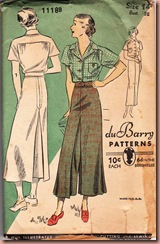
What I did find was these lovely bicycle bloomers.bikebloomersNow this darling outfit would certainly not have been for cleaning. It might, in fact, have even been made of heavy velvet or wool, as this drawing depicts. A quite possibly was put on like a coat or jumper, in one piece, stepped in and buttoned up over ones under things. But I am sure it looked more like that than these darling 1930’sdividedskirtversion. I have to say, though, these would be very good for golf. And, in a sensible serviceable easy to wash cotton or duck cloth, would fair very well for housecleaning. Especially with a pair of deep pockets. One could almost wear it in lieu of a cleaning apron.

Now, here is the rest of the advice for the 1907 homemaker before cleaning:

Pull the sleeves up as far as you want them to go, and put elastic bands on the arms over the sleeves. Trim the finger nails as short as can be borne with comfort. (the fashion for long fingernails NOT  yet in vogue)This prevents their being broken or torn when obliged to work without gloves. Wear a dust cap, a big apron, and loose gloves.

Half the disagreeableness of house cleaning is taken away by having a lotion to apply to parboiled and uncomfortable hands. Soak 2-3 ounces of quince3 seed over night, strain through cheese cloth, and add 2 quarts of water and 2 ounces each of glycerin, boracic acid, and witch-hazel. This is one of the best lotions.

I rather like that they were using quince seeds. Again, something we would consider trash or simply by pre-made the homemaker of 1907 would not have done.

Having cleaning items ready made were also not as prevalent and things, such as dishcloths and dusters, would have simply been made with spare wool and rags.

Here are two very easy crochet patterns for two versions of dishcloths:

  HERE is the pattern

moddishcloth HERE is the pattern for this one. It is rather 50’s and would easy to do up in colors coordinated with your kitchen.

I thought, as I mentioned the lotion from the 1907 manual made of Quince, that I would talk more about the ‘weeds’ in my last post.

chickweed Chickweed, which looks like this: chickweed2 Has a very long and useful list of eating and health uses:

Chickweeds are Medicinal and edible, they are very nutritious, high in vitamins and minerals, can be added to salads or cooked as a pot herb, tasting somewhat like spinach. The major plant constituents in Chickweed are Ascorbic-acid, Beta-carotene, Calcium, Coumarins, Genistein, Gamma-linolenic-acid, Flavonoids, Hentriacontanol, Magnesium, Niacin, Oleic-acid, Potassium, Riboflavin, Rutin, Selenium, Triterpenoid saponins, Thiamin, and Zinc. The whole plant is used in alternative medicine as an astringent, carminative, demulcent, diuretic, expectorant, laxative, refrigerant, vulnerary. A decoction of the whole plant is taken internally as a post-partum depurative, emmenagogue, galactogogue and circulatory tonic. It is also used to relieve constipation, an infusion of the dried herb is used in coughs and hoarseness, and is beneficial in the treatment of kidney complaints. as an astringent, carminative, demulcent, diuretic, expectorant, laxative, refrigerant, vulnerary. A decoction of the whole plant is taken internally as a post-partum depurative, emmenagogue, galactogogue and circulatory tonic. It is also used to relieve constipation, an infusion of the dried herb is used in coughs and hoarseness, and is beneficial in the treatment of kidney complaints. New research indicates it's use as an effective antihistamine. The decoction is also used externally to treat rheumatic pains, wounds and ulcers. It can be applied as a medicinal poultice and will relieve any kind of roseola and is effective wherever there are fragile superficial veins or itching skin conditions.

It also appears to be a good pain relief:

Chickweed tea is a very popular home remedy for pain relief, and one that usually works very well. Because of the anti-inflammatory properties that the herb has it can reduce any inflammation and help to relieve pain, both internally and externally.

Last time I had forgot to mention one fun thing we can do with dandelions and that is make wine! When you consider the amount of dandelions available anywhere. Even if one does not have a yard, they grow in sidewalk cracks, abandoned lots in urban areas, gutters. You name it and they grow there. And I am sure a neighbor would only be to happy to have you pick out those ‘darn weeds’.

HERE is a page that has a few recipes for that lovely wine. This is a very informative step by step process for making the wine.

These lovely and vitamin filled flowers can even be added to pancakes for a delicious taste treat.

I think, now that I have opened this can of worms, that I want to see what else I can find out about using weeds this way. I would also like to find any 1950’s books that might still have had some of this information as it would have been used quite a bit in the early 20th century I am sure.

Happy Homemaking (and weed gathering!)

Tuesday, February 8, 2011

8 February 1957 “Eggless Cupcakes, Those Pesky Weeds or Easy Food and Cheap Medicine?”

I thought I would share two eggless cake recipes I enjoy. Now, I have a generous supply of eggs from my lovely hens, but sometimes I might be low.

The other day was a baking day and I had used up many eggs for breakfast and other things and had only enough eggs for next day’s breakfast (as my hens fresh eggs wouldn’t be laid until later the next day)

chocalmondcupcakeThis chocolate cupcake recipe is SO moist and wonderful. I often use this even when I have eggs available. You can see I made a very rough and natural frosting and it was very delicious. These may have to be sold this summer at the farm fair for pin money.

Eggs Chocolate Cupcakes

2 1/4 C.  unbleached flour

2 C.  sugar

1 C.  unsweetened cocoa powder

2 teaspoons baking soda

1/2 teaspoon salt

2 TBS vanilla extract

2/3 cup oil

1 1/2 Tsp. white vinegar

2 cups cold water

Preheat oven to 350 degrees F.

Sift the dry ingredients (if you don’t have a sifter, put dry ingredients together in bowl and then whisk until blended).

In a large bowl, sift the dry ingredients together.  Set aside.

I mix the oil, water, vanilla extract and vinegar in my Pyrex 2 cup measure, as there is room enough. Give it a good stir.

Slowly whisk the wet ingredients into the dry ingredients. Don’t mix too much, it is okay to be lumpy.

Pour in Cupcake cups and bake about 20-25 minutes. Check with toothpick for doneness.

Now, I used an almond-butter frosting. This works with peanut butter as well, but Gussie (who works on a local farm) had some expired almond butter when their farm store closed for the season. I happily took it. Waste not, want not, as they say.

Almond Butter Frosting

1 C.  butter softened

1 C. chunky almond butter

3 C. confectioners sugar. (You could use more up to 5 cups depending on how sweet you wanted it, but the cupcakes are nice and sweet so I prefer a less sweet icing)

1 TBS milk or Cream

Simply whip butter and almond butter until nice and fluffy (think of how you want your frosting to look) then mix in sugar and milk.

This makes more than enough for the cupcakes, so I put the rest in a mason jar in the ice box and use it as a spread on toast or scones. It also goes wonderfully on a jam sandwich!

Now, here in the late 1950’s we are prone to excess. We seem to be living in a world of plenty. Many things are becoming more affordable and there seems to be a vast endlessness to what we can have at our fingertips. Such bounty, therefore, often leads to a feeling of security.

Such a feeling I found when perusing this little article in one of my magazines about those ‘pesky weeds’ and how they stand in the way of our desire for that ‘perfect lawn’.

As I have said many times, being an older homemaker I cannot but help to think I would sometimes question these motives. There was a time, not long ago (12 years or so prior) that I would  have recalled being hungry and knowing of the want and need of food especially in the war ravaged homes of Europe and Britain. My own lawn, as many other’s had done, may well have given way to veg and other edibles. Today, here in 1957 however, my plantings would seem to be more focused on appearance to actual usage.Fast forward to 21st century and we are well aware of the affects of these ‘weed killers’ to pets, children, the soil and so on.

weedarticle Here, however, I find it interesting how this article points out these various ‘bad weeds’ and the appropriate chemical to do away with them. Let’s take a look, however, at what these plants actually provided for our ancestors when times were tough. Also, before medicine as we know it some of these weeds were also used, by our Victorian and earlier ancestors, to treat ailments.

dandelion First, we have our old friend the dandelion. Probably the most belligerent and determined plant that has fought with the lover of lawns for years. Yet, by its very hardy nature and ability to grow in affect without any aid from us, should tell us that we might want to consider it as part of our food supply.

First let’s look at the suggested aid in destroying this plant 2 4 D. Here is an interesting bit of info on this pesticide, which is STILL used widely today in our country (though I believe it is banned in Europe).

2,4-D was originally developed in 1941 to increase plant growth. Soon, it was discovered to have an even more useful role in agriculture as an herbicide to control weed growth. A mixture of 2,4-D and a related chemical called 2,4,5-T was found to be a more effective herbicide than 2,4-D alone. This mixture was called Agent Orange and was used by the U.S. during the Vietnam War to increase the visibility for war planes by destroying plant undergrowth and crops. The usage of 2,4-D and 2,4,5-T increased through the next 15 years. In response to its potential to cause cancer, and other health concerns, use of 2,4,5-T was banned by the U.S. Environmental Protection Agency (EPA) in 1983. Although 2,4-D use has been allowed to continue by the EPA, its health effects are under review.

Now, the dandelion itself has so many uses and edible bits. The leaves are quite good in any salad or in place of lettuce. The roots can also be toasted, ground and used as a coffee substitute. There are endless uses of the plant. And, surprisingly, a natural plant food for other plants can be drived from it.

Here are the medicinal uses of the plant:

Dandelion is also used for the treatment of the gall bladder, kidney and urinary disorders, gallstones, jaundice, cirrhosis, hypoglycemia, dyspepsia with constipation, edema associated with high blood pressure and heart weakness, chronic joint and skin complaints, gout, eczema and acne. As a tonic, Dandelion strengthens the kidneys. An infusion of the root encourages the steady elimination of toxins from the body. Dandelion is a powerful diuretic but does not deplete the body of potassium.

Research is revealing that the many constituents of Dandelion including Taraxacin, Taraxacoside, Inulin, Phenolic acids, Sesquiterpene lactones, Triterpenes, Coumarins, Catortenoids and Minerals, mainly Potassium and calcium, are very valuable in curing a number of disorders and illnesses. Dandelion is traditionally used as a tonic and blood purifier, for constipation, inflammatory skin conditions, joint pain, eczema and liver dysfunction, including liver conditions such as hepatitis and jaundice.

Another interesting use of the plant is when the flowers and leaves are placed in a closed brown bag with unripe fruit, the  flowers and leaves of Dandelion release ethylene gas which ripen the fruit. You can also make a dark red dye from the roots and a cosmetic skin lotion made by distilling the leaves at the base of the plant in water are suppose to help with freckles.

This is knowledge that our ancestors would have known by course and certainly would have preferred all that from an easy to grow plant over lush green lawns.

plaintain Next, we have the plantian. Now, I don’t know about you, but my yard often produces these, even is spots where little else will grow. They are actually a pretty plant and I have used the leaves in arrangements for my kitchen and dining room table. However, they have many uses.

The herb has a long history of use as an alternative medicine dating back to ancient times. Being used as a panacea (medicinal for everything) in some cultures, one American Indian name for the plant translates to "life medicine."

The young leaves of the plant are great in salads and also lightly cooked with other foods. They are very rich in vitamin B1 and riboflavin. It is interesting to note that things such as riboflavin are now, here in the 1950’s, being added to our wonderful white pre sliced bread, while out in the yard we are killing a natural source of it with military grade poison. We, however, are unaware of this here in 1950. We believe that our government would never let a product be sold that could hurt us. Of course, we also are constantly bombarded by ads for cigarettes, but that is another story altogether.

I have rather found this an interesting idea, these weeds, and will continue talking about these next post. But, imagine, if it were war time or any crisis and we were left to look about us for food and food production. Here we see many plants that, despite our chemicals which in fact hurt us more than the plant, continue to survive. That is an easy source of vitamins, nutrients and ways to fill our belly. Many of these, as well, make wonderful teas or coffee substitutes. Though I am over a decade away from the War, my natural ‘make do and mend’ instinct of the WWII bride would often shake my head at the ‘young people today’ and wonder ‘what a waste, what a shameful waste’ as I save my slivers of soap in old stockings. Garbage and waste would be as sinful to me as anything.

Saturday, February 5, 2011

5 February 1957 “Sleekness in Design for ‘57 and the Need For The Latest Thing”

carcartoonI thought this cartoon spoke to me on two levels. The first was a great portrayal of the ‘keeping up with the Joneses’ becoming more and more prevalent here in the 1950’s.

Secondly, we see the sleek look of design that is starting to appear here in America by 1957. The ‘old’ car of the main couple sticks out like a sore thumb, while the latest more popular couple in the front are squished down in their seats, yet the height of fashion.

Let’s see just how much the overall look of cars from 1955 to 1957 has changed.

55dodgeThis 1955 Dodge ad still has a very ‘tall and rounded’ look. You can notice the major change in the overall design of a car from just 1955 to the modern lower sleeker, though rather larger, 1957 American car, as this ‘57 Mercury displays.57mercuryad

Over the pond, however, the rapidity of change is not as great. The level of production in Britain and Europe is very slow and really the rationing had only stopped a few years prior for England.

Here we see the 1955 Morris.TRCR1050, Morris Minor, One Of The FamilyThis 1955 car already looks rather ‘dated’ by American standards. It still retains a very 1940’s car look. And by 1957 there is not much change to it.57morris Cetainly keeping up with the Joneses here must be a bit easier.

This ‘sleekness’ of design is not limited to cars. In fact the need to ‘update’ our homes is beginning to really appear. We must remember that in the 1920’s-30’s to even have the luxury of a refrigerator would have been just that, a luxury. Even by the 1940’s war time, the concern over how ‘up to date’ ones’ ice box or range was hardly a concern.

Now, however, here at the end of the 1950’s, we begin to see a drastic change in styles. These ads from this year, 1957, for Frigidaire for their ‘sheer look’ in refrigerator as well as stove looks rather modern.

 frigidaireoven1frigidaireicebox1

  Gone is the lumpy image with which we today often associate the 1950’s fridge. This ad is only two years old 55icebox  yet look how dated it appears with the sleek sharp angles of the new ‘57 model.

Some other ‘latest’ designs from this year may begin to look rather familiar to us.moenfaucetad1This ‘state of the art’ Moen single handle faucet probably looks like many that modern people have loathed and had ripped out. Or it recalls the cheap college flat or rental house. Yet, here, it is the ‘cat’s pajamas’ (though that saying is rather outdated here in 1957 as well!)

 celotexceilingtilead1These type of ceiling tiles are always advertised in my magazines from the early 1950’s and by now are available in many decorator colors and styles. Though to modern people it appears that thing to ‘get rid of’ in a home, I wonder if they should be reconsidered. We are so quick to change, to jump on the continual ‘up date’ band wagon, spurred on by the Home Design shows that have been popular since the early 2000’s. What makes something the ‘living end’ one year only to end up ‘ugly’ and on the dust heap the next? earlyamericanroom      Images such as this, which I would call a very middle of the road Early American look also probably has a familiar ring to it. Perhaps in high school days in the 1980’s this type of furniture was relegated to unused rumpus and ‘computer rooms’ in the basement. Or Grandmother had ‘those old sofa’s’ around. Dirty college rental houses often had this type of item on front porches or in back rooms. Yet, here in 1957 they are on the other end of the scale that is Modern on one side and ‘Colonial’ on the other. But they are very highly desired.

What is amazing, is we often see this type of furniture still around and it was very well built AND built IN AMERICA. Yet the inexpensive furniture of today is not and often falls to pieces in a year or two, but who cares, they will but ‘out of style’ by then, right?

It isn’t a new realization to me here, now on my third year in the 1950’s, that the education to waste and spend is well on its way. Though there is much more conservation and much less garbage here in 1957 then in 2011, it is a mad house of spending and waste as opposed to only 10 years earlier in the immediate post WWII years.

I just hope that our love of vintage can allow us to see that we can take and love that which is already made and made well. If we do not do that we will simply wait for more of the modern production to pump out ‘1950’s vintage inspired’ furniture, dishes, etc and allow us to go and buy it with ease. We care little if it is well made or where it is made. I ask, however, to consider the hunt. To find and save and love and repair an old piece, that is to be ‘modern vintage’ in my book. Not only does the authenticity of the piece have more value it also helps out the environment a bit. And, why not give some much needed cash into the pockets of a local seller than wait for that ‘vintage inspired’ flat pack Chinese made sofa from the giant Box store?

Styles change and desires with them, but we must remember that deep down, it is all manufactured. Not only the product but the desire. Before we know it, after our homes are just ‘done’ in 1950’s we will be told it is ugly and 1980’s is the things. That is where we need to separate our true feelings toward a piece or a look and stick with it.

Who knows, maybe your children or grandchildren will be writing a blog, or whatever odd magical form of mass communication exists in 50 years from now, about how lucky they were to have had ancestors who collected up a home full of 1950’s furniture and kept it ‘all these years’.

Thursday, February 3, 2011

3 February 1957 “An Airplane Crash”

planecrash1 On January 31, 1957, a Douglas DC-7 operated by Douglas Aircraft Company was involved in a mid-air collision and crashed into the schoolyard of Pacoima Junior High School in Pacoima in the San Fernando Valley of Los Angeles, California. By February 1, 7 people had died and about 74 had been injured due to the incident. A 12-year old boy died from multiple injuries from the incident on February 2.

Following the collision (of the planes), Curtiss Adams, the radarman aboard the eastbound twin-engine F-89J Scorpion, was able to bail out of the stricken fighter jet and, despite incurring serious burns, parachuted to a landing onto a garage roof in Burbank, breaking his leg when he fell to the ground. The fighter jet’s pilot, Roland E. Owen, died when the aircraft plummeted in flames into La Tuna Canyon in the Verdugo Mountains.

The DC-7B, with a portion of its left wing sheared off, raining debris onto the neighborhoods below, remained airborne for a few minutes, then rolled to the left and began an uncontrolled high-velocity dive earthward over Pacoima. The aircraft broke up at about 500 to 1,000 feet above the ground. Seconds later, the hurtling wreckage slammed onto the grounds of the Pacoima Congregational Church and the adjacent playground of Pacoima Junior High School, killing all four Douglas crewmen aboard. On the school playground, where some 220 boys were just ending their outdoor athletics activities, two students, Ronnie Brann, 13, and Robert Zallan, 12, were struck and killed by wreckage and debris from the crashing airliner. A third gravely injured student, Evan Elsner, 12, died two days later in a local hospital. An estimated 74 more students on the school playground suffered injuries ranging from minor to critical.

ronbrann bobzallan

This PAGE HERE has the actual clippings and article from the story that might be of interest to anyone.

buddy-holly-cricket An odd twist of fate concerning this accident concerns a student of this school who was absent as he was attending his Grandfather’s funeral. He was 15-year-old Richard Steven Valenzuela, who soon became known as singing star Ritchie Valens. Due to this incident he developed an intense fear of flying. After becoming famous he had to overcome this. Of course, the sad bit of irony is that he then, two years later, Valens, Buddy Holly and the Big Bopper (J.P. Richardson) died in an Iowa plane crash. The event became known as "the day the music died" in Don McLean's 1971 hit "American Pie."

Prior to this crash there we no laws over such military test flights, but after this new laws were to be enacted. The incident resulted in over $10 million in lawsuits (that is $70 million it 21st century money)

Monday, January 31, 2011

31 January 1956 “ Desk Set and Floating Island”

desksetposter This year I am excited to re-watch (well for 1957 me it will be the ‘first viewing’) of the Tracy and Hepburn movie “The Desk Set”.
I adore this movie for many reasons. The first being the simple pairing of two of my favorite actors, Spencer Tracy and Katherine Hepburn. The duo were a real life pair and I can truly see them together. The grounded ‘average man’ quality of Tracy just fits the New England Blue-blood eccentricities of Hepburn.
Secondly, this movie really touches a major issue, the computer. Though done in a very Hollywood comedy way, Amorak (the computer) is threatening to take over the lives of the research department of which Hepburn is the head. Throw in a fun love triangle and you have a wonderful movie.
The sad moment for me, when I watch this movie, is that the 21st century me always points out, “Well, it’s all fun and laughs, but honestly those jobs, that very department really won’t exist in a few decades. I can do as much research in 10 minutes on my computer as it would have taken those girls a week of reference material and phone calls”. But, what can one do, the computer certainly came and has not left us anytime soon.
This movie is definitely worth a watch and if you would like to watch it now, simply click on the “APRON TV” button on the side panel and it will take you to my YouTube channel. There click on classic movies, Desk set is there in its entirety. Enjoy.
Now, a very small inconsequential moment in this movie that I love is that in one scene Tracy and Hepburn eat a ‘Floating Island’. The first time I saw this movie I wondered, ‘what on earth is floating island’? Since then, of course, I have found countless versions of this recipe in my cookbooks and magazines.
Here is the section of the movie where they talk about the floating islands. It is at exactly 5:29 on the little counter if you want to forward ahead to the actual dessert. It has little to do with the plot, but I often find moments, such as the beginning of this clip when he is in the kitchen, fascinating. Because being a time traveler one wants to get things right, so to see a kitchen set up and used, it makes a Vintage Gal’s heart go pitter patter. I adore the copper saucepans on the wall and have my own small collection started back in 1955. They do not come cheap but are perfect for certain things. For example, a copper bowl is one of the best bowls to use to make stiff egg whites as one would need in a dessert like ‘floating island’. As to why a copper bowl is better and easier to use, I found this explanation helpful and scientific:
The bowl you use makes a difference when you are whipping egg whites. Copper bowls produce a yellowish, creamy foam that is harder to overbeat that the foam produced using glass or stainless steel bowls. When you whisk egg whites in a copper bowl, some copper ions migrate from the bowl into the egg whites. The copper ions form a yellow complex with one of the proteins in eggs, conalbumin. The conalbumin-copper complex is more stable than the conalbumin alone, so egg whites whipped in a copper bowl are less likely to denature (unfold).
A floating island is basically meringues made from egg whites floating on a custard made with those eggs yolks. There are many varieties out there. My 1950’s Better Home and Gardens has a recipe for a Strawberry Floating Island.floatingisland2As does the Betty Crocker Picture Cookbook. This also has the basic floating island recipe as well.floatingisland1
And just for fun, to share a vintage show you may not have heard of, “My Miss Brooks” that involves some cooking and kitchen antics. This show ran also as a radio program on CBS from 48 to 57. It was adapted for TV and in 1956 (last year) was made into a film of the same name.
Here is the first part of the episode. To watch the rest just go to the APRON TV under classic TV. Enjoy!
And here is the movie trailer for the 1956 Feature Film: 
Happy Homemaking.

Saturday, January 29, 2011

29 January 1957 “Chicks, Chicken livers, and Mayonnaise…Oh My!”

chick1 The other day my first chicks began to hatch. If you may recall, I had ordered a dozen French Maran Eggs to hatch. I want to have a small flock of these hens as their eggs are much sought after by chefs and can command a higher price at our local Farmer’s markets and stores.
One of my hens had gone broody, so I gave her 4 of the eggs and put 8 in the incubator. I am no regretting that decision. As she has hatched out all four while only one in the incubator made it to a full chick.
To keep my hen broody while the eggs arrived by the post, I let her sit on eggs from my own hens. They were, most likely fertilized, as I have a wonderful Rooster (named Roostie).
Therefore the first picture you see is one of our eggs from my hens and rooster hatching. It hatched earlier, as the hen hat sat on them for three days before my Maran eggs arrived. So, I took those eggs and put them in the incubator. This allowed me to hold back the chicks until the eggs under my hen hatched.
A hen will often sit on her nest for three days while the eggs hatch. All eggs will not hatch at the same time, presumably as they would not all have been laid at the same time. So Mother Nature has put it into the Hen’s mind to ‘stay put’ for about three days. So, on the day her eggs were to hatch, I simply slipped the two chicks I had in the house under her. She clucked, felt them move and then accepted they had hatched under her.
Before they went to their new mother, they had two days with my little dog in the house. He LOVES anything tinyand living. He is the most gentle dog I have ever had. I have seen him sit completely still and walk very slow and cautiously around chicks ,so as not to disturb or hurt them.
Here he is with the first little guy. I am hoping she is a SHE as then she will join the ranks of my egg laying hens and not have to end up in the roasting pan.montychick1 montychick2
I have to say, since my voyage back to the 1950’s, my animal husbandry skills  have greatly improved. Though the 1950’s middle class homemaker was often the first to take on the modern plastic world of grocery at the big Super market and to leave the ‘farm’ back in the 1940’s, I don’t think I would have.
As I have said, being an older wife, and certainly a war bride, the thrift and make do of the war years would be such a part of me that I don’t think I would want to let it all go, as I rather enjoy it.
One advantage to having fresh eggs, literally still warm from the hen, is the ability to make my own mayonnaise. Now, really, if you buy your eggs fresh enough, this is still a safe procedure, I would just try to get them as fresh as possible.
The more I have learned to make my own not only do I see how cheaper it can be, but the taste and quality is amazing. I also think Mayonnaise today gets a rather bad rap. It is often portrayed as the ‘poor mans’ condiment, slathered on white Wonder bread and adorned with Spam. But, we must remember that egg mayonnaise is an old condiment/dressing. Well before the 1950’s saw it packaged and in the lunchbox of every working man and child, it was often a staple both in the farmers diet as well as on the tables of the well to do. Many think it is of Spanish origin and brought to France. Other’s also believe that wherever oil and eggs existed their mixture was inevitable.
The mass marketed mayo in the USA started in NYC at Richard Hellmann's delicatessen. It was bottled and sold in 1912 as “Hellmann’s Blue Ribbon Mayonnaise”.
1916mayonaisserecipeHere is an interesting Mayonnaise recipe from 1916.
Yet, despite it being on grocery store shelves here in the 1950’s, many recipes existed as a normal part of cookbooks. mayonnaiserecipesHere is the page from Betty Crocker’s Picture cookbook. And it is of interest to note that mayo is being used in sweet as well as savory, as the ‘dainty pink dressing’ recipe shows us. Simply adding the juice of maraschino/glace’ cherries and whipping cream makes it suitable dressing for fruit.
 dionemayonaiserecipe  These are some of the recipes from my early 1950’s Cordon Bleu cook book by Dione Lucas, who was said to have influenced Julia child in her French Cookery.
The ingredients in any mayonnaise are easy enough: egg and oil with seasonings, usually mustard and an acid either or both lemon juice/vinegar. I have used combinations of all these and used various oils, as well.
The trick to mayonnaise is to emulsify. Emulsification is basically forcing two things that don’t want to blend, oil and water, to create a sort of bond. Certainly a mayonnaise can be made by hand with a whisk, but for me, I find it easy to use my blender. Many modern people would most likely use a food processor, but our version of ‘food processors’ here in 1957 are not the electrical versions of the modern kitchen. The blender, however, does a wonderful jobs at many things from dressings to soups.
mayonaise1This is my 1955 Osterizer. It is a beast. A heavy glass caraffe. Sturdy stainless steel base, this thing has lasted for years before I purchased it. To get a comparable version today would be hundreds of dollars, yet the vintage are easy enough to come by. As an aside, this little darling is wonderful to use at the bar and has seen many Grasshoppers blended in it!
For me the emulsification is easiest with the blender. Simply crack two eggs and put in one TBS lemon juice. I use fresh squeezed or sometimes in lieu of or in addition to I will also use vinegar. Turn it on low for about 3o seconds, just to blend.
Next take one cup of oil (Your choice, olive, sunflower, grape seed experiment with what you like) and this is the trick. While the blender is on low, very SLOWLY pour the liquid into the blender. I set the timer for 3 minutes and begin pouring the thinnest possible stream. If you do that and finish at about 3 minutes, you will have the PERFECT consistency. Then you can add the mustard, seasonings, garlic, what have you, and give a good mix.
mayonise2Then I simply decant it in a canning jar and it is good for up to a week in the icebox. I usually make this once a week, so you can see we use it fairly often. It is great on salads, as the base for dressings, I even brush it with other seasonings on chicken when I bake them. This is NOT Miracle whip. AND it has no preservatives, dies or what have you. mayonaise3Look how wonderful that sheen and swirl is, you really need to try it. You will never buy mayonnaise again. Or, if you think you hate mayonnaise, make this and mix a bit with cold fish or last nights chicken and toss in salad greens, mmmmm wonderful!
Now, for me making my own dressings and condiments is both frugal and good for you. I think this frugality and ‘coin-purse wisdom’ can carry over to everything we eat.
For example, the chicken. We eat a lot of chicken in this country. It is, currently, very cheap mainly due to its horrid mass productions. But, I won’t get into that right now. My point will simply be that here in 1957 what we pay for a chicken, even at the Super Market, would be very similar to what a modern person would pay for a ‘free range’ bird, around 8-10 dollars. So, we do not simply have them in everything and waste as we do in the 21st century. That roast chicken for Sunday’s big meal is not simply tossed away. The bones are made into stock for soup. The leftover meat gets mixed with mayonnaise for father and children’s lunch.
But, there is another element of that bird that many modern people are often not aware of: The Offal. The guts of the bird, the heart, liver and gizzard and even the neck. These are simply seen as garbage and tossed either by the family, or else the big stores as they sell pre cut meat and all the ‘guts’ are garbage. This to me seems so wasteful. And, when we realize how we can use so much of the bird, then the choice to try and support a better bird, (better treated as well as not pumped full of hormones and antibiotics) will be more realistic. An 8 dollar chicken suddenly doesn’t seem so expensive when it becomes a dinner, a soup and lunches.
Now, ever so often I am able, when I don’t have a full chicken with the giblets/offal, to buy chicken hearts or livers. The other day, at my local grocery store, they had little containers of chicken livers VERY cheap. I snatched it up.
I adore chicken livers. They are much milder than a cow or pig liver. They have a wonderful mellow taste as well as being full of iron and vitamins. They are very high in protein and for a very low fat calorie count give you a lot of vitamins. In the below serving of 1 oz, you get the following: Vitamin A 96%,Vitamin C 1%, and Iron 8 %

Chicken Liver:
Nutrition Facts
Serving Size 1 oz
Calories % Daily Values
33 *
Calories from Fat 12
Total Fat 1.37g 2%
Saturated Fat 0.443g 2%
Polyunsaturated Fat 0.232g
Monounsaturated Fat 0.354g
Cholesterol 98mg 33%
Sodium 20mg 1%
Potassium 65mg
Total Carbohydrate 0g 0%
Dietary Fiber 0g 0%
Sugars 0g
Protein 4.8g

My lunch the other day was chicken livers on toast, when of my favorite savories.liversontoastTo me, this looks lovely. But, even if you don’t like the look of it, they taste wonderful. Look at that wonderful texture.liversontoast2
I simply heated onions and garlic in oil and then lightly pan fried these with salt and pepper. Then tossed in salad greens and serve on toast. It is wonderful tasting. You can also add cream to a mixture such as this while it is in the pan, getting all the wonderful butter and onion drippings and it goes great on a large salad or as a Savory or appetizer before a larger meal.
You really should consider the ‘throwaway’ bits of the chicken and see how much good nutrition and good money value there is. My 1.50 container of livers gave me three lunches!
Happy Homemaking.

Wednesday, January 26, 2011

26 January 1957 “Sex Sells”

microsheenad57Well, here in 1957 Madison Avenue is well on its way to the axiom: “Sex Sells”. This ad for shoe polish, of all things, has many suggestions including the obvious pictorial one.
beechnutadIt is also interesting to note that a similar ‘sex advertising’ is also aimed at ladies. Though, this is often in a different guise, that of husband/boyfriend choosing. The idea of the woman wanting to settle down and the man wanting to wander seems to be pretty now set in stone. Certainly not a new idea, by any stretch of the imagination, but certainly more so now.
chubbyads  Another element we ladies are concerned with also is beginning to appear in advertising, our weight. Though the lady and girl of 1950 had much less emphasis on this as we do in the 21st century, we are also really beginning to see this phenomena arising, that of the ‘chubby kid’. Post war American has not only an abundance of food, but endless packaged and increasingly sugared products. As I always find, much of our modern world really has its seeds germinated in the 1950’s.
1940marieclaireThis 1940 Marie Claire cover illustrates the point of selling fashion and chic to women. There is concern here for what the woman is thinking of herself, her fashion sense. Her desire to emulate a well dressed woman. You will also notice the absence of ‘tag lines’. marieclaire Today’s version has a desperation to it. The longing to look ‘sexy’. The promise to ‘really lose those last 5 pounds!”. The endless words and messages we, as modern people, are used to. The clutter and constant noise, our lives and homes are cluttered as are our minds, something will stick, thinks the advertising and then we have them.
mothersonI love this image of the mother and son in the kitchen. I am not sure what the modern version of “Mother”  Marie Claire is suppose to be telling us. I am not sure I am ready to really dissect that one just yet.People Christina Aguilera
  vogue50I do know which of these Vogue covers I feel is the stronger woman and the one I would most like to emulate. Poise, structure and concern more for my personal strength. Even the model seems to be more into her own thoughts while the modern version, the model is begging the viewer, “Please, look at me, I am sexy and skinny! I am happy…right?”modervogue
And maybe I have just been here in the 1950’s too long, but I have to say, I prefer this idea of the homemaker and housework 1950homemagazine To this:desperatehousewives
 Search The Apron Revolution