Monday, February 20, 2012

20 February 1933 “So Many Things not sure Where to Start”

womanpreseving I may seem to be rather lax with posts of late. In all honesty it isn’t the lack of drive nor the scarcity of information that has made me thus. It is, in fact, the sheer amount of things occurring this year that I want to speak about. Their correlation to our own current world continues to astound me and having to also put it into the perspective of the various little recipes and hints is almost putting me in a sort of stasis.

I have yet to talk of the amazing 1932 Nationwide march and strike of the WWI veterans. Three days ago, on the 17th, the Blain Act was enacted, ended prohibition:

The Blaine Act was sponsored by Wisconsin Senator John J. Blaine and passed by the United States Senator on February 17, 1933. It initiated the repeal of the Eighteenth Amendment to the United States Constitution, which established Prohibition in the United States. The repeal was formally adopted as the21st Amendment to the Constitution on December 5, 1933.

This, though once simply believing prohibition was brought about by the actions of many T-totaling women and men, oddly coincides with Henry Ford’s final giving up on his ‘growing fuel’. Prior to prohibition, Ford had developed a motor that ran on a form of pure ethanol and living in the mid-west felt strongly he could ‘grow his own fuel’ thus adding to his business model. Rockefeller, head of Standard Oil, did not like this one bit. Oddly enough Prohibition was enacted making it illegal to move corn and grain alcohols (thus the fuel Ford developed) to not be allowed to be transported and created. His final ‘letting go and shutting down’ of this idea was, in fact, this year and suddenly prohibition ends. Perhaps they are not connected, I don’t honestly know. I just know I bump into these odd facts, dates start lining up and I suddenly have those, ‘ah-ha’ moments. But, I digress and move along.

I want to discuss garbage and rubbish and our concept and view of the stuff. That it was not always viewed as a ‘mess to be taken away’ but that in fact much of our garbage wasn’t garbage at all. The saving of and dividing of garbage into sections, though modern day recycling seems to think it a new idea, was rather a norm. Ash, Organic, and unusable were the three main categories. Ash was saved and in some places and other countries as well, as UK, there were ash men who paid YOU to take this away. It was used both in agricultural as well as soap production. Secondly, the compostable or organic waste was often bought by various people as well to use here in the USA as feed for the hog industry. A very sound idea which also gave better nutrition to our hogs than today’s need to feed the ‘special feed’. This, again, seems to suddenly stop as companies such as Monsanto grow who require certain feeds for animals and also populate various political offices as well as heavy handed lobbyists. Again, I am not saying things are planned but I am saying it was a fact that we once treated garbage quite differently. Much was saved and used over and over and would NEVER be considered garbage, such as fat and drippings.

Bottles and containers, as well, were either saved for canning, preserving, storing and many things, like milk bottles, wine bottles and such, were taken back or brought back to stores to be refilled. The ultimate recycling rather then their being trucked from place to place smashed and remade they simply were sterilized and re-used.

Even something as simple as writing pens were refilled with bottled ink rather than tossed away and more bought. There was literally less garbage as more things were considered to be bought and to hold onto for a lifetime.

There were even Rag and bone men who made a living from collecting these from homes. And at one point the drippings were considered part of the pay of the family cook, or if you were servant less, the homemaker was able to sell these drippings to a local man as well. These were also used in the production of soaps and cleaners. And, of course, there were NO plastic garbage bags/bin bags. What trash there was was put into a trash can and either  a trash man came or you buried or burned it in your incinerator, yard and as the 50’s progressed, garbage became mixed at dumps.

There are many photos of the Depression of people living and getting what they can at the dump. Could you imagine a modern family down on their luck even trying to get into the dump? We need a paid sticker and a car to be even ALLOWED into our local dump processing area and everything is put into large metal bins and taken away.

A 1930’s person transported to a modern house, restaurant, or hospital would gape wildly at the food thrown away. The amount of clothing and such also tossed out would appall and amaze. The lessening of garbage was simply a natural part of buying less, using more, and realizing the inherent value in many things today we would scoff at. Why save the pure drippings from your cooked meat to use again as cooking oil, to oil pans for baking, in pastry, or recipes when you can buy heavily processed vegetable oils?

I am also finding many fun things such as easily drying apples in a low oven, an easy one egg donut recipe, preserving eggs in ‘Water Glass’ which is liquid sodium silicate. This can be bought at some drug stores or even some automotive stores. When this is mixed with water eggs can be set into this liquid and preserved as fresh eggs for up to a year! So, I am finding many non electric forms of storage, remember that it wasn’t until the 1930’s WPA programs that brought electricity to many rural areas of many states. Living without electricity was a very real state of being for much of the USA in the early 1930s.

There is just so much information that I want to share that, as I said, it is almost too much and I find it daunting how to bring it all to you. Therefore, I need to simply try and bring a bit at a time. Today, so faced with this dilemma, I felt the need to simply create this post explaining both my excitement about all that seems to be learned as well as my need to find the best way to present it to you.

I am finding that with many of the shocking things I also see rays of hope. As we can try ourselves to begin to implement the little changes that, though not popular en masse, our certainly doable for we as individuals. Things like approach to garbage, preserving more foods without refrigeration, considering alternative reactions to things that might not be garbage, such as drippings and old bones; these are not only fun ways to connect with our own homemaking past, but also a boon to our pocketbooks in these trying and recessionary times.

I hope today’s ramble gives hope to my future findings and patience with my increasing learning curve of the best way to present and share these things with you.

Now for fun, some inventions that didn’t stick around but fun to view from 1933 from Modern Mechanixhomemakerinvetions

Friday, February 17, 2012

17 February 1933 “A Darling Little House Plan and the Wants of the Middle Class”

houseplan2 I wanted to share this darling little house plan. There is much talk of home building in the 1933 and on magazines of the time as we are now just getting the FHA and so on. As I had discussed before, home ownership was much harder. There were no 30 year loans, one often needed a large percentage down as high as 50% and loans went for around 5 years. Of course, we must remember that homes were more affordable then. So, when the FHA and such schemes came in at the time it was to actually help the poor to buy a house, already cheap, with payments spread over a longer period (not 30 years yet though).

Of course what happened with that system was it became a way to sell overpriced homes in an overinflated market to an unsuspecting populace. I am finding many things coming into play here in the 1930’s that are easy to read game plans for our current economy, yet I know there is no real discussion of solutions in the modern media. At least, that is my impression when I speak with people ab0ut it, as I myself do not watch any TV now. But, I digress.

In the 1950’s there were always many home plans in ladies magazines. The building boom post WWII would make the 1930’s home construction look like like a drip of rain to Niagara falls. And with those homes in the mid century, the modernist movement, which had begun really before the 1930’s, had begun to streamline and become more sharp or precise. The inventions of plastics and increased abilities in manufacturing greatly affected the building process. Though, despite their being quicker to build and more allowed on smaller lots, the 1950’s home, to me, can be a little cold compared to the 20/30’s cottage.

There was much of the fairytale in the 20’s cottage. One self-taught artist/builder in California, Hugh Comstock, took the ‘English Cottage’ and ‘Neo-Tudor’ passion of the 20’s to a small scale fantasy extreme. He first built a little Tudor fantasy for his wife to sell her dolls in Carmel by the sea.photo

It was such a hit that he immediately found himself in the home design and building business. Here are some of the other ‘Fairy Tale Cottages’. comstockcottage comstockcottage2

Certainly there was modernist architecture happening in the 1930’s. And even some private homes. 30smodernhouse Here is such an example of the sort of modern happening, this home build in 1932. However, you can very easily see the influence, rather it was meant or not, of a basic colonial or early house with a box shape and chimney to the side. Though authentic early colonial houses had chimneys interior, as our home does, because it contained all the heat inside as it was meant for heating source rather than ambience.

In Germany in 1919, Walter Gropius founded Bauhaus, which was an art school which combined all the arts. Though it was heavily inspired by the Arts and Crafts school and the Weimar Academy. Yet, the result of the Arts and Crafts, which in the 19th century had shown its ‘back to roots’ appearance in the hand of the craftsman in the wooden and pottery details of their work, the 1920’s-30’s Bauhaus had a much more streamlined factory made look to it. This building could easily be one of the new modern 1950’s American office buildings, though it was build well before WWII in Germany.File:Bauhaus.JPG

I could go on and on, as I am sure you all well know, about such things. But, my main point was to show that both the modern almost rigid idealism of a new and different world post WWI also carried a sub-current of escapism. The quite tide of wanting hearth and home to be, well, rather like a story book. The joys of the nursery, warm fire, lovely little painted furniture, hodgepodge of books and things held dear, ran equally with the high brow ideals of clean modern design.

So, in the 1930’s where we are now, that sense of the ‘homey’ seems to be the main ideal in the middle class building boom. While, post WWII, we shall see the other trend gain footing. Plastics and clean smooth featureless walls are the coveted look of the mass building of the 1950s.

There is much to be said for the look of the mid century home, for sure, but whilst I was living there I kept being drawn to the “Early American” look that was popular in the 1950’s. A look that allowed a new middle class family with their first new little rectangle home, flat roof, smooth window-pane-less windows and asphalt drive to add a touch of homey to their life. Chairs and cabinets in pine with curved and detailed legs. Pokey and primitive Folk Art that looked rather good with the modern smooth architecture, but yet still drew one in. I think that drawing in, in my opinion, is that deep down we all do love that hearth and home lifestyle.

We might scoff, were we so high brow and inclined, at the such things in our terrazzo floor glass walled apartment in NYC with concrete counters and bath. One painting on a wall which in its Rothko-like appearance is simply a slab of orange and brown paint, sadly blending together. But, deep down, I really feel the crackle of the fire, the smell of old leather of books and worn furniture that has been used for years has an appeal that the new may never know. But, of course, we all like different things surely.

I was thinking the other day how this need to change and grow is really middle class. I don’t mean to always go back to class, but I always find it fascinating. One you think about it, the middle class were created when the merchant classes were suddenly born and could obtain more money. They could work their way up and so they are often either trying to forget where they came from or focus on where they are going to. The lower and upper classes often had or didn't’  want any mobility. And is so doing, often kept and used things over and over. Both out of necessity as well as out of simple joy and need. A palatial country home of an upper-class family would happily have shabby silk curtains owned by generations before. The furniture would be old and worn. When more money was available or a particular family member happened to care about interiors, then new things might be made up. Surely they were the patrons of the arts of such new ideas, but they didnt’ throw out the old for the new. And the very poor lower class simply had to keep what they had and repair it.

In fact, even the change in the upper-class attitudes, which we have today, are largely due to the marrying into them the sudden wealth of the middle merchant class, to get a ‘bit of money in’. At the end of the 19th century, there were many dollar Heiresses' made with the growing industrialized money classes. These daughters were married into the old families so they could keep their old piles of homes going with increasing taxes and need for money. With these daughters came the idea of ‘doing over’ rooms and homes. Because, though they may have come from a large palatial mansion on the Hudson in New York, it had only been recently built and kitted out. This idea then, this need to makeover and redo, was really born out of that.

The Victorians, as well, with new mass production of furniture and objects cheaply made but resembling fine art pieces of the upper classes were kept alive by the middle class. They were the buyers. They the purchasers. It makes one wonder, now, with the dying of the middle class, what is our new direction?

We will try, I am sure, to further this odd modern ideal of constant growth, but can it go forever? I mean we are literally filling up the world with stuff we buy use and then toss away. Surely the world is a big place, but we too are increasing in number. And the idea of constant growth in business, home, lives, electronics, is such an odd view and only really a new concept. I wonder where we are all headed?

But, again, I digress. My main point was to share this lovely little plan for a darling little cottage one could have built in a suburb or country lane. I think it’s size is small and manageable for the homemaker, but its clever design leaves much space and style to really create that Hearth and Home feeling I think many of us do like.

My, I do go off on tangents, don’t I? Well here is the article accompanying these house plans.homeplan1

And look at the sweet little options for the bay window and the entrances.houseplanentrance

houseplanwindow
And over all, I find the layout of the little living room with the book shelf detail and the eyebrow openings of the doorways delightful. The simple addition of the wall at the front swooping out to form an entrance at the drive is really easy to construct and yet adds so much to a small houses style. The variety of roof heights, as well, really make a small single story home look more interesting. Though varying roof heights cost more, when you are building small it still is less that a large two story house but with more style.

What do you think of this little plan? Do you like it? Do you think a ‘suburb’ of these with more old growth trees being left, is a more pretty picture than the 1950’s version? Could you live in a house this size and style?

Happy Homemaking.

Monday, February 13, 2012

13 February 1933 “The View of Freedom and the Homemaker and the Facts of the Cost of that Freedom”

Since I began my project the one thing I often find interesting from peoples comments, rather in real life or in letters or comments to me, is the great divide between reactions to a SAHW. These seem to be either Black or White.

I am either told how little freedom I must have. How trapped or unfulfilled I must be ‘forced’ to be in all the time. And how boring and non stimulating it must be. The other extreme is the often misconstrued vision of the endless freedom bordering on slovenly laziness. Sitting on sofa’s all day eating chocolates and watching soaps, was and sometimes is the general view of a woman ‘at home’. Yet, the reality is, there is a great grey area, much as there is in any life.

I thought of this disparaging crevasse of view today when I read this comment. Now, I am not saying this is a bad comment nor did I take it that way. It was simply a statement of their perception of my life, and in many ways it simply speaks the truth. So, do not think I am ‘picking’ on this commenter.

I am so envious of your life. You get to live in what ever decade/time period that you like, get to change home decor, cooking, and clothing styles. Not have to worry about caring for children or working outside of your home and get to blog as much as you like about what ever whim comes your way. I wish that I had the luxury that you have to indulge in what ever whim of the day I feel like. Such a carefree me-centered life, wow! –anon

This was my response:

anon-yes, I am lucky. I am very grateful for my opportunity. Having a loving husband who understands AND appreciates that what I do do at home is a job. It is true that I get to structure my day, though I still have to work around a schedule ruled by meals as to when hubby goes off to work and returns.
Though, I must say that it isn't as glamorous as it might sound all the time. Blogging all the time is rather hard work. Especially as I spend quite a bit of time studying, researching and just endless going through dry boring bits of knowledge mixed in with the fun stuff. It is very much like being at university and writing your papers or being a journalist. I give myself deadlines, have to try and check facts.
Though, of course, we all live ME centered lives, how can we not? I do still have others to consider. My family, though I have no children, still exist and I do have to and often consider and plan for them as well. I wish, sometimes, that we were blessed with a child. But, with the economy as it is and our continuing look at the coming future mixed with the devaluing of the dollar, and the increase in food costs and university, were we to have a child I would alas have to leave the poor thing to others care. And, to us at least, that just isn't what we would want as parents.
Now, I am not saying that is bad for those who have chosen that role, good for them and they are far stronger and possibly much more clever than I. But, for us, a child would benefit from my being home to teach and love and care and provide stability. In our current climate that is not a viable solution in our income bracket. It rather makes me sad, really, that in many ways the US has changed so drastically that that joy of a child, in the way it once was, has been taken from many of we middle class folks. But, what can one do? I cannot change the whole world and many of the things that lead to it continue to happen. And even the changes those they are happening to could do to try and change it refuse to see it, so we are at the whims of the few and the actions of the masses.
But, yes, overall I am very lucky. And I am very appreciative of my life. There isn't a day that I send hubby off that I don't stop and think, "I am lucky".

It got me thinking again about that perception of one working at home. Now, were I to work outside the home, say even a non professional job such as working at a local grocery store all day, then coming home and sitting in front of the computer while I eat heat up food, this would actually, in many cases, be viewed as a harder worker than I. Now, I am not saying that such a person is NOT a hard worker. But sometimes simply doing a job assigned to you CAN be easy, while have to structure your day to get all that NEEDS to be done so that you can have time for your WANTS does take more skill than some might know.

Now, I don’t want this post to seem to be one of those where I try to defend myself. I have no need. I am unapologetic for my role as a stay at home wife. It works for our family and husband and I are both happy with it. But, it does make me consider that again, there may be many women out there who would love to still become stay at homes. And it makes me sad when we start looking at all the obstacles to that.

First off, I think, there is the obstacle of perception of others of you. That, I think, should be tossed out the window for anyone who really wants to try their hand at SAHW or SAHM. One must, in today’s world, be like a ducks back for such thoughts that you are lazy, for they will surely come. Now, getting to grips with that is much easier than the simple hard facts of just living in today’s world.

That fact being, of course, money. We must have it to survive. There really is little chance for anyone to ever be truly self-sufficient again, for there will always be taxes, and inflation of our money, and various costs to simply own a car or home. Nothing is free and very few things are actually owned. Even when we buy a car it is not done for, as we have to continually pay insurance on it and inspection fees. These are costs that have NOTHING to do with the actual running of the car, yet we MUST or we CANNNOT have one.

I was really thinking of this lately as I begin to look more and more into costs during the Depression. What keeps coming forward to me is that despite our view of it as such a hard time, which it was for many, the standard middle class family fared so much better, or rather had a better chance of getting started, then than now. The simple facts of less cost and there being less required costs for everything simply meant one’s dollar was stretched further. And, of course, the relative value of that dollar was, of course, stronger. It was even backed by gold, which we have not had since 1971 in this country.

We all need some basics to survive. Food, Shelter, and Clothing. These are the basics and quite literally all other is simply the icing on the cake. Various degrees of icing, surely, but lets look at these basics.

Food: We all need it to survive. In 1933 many who hit hard times found they were without much of it but they made do with what they did have. And often had to resort to the help of their community in the forms of bread and soup lines. One thing those folks did have, however, is the ability to cook generally. The skills of the kitchen were more a normal part of most people’s lives. There was never a chance to get used to microwaved foods or fast food restaurants for, they simply did not exist. SO, when prices rose and jobs were lost someone, usually mother, were able to look in the bare pantry and consider ways to make the food stretch. I have heard of pancakes being used as a replacement for bread, as they use less ingredients and can be made to be stretched with the addition of more water. These could have items such as a thin slice of lard in and rolled and taken in the pocket to school or to look for work. The truth being that the carbohydrates of the bread and the protein and fat of the egg and lard would carry a soul further than say a quick ‘energy bar’ today which is mainly carbohydrates. And I wonder how many modern sensibilities would be able to consider even eating such a thing.

Now we can continue down and down the rabbit hole on even the simplest of things when we look to the past. For example the right and ease to have that lard in your pantry. Then one had more rights to ownership of said animals. One could keep them in more places and also be allowed to feed them what they like and to, if they needed, sell off what they could of it to help aid the failing family budget. Today, such actions would have the FDA on you so fast you’d haven’t a chance to even think. That ability of self sufficiency again just a bit further away. One might laugh at such a concept, keeping a hog. But if one were worried of the future and that basic element of food think about it for a moment. One hog would not only feed the family basic meat, it would supply the fat you would not only use for making pastry and bread, but that very same fat, mixed with lye or caustic soda, is all that is required for soap. That soap would clean you and your family.

Now, I am not saying all should have a pig or a be a farmer, but if one wanted to spend less and have more at home to care for to be allowed to stay at home, one simply by law, not do so. Just think that you would literally be breaking the law to simply live as our forebears had. That is a scary and rather shocking realization. And I come upon it often when I am studying the past.

Much goes the same for growing your own food. What if you haven’t the time, but your neighbor does and wants to sell some off or barter to help ends meet. If such a concern becomes big enough for attention, we are now at the whims of the bureaucrat who are paid tax dollars to come around and inspect and make sure we are not breaking the continually increasing laws. Though, as far as I can tell, the large corporate farms seem to have carte blanche to spread and spray chemicals proven to do harm in scientific experiments on food that is eaten by all including the sick in hospital and children in schools, yet one could be in trouble for raising a chicken in your yard, killing it and selling it to your neighbor. Again, we have moved away from the ability to self survive and to exist at a smaller communal level. The very way in which, when times get hard, we must often turn to survive. But, I digress.

It just rather upsets me and really makes me sad the more I look into the past further and further back to see the freedoms the average person had really dissolving. Certainly we have made strides in racial and even female rights, but so much of the average rights and the abilities to CHOOSE to stay at home or try and live more self sufficiently are simply gone. And, of course, the more this happens of course it is not only easier to simply work and work and pay and pay, but it becomes more of a Need and less of a Want. And it is no wonder so many waste hours in front of TV, Computer and phone screens. There is little freedom and hope so one must find the diversion.

Let’s look at some facts. Here are some actual ad prices for homes for sale in the 1930’s. I will do the conversion of inflation from then dollars to now in brackets [].

1933 Sheboygan Wisconsin
10 acre chicken farm large basement barn and small house
$1,900  [$31648.38 would cost today]

  1933 Fitchburg Massachusetts
6 room Cottage, garage and large plot
$2,800 [ $ 33314.09 would cost today]

1934 Oakland California
5 room stucco bungalow , breakfast room , separate garage, delightful location
$3,750 [ $62463.91 would cost today]

Now, to understand how much money we were earning in order to buy or rent homes lets look at income.

Average Median Income Then and Now.

1933: $1970  [$32,814.0 in today’s money]

2011: $31,111

(that number is per earner so a median two income family would presumably earn twice that. It is also of interest to note that the avg median per household in 2004 was $44, 389 thus, much like the beginning of the Depression, earnings are going down)

So, here we see a similarity in earnings in 1933 to today per earner, yet we have two earners as the norm in today’s family, so why is there less chance to stay at home? Well, the house costs is the first indicator. One could own a home with about 1-3 years salary. Surely we could add up today's salary three years and thing that might be enough for a home, but there are endless costs one did not have in the Depression. As stated in a previous post just the costs in insurance, fuel, inspections. Now, add to that the increase in things we ‘need’ such as computers, TV, cell phones for all family members, cars for more than one family member, increased costs in health care and insurance for home, car, payments on credit cards. And, well, I am hardly saying anything we don’t already now. The list goes on. Simply put:

More things, more ‘needs’ =higher costs

more laws requiring payments and more loss of freedom in food production= less income to keep.

higher inflation= less purchasing power of the same dollars as yesterday.

Sometimes, as well, I feel we attack one another rather than think of attacking those very issues which are actually affecting our choice to stay home or our ability to do so. Even in this online world we now exist there is a level of anger and entitlement that just didn’t exist before such technology. Others begin to expect what they want when they want it and if it doesn’t immediately go there way or fit into their current realm of thought, they attack it. It is almost, in many ways, quite animal. One views the opponent either they are friend or foe if foe, then attack! I suppose it is the anonymity of the thing that allows one to feel more brave to say cruel or hurtful things to one another.

We are lucky here on my blog as we often have such lovely comments or if we disagree we do so with decorum and sense. We do not resort to name calling or simple hurtful replies. But, could you imagine in the past, the ‘old days’ as it were, someone coming into a shop or someone’s home and just demanding to be entertained or agreed with immediately? They would be seen as crazy at least.

Well, again, I seem to have wandered off my point. I can continue to list the various costs of things then and now and compare how much more it simply costs  to live today and that many of those costs we cant even do away with as they are required by law. We can, however, choose drastic things as I have, such as one car for the family. Almost no extraneous shopping save for what is needed in the basics of food and shelter and saving up one’s pin money for that special hat or scarf we find at a yard sale or local thrift shop.

But, quite honestly, the vigor with which I started this post is now quite gone due to the commenter above now stating the following to me:

How can you claim that you have choosen to be child-free due to the economy. Thant is one of the most selfish cop-outs I have ever heard. if you choose not to have a child that is your right, but do not blame it on the economy. Think of how many families with a lot of children survived during the depression, and without government handouts. I think that your biggest challenge to mother hood would be giving up your "you" time and unplugging and really doing something productive and meaningful.

Now, I know you shall say don’t let such things bother me. But, I must. I see such responses as the very core of what it is we have become. We feel the need to force and judge at every turn. Really, I can’t imagine why it should seem odd that I have chosen a list of criteria for a child and finding myself wanting chose not to do so is somehow bad? Perhaps it is and as the commenter states, surely I am selfish. But, by that very point, I should make a wretched mother and I find myself back to the same decision. Here was my comment back:

First off, I wasn't aware we were not allowed to have any reason we choose to not have a child. A family should make sure they feel comfortable with the choice, I feel. But, I am afraid anon, that for our reasons I do , indeed, blame the economy. Now, we certainly could go ahead and have one. Many do and, as I said, I applaud them. They are made of stronger stuff than I. I am, perhaps, far too selfish in that way and thus, by that very admission, might make a wretched mother anyway, don't you think. Certainly if you think me incapable of my not being selfish you should be quite glad I have chosen not to be a mother. For what a mess of it I shall have made. No, I shall let other better mother's do their job and be happy and proud for them. But, for my own criteria for Me personally for having a child, I do and will blame the economy. Only because those are part of the set of criteria we, as a family, have set down. Were we more certain of the future, were it say actually 1955, I would, without a doubt, have a child! But, it is not and I am, as you say, self interested. So, there you are and her am I , childless. Yet, I don't think I have less purpose or am less a productive member of society. We cannot all be mothers, can we? It is one of the hardest jobs and requires the best of women and they deserve much praise. And believe you me, I happily give it. But, alas, I could not for myself have a child and then go off to work because I AM selfish and would WANT all the time with the child. I am just sad that we do not live in an economy that would allow me more opportunity to make that very choice, but c'est la vie, what can one do.

I think today, after this nonsensical rambling of a post, I shall just end here. I am off to be with some of my friends today and hubby, we are to our local tea shop. Pretty hats and fun clothes and good conversation. Selfish it might be, but I find myself increasingly wishing to retreat more and more into what is important to me and that being simply enjoying what it is we CAN control within the small framework we are allowed by today’s standards. I hope all have a lovely day, I know I shall.

I shall return to simple posts of fun facts about 1933 and perhaps try to do more daily simple postings, less involved, but more simply stated. I am rather becoming a bore or worse yet, a dilettante. For that, I ask forgiveness.

Happy Homemaking.

Friday, February 10, 2012

10 February 1933 “Singing Telegrams, Ukulele, Deviled Shrimp Pie & Unusual Lima Bean Loaf””

H. Armstrong Roberts / Retrofile / Getty Images Today in 1933, Western Union began offering Singing Telegrams. Prior to this (and of course again in the coming decade with WWII) receiving a telegram usually made one feel apprehensive, as it often was a harbinger of bad news.

Western Union Singing Telegram advertisement, 1955 (Photo: Business Wire)Apparently, their popularity picked back up again after the second World War, as here we see an advert for singing telegrams from none other than, 1955!

I read an article saying that Western Union actually launched this year a website to brink back the telegram. But to do so through the internet, so someone could send a singing telegram today. I won’t give the address, because when I followed the link in the article and the page loaded, I was accosted by the worse LOUD sounding hip/hop rippity rap sound that tortured my ears! I had to close the window immediately and listen to this to bring my ears back to the sensibility of good music. The lovely Ethel Waters singing Miss Otis Regrets

Here is a fun song and clip from the picture “Take a Chance” from this year. The song is called “Blame it on the Ukulele”

By now, the Ukulele is the established instrument of the people.

Flappers with Ukes

Transplanted to America in the 1920’s the ukulele, portable, it was considered the image of the Jazz Age. It was first introduced to the masses in 1926 with one of the earlier sound talkies staring the very talented Roy Smeck. Smeck was a genius of the strings and he could do magic with stringed instruments. Here is a clip from that ‘26 film showing off his talents. He plays the uke later on in the clip.

I found some cans of shrimp very inexpensive at my local market and so picked some up. Much as my Depression era sisters would have done, with food prices rising we must try to find inexpensive ways to make meals.

shrimppie Here is the recipe and I will tell you how it turns out.

unusuallimabeanloaf And from my Hostess Handbook from the 1930’s this fun recipe with a great drawing diagram to accompany it. I love that this recipe book has these little illustrations. It makes me want to get back to drawing again.

limabeanloafillustration Do let me know if any of you try this recipe and cost it out if you can. I shall do the same. We can try and build up an arsenal of inexpensive but interesting foods to supplement our menus. It seemed to me today, as it was my marketing day, that prices seem to have gone up again! It is very frustrating.

Happy Homemaking.

Tuesday, February 7, 2012

7 February 1933 “New Hats and Old Laundry Techniques”

aboutphoto I have new hats. The first, pictured here, I really adore. It was bought at the local goodwill but I know it is a modern hat from a chain store by the tag.

Obviously I tinted this photo and placed it in an old edging so as to look vintage. I liked the result so much it is now my bio shot on the main page of the blog.

I think it looks very vintage ,this hat. In fact I wore it the other day when a friend and I went to our local antique shop. There is a lady there who always comes up to me and says, “I know I tell you this every time, but I love your style”.  She wondered how I get all my vintage things, other than what I get there at her shop. (usually hats and bags from her shop) I told her the hat was actually not vintage at all.  But by keeping in mind the style you are looking for, there are always modern versions of old looks. After all, many styles simply keep repeating themselves and with the immense amount of things mass produced today, you are going to find something close to the period you are aiming for.

This hat, which is rather hard to see in this photo, I purchased that day from her shop. It is black lambs wool. I had to have it as I have a coat of the very same fabric with a fur collar, which I am sporting in this photo.

mehat1 I realize dark hair, hat and coat may make for a bad visual of the hat, but I thought the style of the snapshot rather vintage.

hatsbag Here it is with the other hat and the lovely bag I also purchased at our antique shop. The lovely handbag is real leather and has an adorable tassel motif in gold plated metal. This lamb shearling hat is, indeed, vintage and here is the old tag proudly stating it was Union Made in the USA.hattag Something that means quite a bit here in the 1930’s. Unions are and were once an important part of the fabric of our country. An attempt to counter the corporate with the corporation of the working man. Today USA made is very hard to come by and sadly.

Now you might very well say, 50’s gal what a naughty time traveler you are, buying yourself things in the height of the Depression. But, I can tell you, to counter such spendthrift ways (though it was but little out of my pin money) I attempted laundry the old fashioned way. Well, let me correct that Gussie and I attempted laundry the old-fashioned way. I called upon my old ‘maid’ to return from my 1950’s project to aid me here in 1933.

I haven’t  mentioned Gussie in sometime, as she was only a part of my 1955 experiment the first month. She happily stepped in as ‘maid’ for that first month of my 1955 year to see how it would be for a middle class homemaker to have such help. The other day she returned, for a few hours, in that position. We tackled the laundry together.

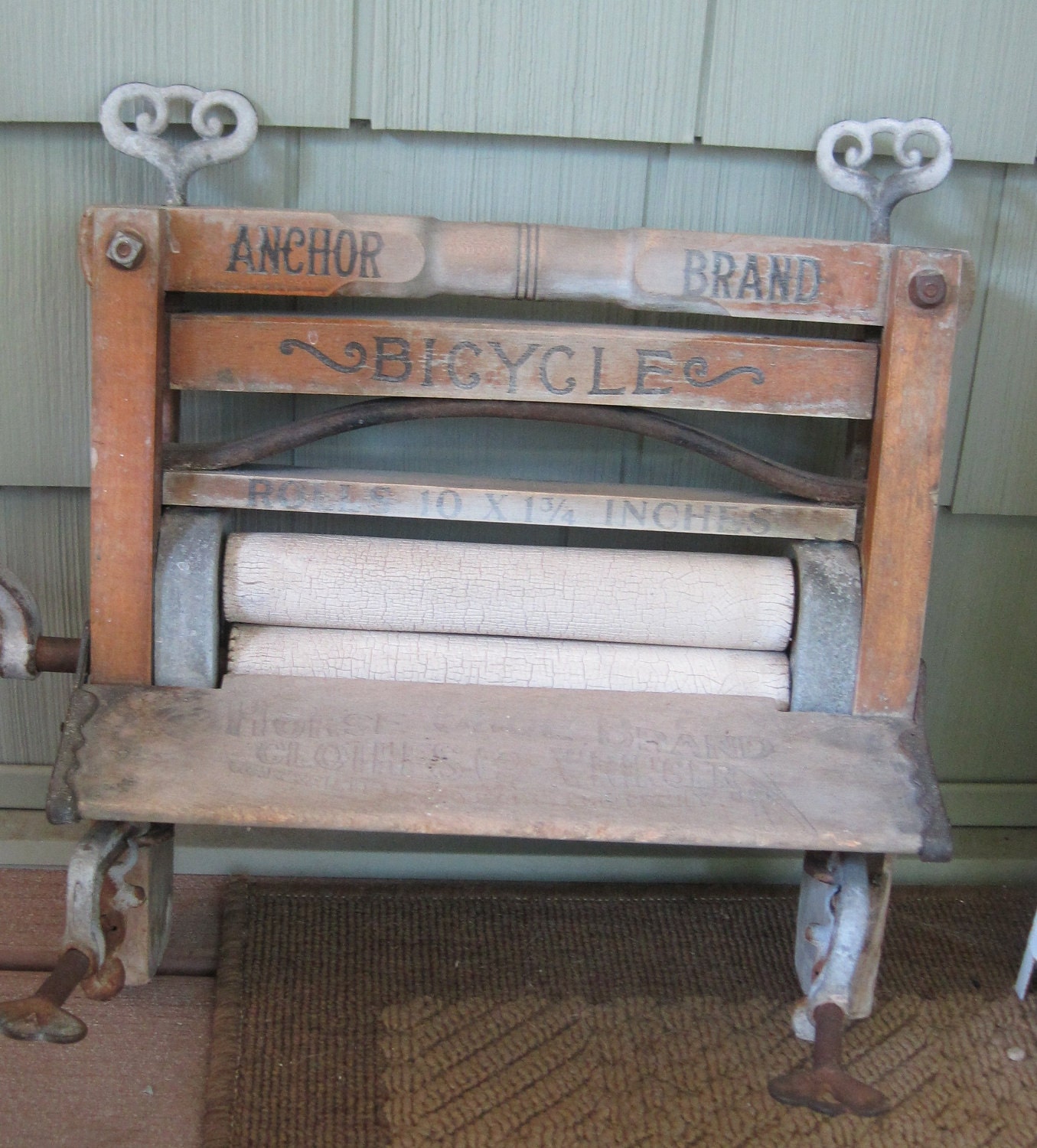
I do not as of yet have an old washing machine so we did a laundry day with my normal machine on cold. Then we hand rung the items. Now having a ringer, even a hand crank old wooden ringer, would have made more sense, but I had not. In 1933 I would most likely have a machine with a motorized ringer, but then again, I might not.

 vintage bicycle laundry ringerBut, I would have certainly at least had the hand crank model that most homes had even in 1900.  As I do not own such a device, hand ringing was what we did. Boy oh boy was it labor intensive!

We were laughing at one point so hard we nearly dropped our precious cargo on the cold damp grown. It was late when we finished and the last to be wrung out was a large feather duvet. We each grabbed one end and folded it in half. Then we both twisted it opposite directions. It was amazing the amount of water that came out! We did it several times (our hands freezing as it was below freezing outside at this point). Even after all that ringing it was so much more damp than had it been in the washer. That machine really spins out the water! What a magic moment it must have been when that homemaker of yore first got her electric ringer.  And then when she got the self contained machines of the 1940’s how magical it must have seemed!

We had to hang that heavy piece over our fence in the moonlight, and come morning hubby commented that our nightly chore was frozen solid outside. But, once the sun came up and it warmed up, it eventually dried, of course.

I know, really, this was not a very good experiment. As I said, having a wringer and washing it by hand in the sink would have been more accurate, and I shall attempt that as well. I think I can get an old wooden hand crank fairly inexpensive come summer at a yard sale. But, I have had no luck as of yet getting my hands affordably on an old electric or gas powered washer with automatic wringer.

What it did show me, though, as I often learn in my little attempts at old homemaking, was patience. Diligence, stick-to-itiveness, and patience were and certainly are the corner stones of any good homemaker. Then, however, we were seeing many new gadgets arriving, many could not afford them. Laundry in tubs scrubbed on metal washboards and hand wrung may well have been a norm for many a homemaker. Still, whenever I am forced to stop in the midst of such a trial and consider the past and my own abilities, I often feel empowered by it. Rather than just giving up and thinking ‘thank God for modern life’, I actually often think, “Hmm, if i wanted to do this all the time, I would simply have less things to wash, as it would make it easier.” And it was just such revelations that really began in 1955 that made me look forward to simplifying my life.

Today is ironing day. In 1933, from what I can find, there were no steam irons. In 1927 the Silex company introduced the first iron with temperature control. Prior to that it was simply determined by your touching the iron and deciding if it was hot enough or not. The steam iron would not be around for awhile and after WWII a pump model steam iron was developed but proved too costly.

33iron Here is an ad from one of my 1933 Better Homes magazines for this latest iron. It only weighs 3 lbs, he claims, comparative to a usual 6 lb iron. We certainly see why the homemaker in the Depression would not have needed the gym. But, as this is fairly new, I wonder if I would either still have a 6lb electric iron from the 1920’s or even, were you poor enough, the old type that simply was heated on the stove or was fueled by kerosene or charcoal placed in a brazier on the iron.

This 1920’a gas iron would simply be hooked up to your gas. Prior to electricity, many homes were plumbed for gas for lights. Appliances were then made to simply plug into this fuel supply much as you would later with electricity.

There were also coal irons were the hot coals were placed inside for the heat source. Oddly enough, in places like India even today such coal irons are still used, as shown in this modern day photo of an Indian man using just such an iron.4164645211_a8811857c6

That goes to show that though we may believe we have all advanced to a state that is only moving forward and that the past is, well, simply in the past, that is not always the case. If times become harder and choice begin to be made one might find themselves hoping to own the workable appliances of the past. Especially when they run mainly on our own sweat and not on things for which we must pay. Now, I certainly am not saying I shall go out and get a coal powered iron tomorrow. And certainly my 1933 counterpart simply had a heavy electric version with no steam, it is important to recall how we did things once. And to consider, for ourselves, when such antiquated things might not be reconsidered. This is an extreme, but hand washing dishes, using clothes lines or a push non electric vacuum are all simply ways to bring back the old and put more money in the bank (or our mattress as the current banking scams might lead us to consider).

So, today, I shall simply use my 1950’s antique iron with the steam off, no water in and a medium setting. We shall see how crease free hubby shirts come out.

Happy Homemaking.


Sunday, February 5, 2012

5 February 1933 “Fun Things for a Sunday”

Girl Scout Cookie box. © GSUSA. All rights reserved.

“In 1933, Girl Scouts of Greater Philadelphia Council baked cookies and sold them in the city's gas and electric company windows. Just 23 cents per box of 44 cookies, or six boxes for $1.24 helped girls develop their marketing and business potential and raise funds for their local Girl Scout council program. In 1934, Greater Philadelphia became the first council to sell commercially baked cookies.”

hairdye Though hair dye had been around for quite some time, such as this 1840’s ad, it was not really considered something a lady or certainly a good middle class girl would have done. What is interesting in this old advert is the name, Circassian. This was a myth that the women of Circassian Mountains near the Black sea were the most purest Caucasians ever and that in the white slave trade sultans would pay the highest price.

The great marketing genius P.T. Barnum made the myth a ‘reality’ in the 1860’s when he had such a pure Caucasian beauty on display in his famous side-shows. It is interesting to note here that the ad informs one that light or red hair (not at all desirable at the time) could be transformed to lovely dark shades. Hair color, like all fashion, follows such trends. Though the popularity of the blonde seems ageless to us, as it has remained a beauty ideal for most of the last century, it was not always so.

This made me think of the wonderful scene in the movie adaptation of the Anne of Green Gables book when Anne, Played wonderfully by Megan Follows in 1985. Anne wishes to dye her unloved red hair (called ‘carrots’ by Gilbert Blythe)  to be like the raven black locks of her ‘bosom friend’, Dianna Barry. The resulting color, however, is green and she exclaims, “The peddler assured me it would turn my hair a beautiful raven black”.

But, by the 1930’s a new color was des rigueur. harlow1In 1930 Jean Harlow appeared in Hells Angels with her almost white platinum blonde hair and caused a stir. It was so popular that the following year, 1931, she appeared in a movie entitled Platinum Blonde. It’s original title had been Gallagher, but Howard Hughes convinced the the producers  to change the title to better support Harlow's career.

 hairtint And the rush was on for light and blonde hair.

flapper evening shoes These are the 1933 Gold even shoes that inspired me to get my own less expensive afternoon version in blue suede. shoes2 The original gold lame shoes are for sale and are rather expensive. They and some other antique clothing can be found HERE. It is a fun site to look through as the few pieces they have for sale are all authentic antiques from Victorian onward. A fun site to ‘window shop’. If you scroll to the bottom you can choose the time period. Have fun there.

I hope all are having a lovely Sunday. Happy Homemaking.

Friday, February 3, 2012

3 February 1933 “Bits N Pieces”

pgad Just a few little fun things today. First off another add from one of my 1933 magazines in which a young man’s shirt, here a button down collared version, is referred to as a blouse. Just of interest to me, as with all things that evolve through history, so does speech and words. I wonder when this died out. I have to say I never heard it spoke in any 1950’s TV I viewed in my 1950’s project nor saw it writ either.

sweaterI just thought this a lovely sweater/jumper and though I have no access to the pattern itself, rather thought it pretty. It would be easy, I should think, to find a modern version of this in any department store today, I bed. I also liked that it shows the model wearing her hair much as I am wearing mine now. I have still yet to master finger waves, but my standard pin curls give me the basic wave at the eye level that this model sports.

haircutpicThis photo, in one of my 1933 magazines as well, if of a lady who writes each month about various new books coming out. I found her hairstyle amazing. It, first off, still has rather a 20’s look, but at the same time it is so modern. If one were to see this today you might think, “Oh, what a fresh new look”. It is also rather similar to the 1960’s Sassoon looks made popular by Vidal Sassoon. twiggymia Seen here is a similar look on Twiggy and Mia Farrow getting such a cut by Vidal Sassoon himself.

   hubbardpicThis was in the letters to the editors section of one of my magazines. I loved that it shows how popular canning and preserving was then. This young homemaker is proud to say this is but a small sample of her put away stocks, much grown by her own hand. I also like her reference to ‘Quince-Apple Jell” as terminology. As the word blouse, this was a term oft used in 1930’s for Jelly (The American version, of course, meaning Jam made with juice therefore clear rather than with fruit like our jam). I faintly recall my grandmother (a homemaker in the 1930’s) often calling it Jell. I recall she had the best wild blueberry Jell, as she called it, around. And would often sneak a taste straight from the jam-pot with a spoon.

As I have begun to read more and more into this year already, I see I shall have to endeavor to keep a balance between the good and the bad. There is much that happens this year, and I was not really aware of that when I chose it. My reason was that 1955 had to ‘5’ so therefore 1933 (two “3’s”). However, there is some divine providence in this date, perhaps, as I see our own times continue to bubble and boil with various changes of hard times. This must be, as it was in the past, be countered with the daily grind of living and the need to smile and laugh as well as be serious. I shall endeavor to keep just such a balance going forward, for you as well as for myself.

Happy Homemaking.

Wednesday, February 1, 2012

1 February 1933 “Chancellor Hitler, Pretty Kitchens and Soap Riddle Solved”

hitler1 Two days ago, 30 January 1933, Adolf Hitler is appointed Chancellor of Germany by President of Germany Paul von Hindenburg. The chancellor is the head of the German Government (today’s current head is Angela Merkel).

President von Hindenburg did not like nor really support Hitler, but after dissolving the government twice with the hard times of the Weimar republic and economic hardships, he was coerced into it by various industrialist giants who ‘encouraged’ him to do so in various letters.

Hitler was actually of Austrian descent which he gave up on 7 April 1925. He was essentially without a country for seven years until he was appointed as administrator for the state's delegation to the Reichstag in Berlin, making Hitler a citizen of Brunswick and Germany.

Tonight, 1 February 1933, Chancellor Hitler will give his “Proclamation to the German People”. This is a film of that speech. I am not certain why it was labeled as being done on the 10th, as it did happen on the first.

When viewing this I had to hit an ‘accept’ button as it said the material was ‘sensitive’. What I find odd is that such a speech as this is important in our own understanding of how things lead to the great second World War. Yet, one can easily click on endless links of sexy material or inane pointless content without such a warning, like “attention content may be pointless and eat up your day with pointless viewing”. One would think it better to know and understand history, especially the bad bits, so as not to find oneself again in such dire straights.

The modern notion that what was bad must now be ignored seems a dangerous pattern that could lead to an innocent ignorance becoming a handicap to decisions better made. But, I digress. If you find it horrifying to watch a Hitler speech, than do not watch. But, there is no harm, and in fact much good, in understanding how the past was formed. I shall leave that decision up to you, but would feel remiss in not including all information I find pertinent to the formation of this very important year (as I am finding out) 1933.

Now, onto some lighter fare. Though the War rumblings are beginning in Europe, it is still just a soft drumbeat. Back at home in the USA, the ongoing Depression is beginning to hit harder, but one must still keep dreams and economy alive.

kitchen1 Here we see two lovely views of ‘New’ kitchens. I find just as many illustrations in my 1930’s magazines as photos, and more so than will be in my 1950’s variety. These kitchens, I think, are rather darling.kitchen2 And I had no idea one could get the old refrigerators in colors to match sinks. I think this is when we are first seeing that idea of matching appliances/sinks.

Now, the first photo the color is a bit off as there was a stain on my old magazine. Though for a magazine almost 80 years old, it is rather in good shape. The colors are the lovely yellow often seen in 30’s era kitchens. The fresh white cabinets and the little eating area is darling and you can just see the electric percolator plugged in. You may also notice in the first picture that the refrigerator is just off to the left in a separate room. I wish we had a shot of that room as well, but I have a feeling it is the pantry. Which rather makes sense, as it too stores food.

There are so many things to appreciate in the second photo! The lovely built in aspect of the sink are is wonderful, with two utility closets. Though one could serve as a pantry, while the second houses the broom and various cleaning apparatus. And, who can complain about the darling Hoosier cabinet next the refrigerator? I would love to add one of these all in one helpers, with their flour bin dispenser and easy to clean pull out enameled countertop. I think I am rather falling in love with the unfitted or free-standing kitchens of old. And these 30’s kitchens have a sort of mix of the old with what will become more ‘built-in’ once we reach the 1950’s.

chipsoad This Chipso ad (click to enlarge) I found very interesting on many points. First, that young men’s shirts were often called blouses. I have seen them referred to this in a few ads in my 30’s magazines. I wonder when this became soley descriptive of ladies only?

Second, that little sons under most likely 5 or so, had little lord Fauntleroy haircuts that are the same as little girls at the time. Of course, in the past and previous centuries young boys often had long hair and even wore dresses before they graduated to ‘short pants’ in the nursery. This may be the last vestiges of that old tradition.

Third, I love how fresh and really modern the daughters haircuts are and I see more evidence that not everyone had the finger waves often associated with the decade.

Fourth, the eldest daughter’s shoes, in the red dress, are so modern in a way. The straps look like a ‘new trend’ one might find today.

Fifth and final, of course, was that this answers the question I keep having about soaps in the Depression that was the same soap used for clothes and cleaning and dishes. It appears that even those who buy their soap would still use it for many purposes. This leads me to now wish to try my dry laundry soap recipe as also my dish soap. I think I might make a darling little container out of an old glass tin lidded jar (say a peanut butter jar) to hold a smaller amount of it for my dishes. Something that would look pretty on my counter and be easy reach to toss into the warm dish water.

For those of you who would like to try homemade dry soap for your laundry (and now apparently for our dishes too!) Here is the basic recipe I use. This site does a wonderful photo tutorial for you and it is basically what I use. Click HERE to see tutorial. (sorry that the links now appear to be grey and may not show up, but are clickable)

If you do try the above on dishes let me know how it works for you.

Happy Homemaking.

Addendum: Commenter Carrie made a good point about the context of the pictured kitchens into the actual time. I think by 1933 many workers/laborers and farmers may still have had a kitchen much like this one, though simply substitute the Gibson girl hair and long skirts for bobs and bared ankles.1910kitchen

20skitchen 20skitchen2 Or more like this early 1920’s kitchens which might even still contain an ice box rather than a refrigerator or both working in tandem (throwing away was not as en vogue back then).

Again, the variation in geographic location from the East, West, Mid-West or South as well as rural versus urban played many factors into how one lived and cooked. But, still all of these women, even the poorest factory worker, would still have access to view the ‘dream kitchens’ so I think it important to show.

I rather like a free-standing kitchen as it seems to make cleaning easier and feels more homey.

Monday, January 30, 2012

30 January 1933 “Come with me Lucille, in my Merry Oldsmobile. The Family Car and the Electric Car.”

 womanwithcar I have been away from you all for these past three days. I haven’t any other excuse save that it is rather easy to slip into the past full tilt and enjoy a walk, books and catching up on chores to sitting prostrate before the glowing beast of a computer. But, duties call and needs must, and I thought I would share today some of the fun things I have found about automobiles.

Innocently enough, as most of my discoveries start, I came across some fun facts. I wondered, here in 1933, what is the concept of the family car? In 1950’s it was rather clear cut and the vast production machine that was set into motion by WWII simply made for cars for all. It was becoming even normal for middle class families to have two cars and for teen Johnny to have his ‘old jalopy’ (which ironically would be an old car from the 20’s or 30’s cheap and easy to maintain at the time)

Before we start, let’s have a listen to this 1909 hit put out by the Oldsmobile auto company (to become GM some day) and sung by Billy Murray. This is an original recording from that time, so enjoy the scratches and life such an old 78 record imparts!

Here is a 1931 Fleishcer cartoon promoting the Oldsmobile. This cartoon uses the song as a basis for a love story with villain and hero and of course, the love of the automobile. At this point the U.S. auto companies are going full tilt, have been through the Great War and mass producing many such vehicles. The evil villain and slightly funny heroine can still be seen to hold the action and sway of the old silent movies, easily in the memories of those who created such cartoons.

My first thought was cost. Let’s look and see where we are here in 1933.

plymouthad33 This advert caught my eye in my 1933 Better Homes and Gardens. Let me state here, as well, that my new stacks of 1930’s magazines are as refreshing to me as once were my 1950’s compared to modern magazines. And now I am finding the 1930’s similar in comparison to the 1950’s. The number of ads are easily half. There are far more articles and it is as if the articles are even written at a level of higher understanding, if that makes any sense, but I digress. That is another post all together.

So, if we take this ad here (the only car ad in the entire issue I might add) as a standard. We see the ‘deluxe’ version at $575. Now, when we adjust for inflation to present time, $575  in 1933 dollars is around $9577.80 in modern day dollars. This does not seem that high for a brand new car. But, as usual, one cannot simply look at cost differences.

I next imagined one should know what average per year earnings were for a U.S. family in 1933 comparative to today as well. My first discovery was that, obviously this is the Depression and wages must be less than the 1920’s. That was true and Between 1929 and 1932, the average American's income drops 40 percent to about $1,500 per year. 

Next, then, we must look at current average family earnings. I found that in 2010 (the latest data I could find) that American wages fell for the second year in a row (meaning they also fell in 2009) to $26, 364 a year. Another interesting point I found was that it has not been this low since 1999! So, I know some people seem oddly angry when I compare things from today to the Depression, but here we go again. Incomes falling from the previous decade. That is simply stated by fact a link to the Depression. One must understand that does not mean we are standing in bread lines and starving as they did. But one must also admit that facts in comparison are there and that in this way there are similarities.

However, here is where the differences between then and now seem rather vast:

In 1933 we have an average income of $1500 with an average car cost of $575 (though cheaper were available). That is simply one third of a families yearly income to purchase said car.

Today average income is $23,364 and according to a few articles (Business Week, NYTimes etc) the average car cost seems to be $29,602. We already see the flaw here. That means the cost of a new car is already greater than 100% of a families yearly earnings.

Now, we must also remember that such things as inspections, insurance, state and tax registrations are all but non existent in 1933 and therefore the upkeep and fuel costs are also much higher today than they would have been for a family during the Depression.

I found these interesting facts from a AAA car magazine article entitled ““Driving costs climb to $8,776 for car owners”. I found that interesting and here is the data they provide.

Breakdown of Car Ownership Costs in 2011 for the Average Car

Variable Costs:
Gas: 12.34¢ per mile
Maintenance: 4.44¢ per mile
Tires: 0.96¢ per mile

Fixed Costs:
Insurance: $968 per year
License, Taxes, etc.: $595 per year
Depreciation: $3,728 per year
Finance Charges: $823 per year

Cost per mile (total) based on 15,000 miles per year: 58.5¢

These costs, too, are before tax and are also higher if one drives an SUV. It is per car as well so must be factored in for each car a family owns.

If we first look at Gas, we see that in 1933 a gallon of gas was .10 cents or in today’s money $1.67 a gallon. We see that cost much higher today.

(as an aside I found the average earnings for a laborer in 1933 was $20 a week. We might think, oh my how little, until we actually calculate for inflation to today’s earnings that means a general laborer would earn in today’s money $$333.14. This is much higher than what laborers in many states at minimum age earn after tax. Just food for thought.)

I haven’t any data on average repair costs to a 1933 car, but I do know that there was less involved in the car. There were no computer chips, nor as many wiring systems to break down, so I think it safe to assume one’s repair in 1933 of a basic car would be no where near the $4.44 a mile found by the AAA article.

Now, for insurance costs. I found that other than my own state of Massachusetts, which required insurance as early as 1925 to car owners, it wasn’t until 1956 that NY state passed such a law and over the years the other states followed suit. Therefore, for the vast majority of car owners in 1933, insurance costs need not be factored.

Therefore, many may cry out, “How dare you compare the hard times of 1930’s to the ease of today” I am now beginning to wonder how many things are worse for us today than those hard hit in the Depression? I am not saying so to put down or belittle the hard times of the day, but we must also remember that not everyone in the Depression was hard hit as dustbowl migrant farmers and those who lost everything in the Stock Market Crash.

And for normal day to day life I now have found that the simple act of car ownership (to which a family would have one) the costs overall are much less than today.

And, down the rabbit hole I continued. And came upon the electric car.


woodselectriccar100 Years ago, in 1912, we did indeed have electric cars. This post card depicting the Woods Electric shows to lovely ladies of fashion with just such a car. This car company also had its own Prius version as well when,  “in 1915 they produced the Dual Power (U.S. Patent # 1244045) with both electric and internal combustion engines and this continued until 1918.”

I found this quote rather interesting:

The New York Times stated that the electric car has long been recognized as "ideal" because it was cleaner, quieter and much more economical than gasoline-powered cars.

-1911

Yes, that’s right, that was said in 1911.

electriccarcharging Here is an old photo an a Detroit Electric Car being charged. You can see the line running to it.

The electric car was also considered a better car for women than the gasoline car, as it was cleaner and easier to run. There was no need for the hand crank of the gasoline cars and the gears that needed constant changing in the gasoline cars do not exist in an electric car. Many liked the quiet, smoother ride, and lack of smell the electric car afforded.

There was even a recharge service where in  as early as 1896 an exchangeable battery service was provided by Hartford Electric Light Company. The automobile or truck (for transport and shipping) was purchased without a batter and the electricity was purchased the company with an exchangeable battery.  So rather than a gas/petrol station, one would go and exchange batteries and pay, as you do your electric bill, once a month. You paid a variable rate per mile. Imagine the amount of waste saved if one simply was able to continually change out the batteries as others were brought back to be recharged!

It almost makes me angry when I think of how much nicer the world might smell and look (With so much less trash, gas, throw away etc) from just the simply act of keeping electric transportation in the first place.

Even in NYC in 1897 a fleet of electric taxis were built by the Electric Carriage and Wagon Company of Philadelphia and put into use. Imagine, if even can, what a city such as NYC would smell like if it were simply devoid of internal combustion cars.

By the 1930’s the electric car had all but been done away with. A car in the 1910’s may have cost 1500 dollars at the time, but by the 30’s car prices for gas cars had gone down to $400’s. This, however, seems to have been more to do with the increase in Gas production and power of Rockefeller than any real advantage the gas car had over the electric. And, as I said, the electric car was actually easier to operate and repair. One wonders what really went on.

My innocent forays into the past often leave a bad taste in my mouth when I discover odd little facts such as these. I hope, though, that what I often take away from such discoveries as that we, the little people, the middle and working class homemakers, may not have much power in policy or major decisions. But, what we do have is our mind, our wits and the ability to implement change and rationale in our own families and daily lives. Many may think the idea of one car for a family unthinkable, but then we could think what do we use the car for? Are there endless practices and play dates that could simply be avoided therefore saving money and creating more family time? Are there wasted trips for ‘shop therapy’ or to just ‘take a drive’ that could be deleted from our life and replaced with lower costs creating less stress. And finding new joy in one’s home sipping tea with a good book by the fire rather than fighting traffic or swiping the card for one more ‘great deal that was almost cheaper to just buy it then”?

I think the more I have learned of the past, despite how one wishes to take it, there is lesson there. And when we are often fed either that the past was horrid and wretched only or that it was all starlight and sunshine through rose-colored glass we are also being cheated of the lesson of the past. We can see that with each decade we peel back, like the layers of an onion, there is always one aspect the remains: simplicity. Each decade has improvements surely, but as we go back one we also see a simpler way of doing things. And in some cases that simpler way need not be tossed out. It might be harder but only at first when one realizes the savings in cost of repair, and money lost.

I hope when I do such posts as these with numbers there in our face showing us the hard to fight high costs of today, that we can see we DO have choices and we CAN make change in our own life.

I hope all have a lovely day and as always Happy Homemaking.

Thursday, January 26, 2012

26 January 1933 “Hairstyles, Shoes, & Conveyor Belt Lives.”

myhaircut2  I really didn’t get a very good picture of how I have been wearing my hair curled, but the one I did manage to get, I messed about with to give it an antiquated look. It is hardly flattering but I wanted to show the general shape and style of my hair now curled. I have still not done the finger waves, but shall. I want to get some proper metal clips, which seems to be a better bet than bobby pins.

Overall, I love my shorter hair. As my curl was fading the other day, I realized it was basically the shorter 1950’s cut I had wanted as well. 50sbob And I really saw a similarity between the short close cut and style of the mid 50’s and mid 30’s, fashion does repeat itself.

victoryrolls  The 1940’s sported much longer hair and this was due not only to the usual change we women look to in our styles, but also the war years left little time or money to mess about with hair. Longer hair was easier to roll into “victory rolls” or tie up out of the way with scarves and kerchiefs. A few twists and bobby pins gave a busy war working gal a lift and style on the go.

This wonderful color film shows fashions from this year, 1933, and you can see there is still quite a bit of the 1920’s still here in the clothing. The waist has returned, but the cloche hat is still prevalent and occasionally a dropped waist shows up. We must remember, as well, that clothes styles finally hitting the average women by the end of the 1920’s would of course continue a bit. I always find the beginning of a decade fascinating in fashion as it always has the flavor of the previous decade but then you see hints of the trends that will become the ‘look’ of the later decade.

I know I have shared this video before, but I think it very fitting here. What we imagined the future to be from the 20’s to the 40’s outlook of the future 21st century. I have to say some things had an eerie image of reality. Though the gentleman's tool belt looks old and cumbersome, the fact that he has a phone and other items with him is very telling. And the view of the city in 2000 has a very real feel of the dense traffic and large scale freeways that we certainly have today.

One joy of vintage dressing or living in a particular decade is that one can grow a wardrobe and feel it can last forever. Therefore, with my travel back to the 1930’s I didn’t want to just toss out my 50’s wardrobe (especially as I may end up there again at the years end!) But, I found that some of my straighter skirts are very fitting for the 1930’s particularly the longer versions. Skirts became their shortest in 1925 and then gradually went longer again. By the early to mid 1930’s skirts were more mid calf, much like the length of the New Look in the late 40s' early 50’s that caused such a stir. Again, fashion repeats itself quite often.

Living in the Depression, one wants to make sure to conserve their pin money, but I did splurge on a pair of vintage styled shoes. I have already two pair of lace up heeled oxfords I showed before, but I wanted to add one Mary-Jane style heeled shoe that could be dressed up or down. What I have found is that the heel width is quite comfortable and would also be appropriate for early 1950’s dressing. What do you think of these.shoes1 shoes2 I think they look quite lovely with the darker opaque stockings of the 20’s early 30’s. And my 50’s wool skirt becomes rather 30’s I think. The color was also very 1930’s to me and though ‘Blue Suede Shoes’ doesn’t have the same meaning it will come to have in the 1950’s when Elvis sings about them, a gal can still feel happy with a bright shoe and cutaway class in her step.

Some may think it silly to so immerse onself into a decade. But, I have always loved history, all aspects of it. And so there is a certain joy, perhaps only experienced by the true historyophile, to reading a vintage magazine or novel while one is adorned in the clothe and hairstyles of the day, with the proper underpinnings. Perhaps it is merely self-indulgence, but I do feel more akin to things and as if I am somehow giving my proper respect to the past, when I try to, quite literally, walk in their shoes.

But, I think a healthy dose of curiosity and a questioning mind are all is really needed for one to become a happy and contented arm-chair time traveler. Either way, I do like to mix my serious findings of politics and laws of the day with fun meals, interesting desserts and hairstyles and shoes to enjoy them all the more.

One cannot be only happy or sad. The complexity of life simply makes it more interesting and also makes one a more complete person. I believe the main aspect of the modern age which often irks me is the hyper-specific groups one feels the need to belong to: Oh, I am a nerd, A techno-geek, a preppy, a fashionista, Green, hippy, conservative. 

Even in the university system with so much focus on single educational goals that we become, much like Ford had thought of with his automobile production, an assembly line of people. In production, sure it makes for a faster and more equally created mass produced product if every person simply learns that one special part and does it over and over again.  However,  the individual never sees above their part in that line. They cannot make or understand the whole item produced and therefore their focus becomes narrow.  I think that a very good view of modern man. We have allowed our education and culture to become one great conveyer belt mass produced life. We need to peek our heads about our little specialties and see what else is going on. The more we learn and try to understand the more we see we don’t and that leads us to understanding and better education. Mass production might be fine for our products, but shouldn’t be the pattern for our lives.

Well, I shall step down from my soap box now, gingerly mind, with my lovely blue suede shoes and head off to my day. There are so many recipes and news articles to get to. I hope all have a lovely day and Happy Homemaking.

 Search The Apron Revolution