Friday, October 1, 2010

1 October 1956 “Sweet Extra’s With Late Season Vegetables”

earlyamericanlivingroomred I just thought this image from an ad in one of my 50’s magazines did a good job of showing another way the ‘Early American’ look was expressed. It almost has a ‘modern country’ look to it with the clean lines of the sofa with it’s bold plaid paired with the Windsor chair. The old bench as a coffee table is darling and I love the bold use of the bright wallpaper and the complimentary color of the solid green three tiered curtains.
Another aspect of this photo that is telling of the times (the early 1950’s) is the vast farmed field across the way. This home might very well be sharing their side of the street with many similar houses built on old farm land. And most likely that view across the street will change by the 1960’s as the building boom continues and farm land is converted to sub-division. A pretty prospect from their window now, though and I love their ‘woody station wagon’ in the drive. The entire scene makes me want to put on the fire and sip cocoa. It did a good job of not making me dread our coming winter.
This is a great article from an October issue of Better Homes and Gardens from 1954. It gives three recipes and ideas on how to use up those late summer vegetables in the garden in a fun way. I think I shall try these. Simply click on them for a full size view.
canningarticle1 canningarticle2 canningarticle3
canningarticle4
Enjoy and Happy Homemaking.

Wednesday, September 29, 2010

29 September 1956 “A 50’s Gal Remembers Her Youth”

I was thinking lately how I might recall my fictional youth. Being the age I am now in 1950’s would mean my ‘teen years’ would have been spent in the 1930’s. This is when I would recall my own first foray’s into fashion and music. My cooking and even my memories of my mother would be from this time, mainly. Many of us identify with that time when we were teens into early 20’s and so I thought I would share with you what my fictitious 50’sgal memories could be.
I might be getting too old for what may have been one of my favorite radio shows, “little Orphan Annie”
I would most likely look forward to listening to Fibber McGee and Molly.
What young lady isn’t always excited about the latest fashions!
patterns30s 1930spattern2 Patterns such as these would be my template for my own wardrobe, mixed with store bought I imagine. The ‘New Look’ I will encounter with Dior after the war will seem oddly familiar to these lengths I wore in my youth.1930sfashion And these predictions from the 1930’s to the year 2000 will seem fantastical.
A lady’s hair is her crowing glory and short but highly stylized is the look of the day.30shair1 Though it is becoming a little looser than the 1920’s. Although some of the styles will seem familiar, again, in the 1950’s. This 30’s look on Alice Whitealicewhite1 is not that far removed from these 1950’s styles.1950shair 1935 hair Maybe I would even covet the brave new brush in colors used in high fashion, such as this winning exhibition of hair design in London 1935.
And though I would be going to the pictures and seeing all the glamorous stars, even hoping to be as lovely and decked out as them 1935dress   I would still have to contend with seeing images such as this. If not in my own town, then at least in papers.depressionimage1
A young gal would most likely be expected to learn to cook, even if she were lucky enough to have a maid later on (except the upper classes of course).
 cookingclass30sThis might well have been me in a cookery class in the 1930’s. How old fashioned it would seem, looking back now in my modern kitchen with a dishwasher, easy to use range and large refrigerator and freezer.
And the 1930’s kitchen might only seem different with all the newer appliances, but bright fun colors and linoleum were still what was ‘in’.1930's kitchen
Here are some recipes from a cookbook I have from 1926 that I sometimes use. I imagine it would have been in my mother’s kitchen and perhaps she would have given it to me. These are some fun dessert recipes:26recipebook
And, certainly, the old music would still be played on the radio here in 1956 and I might tap my foot recalling summer dances in my long slim satin dresses, flowers floating in water, paper lanterns, men in wide pants toting ukuleles.
So, on a day such as today, when my mind might wander to my youth, these are some of the things that I would recall. Do any of you have any particular things of the 1930’s that you love?

Tuesday, September 28, 2010

28 September 1956 “Transatlantic Telephone, Global Warming Discussion from 1956, and the first Morning Shows”

On 25 September 1956, the first Transatlantic telephone cable (TAT-1) is successfully laid.
This video is not long and worth the watch. It shows this historic moment. It has Mr. Craig, the head of AT&T making the first transatlantic call through the cable. It shows now how every continent on earth is now connected with these cables. And, fairly recently, the use of fiber optic cable has actually reverted the use of cable over the satellite system we were beginning to rely upon.
Though we had trans-Atlantic calls since 1927, they used to rely upon radio waves. But  the cables provide a much higher signal quality, avoid atmospheric interference and offer a greater capacity and security. The initial capacity is 36 calls at a time at a price per call of $12 for the first three minutes (that’s about $85 dollars in modern terms) so this didn’t cease letter writing, but (no pun intended) the writing was on the wall.
Again, so much of what is part of this modern world we now inhabit was created in the 1950’s. Think of just the move from last year, 1955, to now 1956, the very way we communicate to our friends and neighbors overseas has been radically changed. Again, the cost would be prohibitive at first, but in time it would reduce and soon calls would replace letters to catch up with old friends and family.
This is really worth listening. It is from a Radio Broadcast from this year 1956, where they are talking of Global Warming. I love that they say, “Well, Grandpa might have been right, it was colder when he was a child” It is also nice to hear it on the old LP, as this is the sound quality you would have heard in 1956.
Here they are talking already about how the burning of coal and other human forms of carbon dioxide is greater than any other natural phenomena. At this point, here in 1956, we are discussing the fact the the increase in industry and cars WILL increase global warming. Why did we never hear this continue? This really is worth a listen as it gets to the end it discusses how much man is affecting this change. I wonder how many people wrote to get this science paper number 646? I would love to get my hands on a copy.
With the assumption that no one would watch a tv program before 7 a.m., morning radio programs were presented. Here Ernie Kovacs was willing to prove them wrong. I always remember Ernie Kovacs from the later 1950’s move Bell Book & Candle, staring Jimmy Steward and Kim Novac.
This is an early version of his morning TV show. It is in three parts. The beginning starts with goldfish and then points the camera at people in the audience ( a good view of the average 1956 person).
Enjoy and Happy Homemaking.

Monday, September 27, 2010

27 September 1956 “They Don’t Make Things Like They Used To”

mybike1 The other day my old tires finally gave out. I have a vintage 1950’s ladies bike. When I purchased it at the beginning of my project I remember how excited I was. I had found it on a local craigslist ad and it had sat in someone’s basement for years. It had been the gentleman’s wife’s bike. It had the original tires on it, which of course were flat. So, I assumed I needed new one.
 mybike2(my bike was proudly made in Westfield MA)
I immediately took it to a local bike shop, which was a rather busy place, and told them I wanted white walls. They nodded, looked at me a little strangely, slipped a tag on her and set her aside. One month later, I realized it was not going to get done, so I rescued her, flat tires an all, and returned her home. Uncertain what to do next, hubby said, “Well, let’s at least pump up the tires and see if they can be repaired”. To our amazement, not only did they not need repair, they held air wonderfully! So, I felt even more authentic traveling about on my vintage tires.
About a month ago I came out to hop on the ole’ gal and saw the back tire was low. We pumped it up and heard the tell-tale whistle. My heart was broken. But, living in a new town now, we went to this local bike shop where they were much friendlier and also had more time, it being the end of summer.
I left her with him and came back in the half hour I had been told only to see my bike still tireless. “The tires today are wider than back then” he told me. “They will hit the frame”. I was sad, for sure, as he was even able to find white wall tires. But after some calling, he found a pair of thinner white walls. They were more expensive and more than I was willing to pay. But, my good friend, who was with me, chimed in and said, “I will buy them for you for your birthday”.
Now, normally I would not accept such a gift, but this friend bikes with me all the time and would hate to lose my company and she and my other biking friend, who we were to meet later that day, decided to split the cost. So, I gave in, happily.
Now, when I went to pick up the bike the other day, I jokingly said to the gentleman, “Will these last 60 years like the old tires”. To which he laughed. “No, maybe three to four years if you keep them dry. They don’t make things like they used to”.
That last statement really hit me. It is true, they don’t. But why don’t they, I wondered?
So, why did my 1950’s tires last longer? From what limited information I can find, it seems they may have simply been more rubber. Today tires are made of three components a  bead to hold the tire onto the rim and layers of fabric then rubber over that making the tread. I assume this is sold as a ‘superior’ way of making tires, quicker, more efficient etc. But, I have a strong feeling it is cheaper and therefore they wear out faster as opposed to the higher rubber quantity of older tires.
This, to the modern person, means very little. We are always sold on ‘newer, quicker, better’. We are so far removed from, “It is built to last” that the very concept might even be laughable to some. “Why would I want that in a few years? It will be out of date or style”.
Look at our cell phones or any of our expensive and often used technology. We never think, “Hmmm, this will be the computer I have forever, my grandchildren will use it”. Because it isn’t really practical considering the level at which the technology advances. But, with clothes, bikes, appliances, furniture?
Do we need sleek fast cutting edge clothes and furniture? Shouldn’t we want and expect our things to last and have a good quality. And, if things were built with a  style that could be appreicated, instead of a bunch of things thrown together in bright packaging and sold cheaply, we might actually consider wanting those ‘old things’ around more.
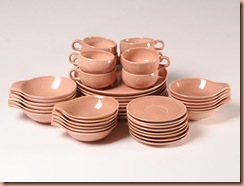
russelwright1 Recently I heard that Oneida was reissuing the famous sets of Russel Wright designed pottery called “American Modern”. This was such a popular thing in its time, it was the highest selling pottery around and most likely someone had at least a pitcher, some plates or cups. russelwright2
Now, with the resurgance of mid-century design and people clammoring after 1950’s era items, the original pieces can often sell rather high. Yet, if one takes the time to look and carefully collect up a set, a piece here and there, spending more on the original may be wiser than this re-issue. But, first, let’s learn about Russell Wright:
Wright is best known for his colorful American Modern dinnerware, the most widely sold American ceramic dinnerware in history, manufactured between 1939 and 1959 by Steubenville Pottery in Steubenville, Ohio. He also designed top selling wooden furniture, spun aluminum dining accessories and textiles. His simple, practical style was influential in persuading ordinary Americans to embrace Modernism in the 1930s, 1940s and 1950s.
guide to easier living Wright and his wife wrote this very famous book. It helped to change the way the new nuclear family lived, ate, really thought about their living space. I do have it in the corner store HERE, but it is rather expensive.
This made me realize another difference between 1950’s and present day. In the 1950’s, though many new and varied items were coming out and being marketed like never before, Americans still wanted to know:
  1. It was built to last
  2. fit into their budget
  3. made in the USA
What Wright was doing was bringing a well designed item that was relevant to the quickly evolving time in which he lived and having it well made as well as accessible to most people. This does not mean it was one dollar a plate at Wal-Mart, but it did mean one could collect up a set over time. Mother could receive that gravy boat at Christmas. There was more a sense of one waiting and hoping and then getting the desired object. Today there is so much instant gratification, we have lost those elements that make owning something more fun or worthwhile. We live like spoiled rich children, yet we have no money or savings and are in debt.
S0, back to Oneida re-introducing the American Modern dishes collection. The glaring difference which I noticed was that it is not made in Ohio any longer (Steubenville Pottery went out of business in 1959 and was bought by Canonsburg pottery which went out of business in 1975) When it was created in the 1950’s it was made affordable for all (not what we would consider cheap today but more affordable than fine china) and it also was produced within the united states, including the clay being created here as well. Now, the Oneida version allows one to pop over to Bed Bath and Beyond, or what have you, and buy up the entire collection in one fell swoop. Ta-dah! Instant esthetics. There is one very interesting point, however, this china is made IN CHINA! So a product known for its very American ideal designed by an American Designer and produced in America is now mass produced in China.
I found a few sites that did a sort of quality test and their biggest concern was that it could be differentiated from the ‘real thing’ so as not to hurt the market for the actual vintage dishes. What is amazing to me is that if one likes mid-century design, and apparently subscribes to that esthetic, wouldn’t all that made it what it was be important too? That means the very American craftmanship of it. Yet, today, we simply take old molds or make new ones to copy it and off it goes to be mass produced cheaply in China so we can instantly fill our over-glutted cupboards with more things.
I think what is frustrating to me is, why couldn’t an American pottery concern be contracted to make the things. They would cost a little more, but so what? Instead of buying the entire set in one day, you would have to acquire it over time. But, again, that would be part of the joy of owning it. Isn’t there something lost when we just simply get something quick and cheap?
I have really been thinking about this a lot lately. How so much of the production and selling of basic goods or artistic elements in our homes are simply owned and sold by the big box stores. Where there was once individuals and couples, like the Wrights and the Eames’ who were American Designers, living a very American experience and then taking that artistacally and translating it into dinnerware, furniture, lifestyles one could respond to, today we either just cheaply reproduce this or simply let board meetings of marketing groups decide what it is we will like based on how cheaply and quickly they can get it into our hands. The very design esthetic of living, therefore, also seems to be owned by the corporation.
Now, I know many of you dislike when my blog gets ‘poliltical’ but sometimes it cannot be helped. And I wonder if we simply assign the term ‘political’ to things when we don’t want to face them. Many of us like, admire, ascribe to or strive towards a mid-century lifestyle. Rather it is the clothing, the design, the very nature of people in that time, we seem to feel something is missing. And I think that main element missing from today that was prevalent at the time was genuineness or pure experience. Today so many seem almost props on a stage, as if there is nothing behind it. People’s motives and the over all general aspect of modern life, at least to me, has an almost disingenuous or false quality to it. And I think the reason for that is we are not engaged in our lives in the way we once were. We have no say in the production, design, and overall affect of our own country because we have let so much of it be dictated to and presented to us by a few people in charge. Our own towns and local areas are not colored by the people in them, but by the vague and generalized feeling of TV shows, internet and what is in the Large Corporate stores that you can see and go to in ANY town. We have, in many ways, lost some of our humanity.
I know, this sounds like a wide leap of reasoning from a bike tire to here, but it seems to follow a path. I am not really sure what can be done about it. I know we say shop local, and that does help, but our options for that is limited. We need, somehow, to both by old and reuse the good ole’ stuff, but also to really start thinking about how to build up our economy with more small local production. I wish I could start a pottery concern, now, and we could have local designers and people who are experiencing our way of life interpret that into products made and distributed within our own borders. As it is now, every year we lose less and less of our production, we receive more and more money from outside our borders to continue this lifestyle of self hurting.
How can we try and fix our towns, cities, states and therefore our country? Is it fixable? Does it matter? Maybe I am just the one idiot feeling this and I should somehow figure out how to get back to that ‘old me’ and just take the red pill and quietly resume my place among the consumers. I honestly don’t know. I hope this post does not seem to political nor too dark, but I do feel increasingly this disconnect from the modern world that has me worried. I don’t think it is just because I am trying to live in another time, but because of it I see all the flaws in my own real time. Flaws that I want to fix because I honestly believe it would make for a better world.
It seems to me even things that once didn’t seem connected are now really connected to the way we do live now. Even children or how teens behave today, or the current state of our welfare state and on and on. All of this seems to somehow be connected to the very core that a vast majority of us live so disconnected from reality (yes this being said by a woman pretending to live in the 1950’s) that we cannot see all these problems are interconnected. It is as if we have no hope or control over our own country. From what we are meant to like or be concerned about, to what we wear, eat, live in or how we spend seems to be coming from some outside source that subtly makes those choices for us.
I almost did not post this because I don’t want to seem preachy or off-my-rocker. It is just that for myself, the person that used to be happily plugged into the modern world, a great consummer, my very esthetics and ideals, my language and expectations from somthing as simple as entertainment to even what I expected from other people has vastly changed once I saw what it COULD be or HAD been once. Some may say, “You are looking with Rose colored glasses” but rose colored glasses do not deal with facts. It IS a fact that the dishes I was speaking of WERE designed and manufactured in THIS country and now are not. It is a fact that Teens once dressed what we would now consider (more conservatively) and treated one another differently but there WERE less teen pregnancy (4% in the 50’s to 40% today). It is a FACT that there was LESS TV only available during certain hours and people got more things done in one day than now.  It is a FACT that the the GDP grew in spite of the fact that real estate was valued more realistically toward the average incomes. It was more realistic to live on one income for a couple, yet credit cards and easy high interest loans and debit cards were not there. It is a fact that the way one felt about buying on credit was not looked on the same way as it is today. College was considered important for some but not needed for ALL no matter financial circumstances. There was not as much Concern of Waste and Garbage BUT there were not even  half of the ‘throw away’ things we have today. These are facts that are there for any one to find and read.
So, Things aren’t made the way they are used to does not have to be a ‘fact of life’ but could be a ‘message to us to wake up’. We shouldn’t just accept cheaper things shoddily made outside our country. No one is holding a gun to our head forcing us to spend and spend. If we slow down and see what it is we are doing with our lives and look to our community, then maybe we can get to that point when a few people can think about taking those first tentative steps toward small scale local production, if they feel their friend, neighbors, and community will want to purchase that product, even if it IS cheaper at Wal-Mart.
I hope this post makes sense and believe you me, I have seriously contemplated trying, in some manner, to simply let myself slip slowly back into the old me. Because, it was easier to be that person, to not think as much and just spend and not care about tomorrow. Yet, today, even with the sometimes feeling of hopelessness, I feel the most genuine and alive than I have ever felt. Making my own, caring for what is considered the ‘little things’ or the ‘silly things’ does make ME happier at least.
So, what do any of you think? Am I right? And is there a way to get back to having more general control over our towns/country? Those of you who live outside the USA, how much do you feel our USA ‘culture’ affects where you live, i.e. McDonalds, American TV/Movies/music, American products?
I just want to add that I don't want to be to 'on my soapbox' because I honestly feel as if we can successfully work within the system that we now have and yet begin to just think differently. Maybe we replace a thing here or there that is made in the USA or local. And maybe we, if we are so inclined or have friends who are so inclined, to think about actual production in this country. Maybe we could open a dialog about starting a collective for something like pottery or making fabric or such things locally. Even simply researching your own part of the country and see what used to be manufactured there that is no longer there. I am still very hopeful and I think we CAN make a difference and move forward with more say in our lives, towns, country, don't you?

Saturday, September 25, 2010

25 September 1956 “Curtains of Fiberglass, A New Pattern, and A 1956 Color TV”

I do apologize for not having posted yesterday. We were off to my MIL to celebrate my SIL birthday. Along with the festivities, I was also crating up three of my chickens: Roostie, my beloved Rooster, and two hens. My mother in law, who has had chickens before and has a darling little chicken house and run, has been without then for years. She spends winters in Florida, so hadn’t wanted the fuss of them over the season. My SIL has agreed to care for them from Christmas until she returns in Spring. However, for now, she gets to enjoy their antics and hear Roostie’s call. They live in a very private setting on a pond and so no really close neighbors to annoy with his crowing. They were happy and so was she. A good day was had by all.
I am sure many of you have seen Fiberglass curtains, but maybe were unaware that they were, indeed, fiberglass. Many may simply recall them as a sort of shiny frilly curtain at Grandma’s.
fiberglasscurtains This add shows the style popular from the 1940’s through the late 50’s with the crossed frilled sheer curtain. You often see these in movies of the late 40’s in bedrooms as well as living rooms. There is something endearing about them to me now. While I may have thought them rather ‘icky’ their nostalgia value seems rather enticing to me now. I am certain these are easy enough to come by at local yard sales or Good Will. Do any of you have or recall such curtains?
The pricing is also interesting in this add as well as the celebrity endorsement of Arthur Godfrey. If we do the conversion from 1954 (when this ad is from) to today’s dollars, the curtains would be around. So the first price curtain at 1953 dollars of $4.98 would make it around $40.00 dollars today. I also find it interesting then when placing your order for these curtains, as you can do with the little cut out coupon, one could opt for COD (Cash on Delivery) I wonder if that ever exists today?
butterick6869 I just bought this lovely vintage pattern. It is actual vintage, not reprint, and is in really good condition. I am excited as it is a nice shirt dress. I like the flattened pleats in the front, the three sleeve options and the collar is adorable. I think making the color have a different color or a pattern with a solid dress and then making a matching belt would be very cute. It also looks like it would be a very comfortable working dress. I will, of course, post the results. I have not yet chosen a fabric or cut it out yet. The advantage to this being  an actual vintage pattern is some lovely lady in the past has already cut out the pattern for me.
homemakersguide In my last post I included pages from this text. A few of you asked what it was called. I have tried to find it on Amazon to put in my ‘corner store’ but no luck yet. There is much good information in it that I will share with you. A couple of you emailed me with the idea that as it is beyond its copyright date, I could scan it and sell it digitally. They said people do this now with older material and patterns. I have seen that done with older patterns. If anyone thought it was worth their while I could try and scan all of it and sell it for say $1 or so. It anyone is interested let me know and I will see how involved that would be, if not, then you can just enjoy the good stuff from it that I will share with you in the future.
This is just for fun, but here is a video of a 1956 color TV. Yes, color is now available, but rather expensive. This shot has Bonanza being shown, however Bonanza will not be created until 1959 (that’s three years away).
And to close today, a 1956 sign off from Columbus OH. Here in 1956 there is no 24 hour TV. You can’t wake up at 2 a.m. and expect to watch anything. At the end of a broadcast day, stations (which were local and part of your town and cities community) would sign off leaving only a test pattern. This is an interesting clip as you can hear and see what one would have seen at the end of a broadcast day here in 1956. So, with that, have a good Saturday.

Thursday, September 23, 2010

23 September 1956 “Food Shopping and Kitchen Equipment: The Essentials”

shopping I thought I would share with you today some of the information from my 1950’s homemaker’s guides. Though the information might be dated for some, I find good common sense is timeless.
Here are some good lists to stock your pantry. (Click to enlarge)letsgoshoppingI would add to the diary a different variety of cheese, as I don’t usually like the taste of American cheese, but you could certainly follow this list to a T and be quite fine.
Isn’t it also interesting to note that many ladies had shopping baskets (as in the picture). Another point where we were ‘green’ in the 1950’s without even knowing what green was. A shopping basket or personal cart was rather normal. Paper bags were becoming popular at the large supermarkets, but many women were used to going to the local grocer and only filling their marketing basket. This especially continued in the cities, while in the new suburbs, shopping was not as frequent so you bought more and could carry it in your car as opposed to a bus or walking, so the paper bag became the norm.
Today I carry a vintage 1950’s circus canvas fabric basket from an old 1950’s grocery store. It folds up nicely and is easy to carry with my shopping bags.
I think this is a good way to approach a list. The idea of breaking it into percentage is a good solution and even could easily cater to your own needs. One could break it into any number, though this is a good solid foundation. This, by the way, is basically the formula that I use. I find that by having my marketing list annotated to these various needs it makes shopping simpler and easier to stay on budget.  A calculator (something not available to a 1950’s housewife) is also a good asset to this list. This allows one to tally up their products before reaching the checkout. Then, if something is putting you over your limit (and remember if you are shopping with cash you cannot just say, “Oh, well” because although the debit/credit card doesn’t care, the store will most likely frown on your trying to buy 50 dollars worth of groceries with 40 dollars.)
budgeting
This is a fun little list to have. It gives a homemaker a good goal to reach for her stocked kitchen. One needn’t have all these things, but perhaps tacked up in the pantry as a sort of ‘wish list’ would certainly help. I have almost all of these things listed, including the deep fat fryer with basket. Mine is a vintage 1950’s variety I bought at a church bazaar for all of one dollar and is similar to this one.fryerad One day I would like a vintage stove that has one built in, like this: fryer A gal can dream, can’t she?
Many of these items can be bought ‘vintage’ and rather inexpensively. And, as I have almost always found, if it has lasted the past 60 years, it is well made.
yourkitchenneeds
Well, I hope you enjoy these little tips from my guides and I am sorry for the lateness in my posting today.
Until tomorrow Happy Homemaking.

Wednesday, September 22, 2010

22 September 1956 “TV for Australia, the 1956 View of Tomorrow, and Fun Well Behaved Teens”

This month, on the 16th to be exact, Australia finally joined the ranks of TV viewers. It began on the 16th this year, 1956, broadcasting from TCN-9 Sydney. That is where the first TV tower was built in Australia.
Here is an example of some of the opening night sort of Australian Programming. ( I think this must have been from some modern Australian programming looking back to 1956. I thought it almost rude of the native gentleman at the end to laugh and make fun of the woman. I think for a white woman at that time, it is rather fine of her to care about the native culture and to want to study it. We may speak a language not our own with an accent, but it is hardly fitting to poke fun at it.)
While we are on the subject of tv, I thought I would share this little short. It was made by GM, but has some interesting fashions, home and cars. There is a fun part where she is in the ‘kitchen of tomorrow’ so space age. And her costumes for tennis, golf and swimming are adorable. Just a fun little piece to watch.
Here is also a darling film about auto safety. It is worth a watch to see the kitchen (wonderful red stove) great outfits and really well-behaved people, especially teens.
Until tomorrow, Happy Homemaking.

Tuesday, September 21, 2010

21 September 1956 “Small Kitchen and Early American”

I have mentioned before how my home, which is quite old, has a very small kitchen. It was most likely added around the turn of the 20th century. It’s cabinets show that it was updated sometime in the 1950’s but unfortunately it is in a sad state. At some point the whole thing must be redone.
I originally had thought of making it larger and every time I draw out plans I continue to scale it down. In fact doing the opposite of what happens in my favorite movie “Mr. Blandings Builds A Dream House”. Mr and Mrs. Blandings (played by Carey Grand and Myrna Loy)are in their architects office just to ‘look’ after having to give up on their antique home to the bulldozer. By the time they leave they have added extensively to the basic plans. At one point Mrs. Blandings exclaims, “I will not subject my daughters to live in a home with less than four bathrooms”. Though, they currently live in a one bath two bed apartment in NYC. It is a great movie and really shows the beginning of the American move towards the bigger home. Though, it won’t really come to fruition decades later for most of us.
So, to my point, in one of my vintage interior design books, I found this kitchen.smallkitchen1It is so tiny yet so pretty. It has even made room for an eating area for two. Here is the blueprint of the room.smallkitchen2Yes, you are reading that correctly. Roughly an 8 x 8 room. That would be a walk in closet in a modern home! Yet, my own kitchen is just about 10 x 10, quite small. I have no problem whipping up all kinds of lovely dinners and desserts in there. It has its quirks of a floor that slants to the right. I have to prop up my cakes in the oven with little rocks so it sets evenly, but I deal with it.
So, the more I think of any of the expense that will have to go into this room shall be in the basics such as tearing up the floor to have new joists installed and a new subfloor. While doing that I might move the door and simply rearrange the layout of the room to fit my needs based on various ideas from my vintage magazines and books. In other words, the smallness is really growing on me.
I also have really come around to the Early American look. I have talked of this little discussed decorating style of the mid-century. It was a modern/quirky take on colonial furniture. Copper jell-o molds, colonial inspired fabrics, knotty pine and anything ‘old’ made into lamps and tables such as spinning wheels and butter churns. There is a very tongue in cheek quality about it that I have come to appreciate.
Since my own home is from the actual New England colonial era, I think it a very fitting look for my new vintage kitchen when that time comes.
 knottypinekitchenI love the use of the bright red counters with the knotty pine. I think I would have my trimmed in either the 50’s aluminum or see if I could get a vintage aluminum dipped in ‘copper’. And though I am going to have a new subfloor, rather than put in heart of pine wide boards like the rest of the house, I want real linoleum (not vinyl). This is actually kind of expensive, but again, if I were to keep the room it’s original small size, than one could have nicer quality items as it would be used sparingly. Even a vintage roll of wallpaper can be as costly as 100 dollars a roll, but when one only needs one roll to do one wall and maybe the back of one open set of cupboards, a realistic expense. The same goes with vintage fabric, which is often hard to get in large amounts.
How many of you are unhappy with the size of your kitchen? Could you be actually happier with less space, but better laid out with your own choice of nicer appointments which would be less expensive due to the smaller space. And as always with small spaces, less clutter when one had less space to accumulate, right?
What are your thoughts on smaller vs. larger in the kitchen? How much space do you actually use in the kitchen? Are there cupboards or counters that actually just hold ‘junk or mail’ and don’t actually serve a practical purpose? It is a fun project to look at a room and think, ‘hmmm, what if it was smaller, what would I keep?”

Monday, September 20, 2010

20 September 1956 “A Day of Biking”

We had such lovely comments yesterday and I really appreciate our discussion. And from that I plan on making a new post open-ended to any who lived in the 1950’s to share with us.
manwomanbike2Today, however, two of my gal pals and I are off for a bike ride. It is a lovely New England Fall day here, sunny and the air is crisp as a ripe apple. We will bike to the beach then into town. It shall be a glorious day for it.
 womanonbikestockingsYou can bet I shan’t look like this, I do wear a dress biking but stockings and heels are a bit much, ever for me. I shall look more like thiswomanonbikeLoafers and socks and a dress or skirt are my usual biking attire. It is a quite comfortable way to ride, you can be sure.
elvisbikeJust for fun, here is Elvis on a bike signing autographs. (the photo links to the source for the picture) If only his popularity could have remained innocent enough to be allowed such freedom.
Also, enjoy this fun educational biking film from 1955. It is also interesting as it tells you, near the beginning, how to start a car then. Enjoy!
So, have a wonderful day and enjoy whatever it is you have to do today.
Happy Homemaking.

Sunday, September 19, 2010

19 September 1956 “Comment Rebuttal”

I received this comment yesterday and I have thought about it quite a bit. I hope you will allow me to share my thoughts on the matter:


Anonymous said...


Your comment yesterday about not want to have a child who would be another employee at Walmart is down right condescending. One minute you talk about being thrifty and frugal, and the next minute you talk about your family buying new cars during the depression and not wanting to raise children of the working class. I used to think that your blog was authentic, but now it seems like you are one of those bloggers who makes it up as they go along, who post about imaginary lives they are not even living. It this just the blog of a bored vain person???


The story of my family buying cars during the Depression really made me think. That story was often told to me, with pride, by my mother. She now, and for some years, has had Alzheimer's Disease. So, when I recall things she used to tell me, they are often with a sad little realization, as for all intents and purposes, she is no longer here.
My off-hand comment was made during a discussion we were having about how times or decades often wear a certain look and we assume that it was that way for all. Someone was mentioning the conditions of their family during the Depression. So, of course, I thought of that story. It showed that everyone had a different situation during that time, much like I have continued to discover about the 1950’s.
I think what most surprised and hurt me was that my casual reference to a story my mother loved to tell me became a catalyst for someone ( who claims to have both liked my blog and me) to turn their anger and hatred towards me.  Why do we feel the need, particularly in this digital age, to run so hot and cold with emotion? The step from casual enjoyment to killing outrage seems a short step today. I have witnessed such jumps even in public on employees in stores, “yes, lovely day…WHAT DO YOU MEAN YOU DON’T HAVE THAT IN STOCK!”
What I find so amusing in this particular situation is this: the complete stereo-type assumed by a few remarks. My having said that my mother’s pride in her father having bought a new car in the Depression suddenly lumps them into a category in which to hate. One commenter, who was quite kind about what was said, even added:
I *will* say that I find buying new cars in an economic crisis distasteful…
This I did find funny because supposedly we are currently in an economic crisis and yet I am sure there are many new things being purchased today. It also made me think of a TV family that a follower recently told me about: The Duggars. I have not watched the show, but I googled them after a follower mentioned them. They certainly have bought not only one new vehicle, but I saw an aerial shot of their property and they have many including a very large RV. Are they cruel or evil for purchasing new during economic hard times? Have they the right to do so, or if their show is using positive ‘spin’ to represent their good values, is that all right? I am not saying anything for or against this show, as I have not seen it, but just using it as a point.
Now, the actual story, which I had not told but didn’t think I had needed to, about my mother’s parents is as follows. It is true that my grandfather bought a new car each year during the Depression, or as I recall it being told to me. However, he was not a Rockefeller. He had built up his business over time. He and my grandmother had 13 children and my mother’s pride was in the fact that he was able to feed and cloth all these children AND help his community during the Depression.
My mother’s particular pride for the new car purchase wasn’t that she felt ‘better than others’ because of it, but due to what her father had told her. He pointed out that many people were struggling and no man likes a hand-out. To return a car and to purchase a new car gave a job and money to the local man who sold cars. He was able, to those who could afford it, resale the old car for a profit, as this was his job. Also, a new car each year was adding to the economy in that there would be one more man needed on the line to make the cars. Simply hoarding what you have when the chips are down was not considered good to my grandfather. He could easily have done so, but instead was always spreading what he had around, even during the uncertain times of the Depression when one didn’t know when they might suddenly be without anything.
During the Depression, and in fact in the ‘olden days’ in general, most people did not like nor would not take hand outs. The concept of welfare was really born out of the Depression and many families would rather starve than feel they were just taking money from somewhere.
This same grandfather, who I am now suppose to feel bad about somehow, or feel less genuine because of, did many such things. The car was really just a more abstract way of helping out. It may have benefited some people far away where the cars where made, but it was important to him none-the-less. It definitely helped the local man who sold the cars have something to make a higher profit on, a one year old car sold locally to anyone who could afford it, was a good source of income.
These grandparents did many such things during the Depression. They often bought fruit and ‘treats’ and handed them out to children. This, however, did not want to be seen as charity either, so my Grandfather would have the children invite over the other less fortunate children to dinner or to play where they could receive such gifts in a way that seemed natural and not offensive to their parents.
They also built a new house during this time. That statement, much like the car, could easily have been given a chance remark, “Oh, he thinks he is so great”. But, as mother liked to point out, it provided so many jobs locally for families to build and feel the pride of earning their money. This was even somewhat of a strain on them financially, but he felt it important for his community and his family.  He even added new ice houses where fish were stored (this was part of his business) so that more local men could be paid to cut ice for it. In those days, even though they had refrigeration, they still used ice houses where they would cut ice from local waters in the winter and store it in sawdust. This was good honest work, my grandfather knew it and had, himself, once done it. This was another way to provide locally for people without it seeming to be a handout.
My grandmother also bought and made new clothes for my mother and her siblings in order to have newer things to give away locally. This allowed one to casually say, “Oh, sally outgrew this, I bet it would fit your Betsy” and the mother receiving it would not feel she was receiving charity. Just as the dinners she would host when she would ask her children to bring their ‘friends home’.
My mother remembers a few smelly boys she did not consider her friends but her mother insisted on her inviting them over as friends. They would receive meals and be less mouths to feed at home without it seeming charity. Billy is at Sally’s house for dinner is much kinder to think of than a child in a soup line.
At the time, my mother didn’t quite understand, but as she grew older she did and that was when she felt the pride. This left an impression on her and I recall, when I was little, going with my mother when she did various charity things including working for hours at a local place that collected old glasses and worked with volunteer doctors for eye exams and free glasses for people who could not afford it. It was set up like a clinic or office, people could come in, greet my mother who acted, really like a nurse or receptionist at the office, and the people would feel as if they were just going to any old eye doctor. Though they never had to pay,  they were treated with dignity and respect and not just simply handed some money or glasses. They had choices and were actively a part of that choice.
There were many such stories my mother told me of her parents, just as there are stories of my own parents helping others. She was proud of her family and what they did. I am too. And, even if they were horrors or even if he was a Rockefeller, how would that make me a different person? Am I not allowed to grow or change as a person because a relative did something good or bad?
That is what  bothered me most about what the commenter had said, that somehow anything I did would be colored by what my grandfather did. When someone assumed the ‘type’ or ‘box’ into which they could lump my grandparents, they could not do so with me and this made them suddenly think I was not genuine. “If your grandparents bought new cars during the Depression and you are talking about Thrift now, where do I place you?”
It is harder to hate someone when you cannot place them. I don’t like to think I fit into a category, I don’t think any of us do, but yet we are always trying to do so to people. If we can pigeonhole someone it is easier to hate or like them. “Oh, they are that group, no thank you” or “Oh they are that group, I like them” I see this all the time in the blog community. Because I am now a part of the ‘vintage community’ that does not mean I automatically will like everyone who has a vintage blog and what they say or equally hate anyone who has a blog about modern things and technology. I want to always ask why and find out what is behind it all. So, my decisions are based on the merit of the thing or person and not because they fit into some pre-conceived ideal. This, however, is very hard to do. I, too, struggle with it all the time.
Maybe, in some way, because marketing and advertising groups are such a part of our modern world, we cannot help but think of people in that way. Almost like a product: Now where does this go on the shelf? “Empty headed rich person, or integrity-filled poor person.”
If my grandfather had been a Rockefeller and I grew up in the lap of luxury, would my own personal growth about thrift and realizing who I am and what the world is really like be less valid? Are we really to have a different set of rules of what is considered genuine based on someone’s bank account? Is there no growth or realization of change if someone has more money than another?
As it so happens, I myself have been a ‘working class’ girl. The very thing I am supposed to have not wanted for my phantom child that does not exist. Yet, during that time, did I love my work? Not always. Would I like to make a world for a future child where he is allowed more freedom than me? Of course. I think it should be a parents job to allow a child to have better chances then they had, and that does not mean more money.
In fact, I think I would still want my child to work for a bit, even if he didn’t have to as much, so he can understand what it is to work. So he can understand what it is to save and earn and have one’s pride of place based on their own hard effort and work as well as anything they are given.  And, if he chose to not go to university but to be a mechanic, would I love him less or discourage him? No, because he would be following his heart. But, I would want him to do so because he had the choice to do so. It that makes me a bad person, then so be it. Those are the choices Hubby and I made together as criteria for our future children.
As it happens, I am not rich. My hubby and I have worked very hard for anything that we have. I stay home now, not because I am a bored and vain housewife, but because I am learning and actively working at a frugal life-style so it can be so. It IS a job. I make almost all my own clothes, which I taught myself. I cook and preserve so that I can spend less at the market. We do without holidays, so that we can live the lifestyle we have chosen.  We have one car, so there is less expense AND less opportunity to go and spend willy-nilly by me. I have found, anyway, that I am always so busy at home, I haven’t time to go and be bored and shop aimlessly. Though, I have been that person too!
What also struck me in the commenter's tone was the quick assumption about a ‘stay at home wife’. That quick as a wink, ‘here we are again’, attitude that says  the ‘stay at home woman’ is lazy, vain and bored. As if I just lie about all day on pillows of satin, eating bon-bons watching ‘my stories’. In the PC world in which we live, why is that not considered discrimination?
The assumptions we make of others is often based on the material aspect of someone. We see what they are wearing or buying or driving and then conveniently place them in their box. We, modern people, have made it easy for such assumptions. And if we want to take on a groups’ view we simply need to dress and act like the accepted norms. It is almost warrior like, but rather than eating your kill to take on its powers we simply don the clothes or attitude of an accepted ‘group’. And suddenly we magically are a part of it or we take on all that group represents: Instant personality; instant lifestyle.
And isn't’ that what so much of the modern world is, instant? We want it now fast and easy! No thinking or struggle, just pop it on and go to the next thing. This is another reason I like to dress vintage. Many people don’t know what box to put me in. Or, if someone sees me dressed up, they might think I am all prissy and think I consider myself better than them. Yet, in reality I am also as comfortable going home and wielding power tools and doing construction. I can dig in the soil and raise chickens AND dress up and go to the opera. My life is a series of choices based on what I like and what I would like to achieve. Why should I ever limit myself to what I think I SHOULD be doing based on whatever group I WANT to belong to. I never think, “Oh, I can’t do that because this group to which I subscribe would not do it”
That was why the 1955 project also scared me, because I had preconceived ideas of what a middle class 50’s housewife was and did. I didn’t want to NOT do something, yet in my practiced attempts to NOT use certain conveniences, I then learned to do even more. And, as with my own life, I am finding that there was no one type of 1950’s person. The world was made up of many different people all experiencing the same thing in different ways.
I also discovered through the old magazines (as opposed to the modern uber-specialized magazines of today) that women at home not only got to wear nice clothes but also learned to fix the toilet, build a shelf for the kitchen, become a master chef, decorate and paint and the list goes on. More was expected of them and they did more because of it. Not because they were assumed to be a certain way and therefore could only be that person. Today we seem to expect so little from someone.
Well, if any of you are still with me at this point, I just wish to say that I hope this rant is not seen as too self-indulgent. I just wanted to point out that we might view or think we know someone based on some criteria we either have learned or been shown on TV, when often times each individual should be taken on their merit, despite their parents or ancestors.
I am proud of my own mother and what she accomplished even though she was ‘just a homemaker’. I am also proud of my grandparents for having the ability to see the world and community in which they lived and to have done their share. They could easily have walled themselves away and pretended it wasn't’ happening, but they thought about it and made MANY choices to help others to be empowered to work and feel they were still apart of their community and not just receiver's of hand outs. If that makes me disingenuous or living an imaginary life, than I am guilty.
Thank you for listening to my ramblings.
 Search The Apron Revolution