Friday, January 20, 2012

20 January 1933 “Haircuts and Words”

30shairphoto1 I thought it’d be fun to post a quick rebuttal today concerning an anon comment about hair and girth. First off, I think a woman my age would most certainly, by 1933, have had bobbed hair. I will be wearing it more curled, as I learn, but being in my late 20’s and 30’s in the 20’s would have certainly seen my have already bobbed my hair. In fact, being young during WWI, may have even lead to it happening a bit earlier.

Here we see various shots of middle aged women in the 1930’s proudly sporting short hair and they are far from ‘Socialites’.

30shairphoto2 30shairphoto3

I love these shots of Granny’s proudly sporting their bobs, free of finger waves and curls I might add, despite it being the 1930’s.

30shairphoto4 30shairphoto5  I also had to laugh at the comment about my non-waifish or ‘matronly’ comment. Some of you certainly thought I should see it as a put down or an insult. On the contrary, Matronly, by definition means:

adjective

1.

of, pertaining to, or having the characteristics of a matron; maturely dignified; stately.

And of course the definition of Matron:

noun

1.

a married woman, especially one who is mature and staid or dignified and has an established social position.

Hardly a put down in my book. And I certainly suffer under no delusions that I am a thin waifish socialite. In fact it rather made me think of how the use of words and the attitudes towards those who are older (today really anyone over 21 as far as I can discern) or anyone of normal or heavy weight (above 100 lbs if we are to use the Super Model index). Such things seem not offensive but rather a compliment. I should like very much to be seen as matronly, particularly when compared to the actual definition. Or if one were to consider it more a definition of one’s own mother, I also like the comparison as my own mother was a kind and dignified and gentle-woman and I very much aspire to her ways, though often falling rather short of them.

It made me recall an incident awhile ago when I and some ladies were smelling scents and I was asked about one scent. I replied, ‘Hmmm, smells like grandmothers’. To which the immediate response was ‘Oh, God, No” as if I had meant it in a bad way. “No,” said I, “It smells wonderful, like more spice or stronger musk scents of the 20’s. Like my Grandmother’s Chanel no. 5. I like the smell of Grandmothers” I proudly stated.

It also brought to mind a commercial my hubby had told me about he saw online for audible books. In their selling point to show how good audible books are they first have the ‘critics’ exclaim why they would at first be put off by such things. A woman looks at the camera with disgust and says, “My GRANDMOTHER listens to books on tape” as if her Grandmother were the devil incarnate and to imitate her in any way would be the very epitome of bad choice.

I think there has always been a divide somewhat between the young and old, for sure, but the continual ‘youth worship’ (which I even covered an article about in my 1955 year) has been raging onward post WWI. I often see today mothers who are older than I happily bleached blond hair, ponytail gum, low rise track pants with writing where it ought not to be, cell phone in hand and wearing Uggs in an exact replica of their 16 year old daughter. Once, young girls couldn’t wait to be like mummy and dress as an adult. Today it seems rather the other way around. It is just another way the modern world sets unrealistic expectations upon us so that we try, feel bad at the failure (Which is inevitable as we most certainly get older rather than younger) and then need reasons to feel better. I know, they may think, some ‘shop-therapy, Depression drugs, or how about a face lift’?

I have been quite thin in the past and even sometimes called glamorous, but do I aspire to look young now? I hope to look my best, but today I am where and who I am. I may lose weight in the future but even if so, I am currently who I am today and therefore still want to look the best I can as I am. And, with that look, I am proud of my often grandmotherly ways. Hat, gloves, lipstick and hose might make me look older than I am or perhaps just my age, but for me I believe sometimes those ladies dressed as 16 year old girls might be more in ‘costume’ than I in my vintage outfit.

So, lets bring back the positivity to age and terms like matronly and Grandmother. And when you smell something that has an old fashioned scent or a look of the past that you like proudly proclaim, “Oh, how lovely and matronly that is.” Or “My goodness, what a fine Grandmotherly air it has”. Any way you slice it being happy with yourself and caring more about what is in your head than what is on your head will always make one happier.

Happy Homemaking.

Thursday, January 19, 2012

19 January 1933 “New Hair Cut and Possible Styles.”

I spent yesterday getting my hair cut finally. Getting it bobbed after letting it grow so long was rather a similar feeling I am certain to that first bob a woman received in the 1920’s.

I cut my hair for the 1950’s project with bangs/fringe and a longer bob or ‘page boy’. After that first year I let it continue to grow out and wore various “up do’s”. By the end of the past three years it was well down my back. longhair(This picture was taken before I was off to the salon so do excuse the look of my hair. I was just about to simply brush it and French knot it until the hairdresser could address it.

louisebrooksMy actual cut right now has a more 1920’s look, but that is only because it is a bob without curls or finger waves. Thus, making the transition from the 20’s onward.myhaircut1 Here it is last night. I put a barrette in and thought it looked rather vintage. My next attempt will be with pin curls. Then I shall attempt finger waves.

Here are some of the images I brought with me to the salon as a guide for how I would like to style it.

haircut1 haircut2 haircut5 As you can see, these are a bit longer, a more grown out bob, which was the basis of the 1930’s style. Which is quite logical as one moves towards a new trend the bangs/fringe grows out the bob increases in length and one plays about with different curls and waves. The early part of the 1930’s, where I am, would have still be very peopled with 20’s style bobs, which had a tighter wave or was left straight. There was more closefitting pomaded highly sleek looks like the second photo. But, as the decade progresses towards the 1940’s, the hair becomes looser and has more movement. Thus, my more severe bob will be a great way to move out of the late 20’s and into the mid 30’s. My hair grows rather fast so the shape will evolve rather quickly.

Getting back to that feeling of the ‘first bob’, I rather felt that. Having had my longer hair over the past few years and before that it had been long for quite a few years, to suddenly have that weight removed felt rather liberating. It was long enough and not color treated so that I could donate it to locks of love, a charity that makes human hair wigs for those going through chemotherapy. That made me feel even better about having it bobbed.

Because of that, the hairdresser put in a tight elastic and then just cut off that ponytail, so that it could be bagged and sent to the charity. Thus, the liberation of that long hair was simply a cut snip. My head actually felt five pounds lighter! And this morning I reached for my braid/plait to undo and brush out and was happy to find my neck and short hand in its stead. I think this will make some of the harder aspects of this year a bit easier as shorter hair equals less work in maintenance and even use of shampoo (though it will mostly be bar soap for me, I believe.) I am still trying to discern what shampoo was available

shampooad This ad is from 1937 but am still looking for earlier 30’s shampoo advertising. And many, simply out of habit or economy, may simply used bar soap such as ivory soap, which was available in the 1930’s.ivorysoapad This ivory soap ad from the mid 30’s exclaims it has been making its soap for over 50 years, so that may have been readily available. I have spoken with many older ladies who said that they often used bar soap on their hair, which was usually washed once a week. And as an aside, how adorable is that gentleman’s bathroom? So masculine with the lovely black time and the shower curtain depicting golf and tennis rackets. Truly a wonderful look for a man’s private bath, if one were lucky enough to have such a thing.

handsacrossthetableposter I will close with this clip from the 1935 movie screwball comedy, “Hands across the Table” staring Carole Lombard and Fred McMurray. It is about a manicurist looking for a wealthy husband. This clip shows a woman at a salon getting her hair washed with shampoo.

This is a darling film, though two years away from 1933. Here is part one of it:


And iff you would like to watch the rest of this movie in its entirety i have it HERE on APRONTV.

I also apologize for not posting yesterday, but stayed off the computer all day in my own little black out protest for the current PIPA laws, which luckily seemed to have had a turn about. The internet is really the one aspect of small, grassroots and community we have left in this world. In many ways, despite it being cutting edge technology, it is probably the most really ‘old fashioned’ thing we have in this modern world. By that I mean, it allows a local singer, or an artist, or movie maker or yes, even a blogger (the new local journalist) a chance to share their ideas and views. Despite it being a mash of good and bad it is, for now, all of ours and has a sort of democracy missing in many countries actual political policy. So, hear hear to the reversal of Pipa/Sopa and I hope we can, all of us, hold onto our little bit of self expressive freedom. Even I, with many of the materials I share and scan, could have been taken down. And what good is it to let all that information molder away unshared with others? No good, as far as I can see.

Happy Homemaking.

Monday, January 16, 2012

16 January 1933 “Cleaning and Old Household Hints”

littleboywheelbarrow First, I wanted to start today with this darling little picture I found in a 32 magazine. I thought it went well with our talk last post about children-sized adult toys. The little washing machines and irons were adorable and practical. And, I might add, that one need not only hope a role of homemaking for their little child to want to instill these skills in them. Even the bachelor engineer has a need to keep his clothes clean, his floors swept, food on the table, and a balanced bank account. Such play, I think, should be encouraged in both sexes because they, the homemakers skills, are a basic skill for all mankind to get a handle on.

This photo shows little Donald with his own wheelbarrow. And while he is having fun and getting to get dirty, he is also learning about the importance of composting and keeping the soil for growing food. Another element to our living is food and surely now it is easily got at local stores. But, as I have been saying, one never knows with our current economy.

And learning to grow correctly is a skill we should all wish to acquire. Pesticides, chemicals and ill planned growing is certainly a bad road. Even the dustbowls of the Depression were largely due to the sudden cessation of old fashioned growing techniques. The hedgerow as windbreak and environment for animals that create waste to fertilize the grown and help carry seed was wiped out. The changing of garden sections to lie fallow and to plant up with winter wheat an the like was abandoned with the new modern means of plowing it all over and knocking down great expanses of land to plant larger same crops. This, when drought arrived and the wind was allowed free reign across the  plain, simply took up all the topsoil layers of rich nutrients plant need to grow. And, because of that, many people were homeless and starved.

We need to realize it is a serious business, understanding planting and the earth. If we think to always rely on the store or the large Monsanto breed genetically altered plants we may find ourselves in sore need of some good old fashioned planting and soil maintenance know how. But, I digress. I think it a quaint and wonderful little task for Donald to understand digging in the dirt isn’t just a fun pastime (though surely it is) but is a means to an end to feed oneself. Even if one were lavishly rich and had servants at hand, one should still possess the knowledge of how to care for oneself. The one certainty of the future is its Uncertainty. 

Now, to the home cleaning. I have reduced my already small cleaning arsenal from 1950’s. Though, there were many cleaners available, I felt my older homemaker self having lived through the WWII years would have held fast to my vinegar and water, Borax, baking soda and other simple solutions. I did get a push sponge mop that wrings out as I saw them readily advertised in the late 1950s. I often would return to the old reliable cotton mop, though ,as I could toss it in a bucket of bleach and then wash it with my whites.

Now, here in 1933, I am getting confusing and contrasting notions of what one did use to clean the floors of the house. I see vacuums available similar to my 1950s vacuum, so that has remained in my arsenal.bissel I have even added a lovely old wooden push Bissel  Sweeper carpet floor cleaner. This is not a picture of my exact one but it is very close. Lovely old varnished wood and it really does a treat of attacking the carpets and floors. I now find myself going for that before I drag out the vacuum. That is reserved for vacuuming day, while my bissel is for everyday. I rather sound like a commercial.

Look at these adds for the Bissel and you can see how much they were prized.bisselad bisselad2

Just for fun: HERE is a great site of a UK collector of early vacuums fun to look at his items.

scrubrushhandle Now, this ad here from 1930 shows the push scrub brush as an innovative notion. I don’t know if that is true or not. I would love to see how that wax spreader worked, wouldn’t you? So, I am assuming the norm was the old hands and knees approach to cleaning the kitchen floor, so here is what has replaced my mop and by sponge spic n span 1950’s push mop.bucketnbrushThough, I saw something similar to thisscrubbrushhandledat our local hardware store. Certainly meant for outdoor cleaning, I believe this might very well be the wonder advertised in my 1930 magazine. It is around $5 today and I think on my next shopping trip it might find its way into my basket.

As I keep doing the math for my own age today in 1933 to when I would have been a young housekeeper, I marvel at how differently I would have done things in the the mid 19teens! With that in mind, I was lucky enough to find this book free online. I am including the link so you can peruse it at your own leisure, but be assured, I shall most likely refer to it again in the future. As it is from 1913 I most likely would have had a copy in my library as my early Homemaker life started out. 

householdhintbook Household Helps, Hints and receipts

soap1913 Here are some tips in using soap. Right now, for my floor scrubbing, I am using fels-naptha in water as it seems an old-fashioned soap to make into floor cleaner. I slice a piece off, pour boiling water into the bucket and to it add a bit of Borax cleaning powder and mix it all up. This is essentially what I use to make my laundry soap and see no reason to not use it as a general scrubbing soap on floors and counters. I do wipe and rinse well with warm water afterwards.

soapmakingcare How to economically use the different soaps available are outlined here . I wonder if this would have been a norm for me in the 19teens. I do, however, strongly believe that I would have had, at the very least, a day girl or one young live in servant, probably a young girl. She may have been a great help on soap making days. I have to say, that I shall indeed try to make these soaps and will share my results with you. I found caustic soda for sale around $6 and put it HERE in the corner store if anyone else would like to try along when I make some soap. I will let you know, as I will need to keep more of my fats from cooking. I do so now, but want to have a separate jar for such fat for soaps as opposed to cooking. I also added a modern Bissell (which is metal) to the shop as well. They run around $20. HERE is the link to the Home Care Products in the corner store. I make very little (sometimes a penny or two sometimes nothing) but I have kept the store open as a resource for any of my followers if they would like to have a go at the ‘old time’ products still available.

Enjoying perusing the online book from 1913. I had planned on sharing the last recipe for Meat Pot Pie but I will be making that tonight for dinner, so shall share the results and photos of that next post. Happy Homemaking.

Saturday, January 14, 2012

14 January 1933 “Our Little Princesses: Cleaning as Play, Some Vintage Newspaper Recipes and Hopes for an Old Washing Machine”

bonamiad I thought this ad for Bon Ami was not only darling but rather telling. Today I see so many ‘Princess’ items for little girls. Certainly, playing make believe and dress up is fun, but I am not sure if one needs to buy endless synthetic kits to allow our child’s imaginations to go there. However, playing house was once not only a norm but also a way for a little girl, or boy, to have a go at being an adult. And surely, there are but a handful of us in this world we can grow up to be a princess or a king. But, we must all know how to cook and clean and care for ourselves, even when we are simply University students.

Now, I am not saying to not let children have fun and play whatever their imagination can dream up, but I feel like a lit of the fantasy and Princess world is really being fed to children with books, videos, cartoons and so on. It isn’t as if there is suddenly en masse a movement among children to want to go down that lane. But, I also think the counter of playing at real life can be fun. I remember playing house when I was little and I loved it. I loved the chance to have a go at being an ‘adult’.

As I have no children myself, I don’t know. Perhaps there are just as many kits and toys and games out there for children to learn basic things like cleaning and caring for ones self. I know there  used to be little irons and sewing machines even washing machines.

 Muller 10  Here is a toy sewing machine from the 1930’s, which of course actually works. toywashingmachine A toy washing machine and ringer.

toycleaningkit And a little toy cleaning kit like mothers. Now this is a REALISTIC Princess a young lady could hope to be. Hardly a bad type, I think, considering learning to do and care for oneself and others is a very good skill and can be fun to boot.

Many of you have children, so do set me straight. Is there as much ‘playing house’ as there once was? Are there toys and things on the market that encourage children to play house. I don’t even know if I see play money and coin any longer, like I remember having when we would play store and bank, practicing making change and saving. Now, I wonder, do they just have toy credit cards? I know they have toy cell phones, but today I see very young children with the real thing, so no toy even needed there.

newspaperrecipes1 newspaperrecipes2 I wanted to share some lovely finds from my 30s Better Homes and Gardens cookbook. In the back, tucked away in the little section for cut recipes, are some wonderful old 1930’s receipts and cutouts from newspapers of the day.

Here are some of the delightful finds from the two above. They are from a September 1931 Cinncinati Ohio newspaper. This meat pie sounds a God send to me and I am going to try it tonight and share the results on next post:

meatpotpierecipe  What a great way to use leftover meats and even veg and stuffing would be good tossed in. I say this recipe is really a great aid for any leftovers. And even the timid homemaker or cook can manage a simply wet batter poured over her leftovers and baked! And imagine the ways to spice it up. A dusting of cheese on top. Maybe some garlic and fresh herbs in the batter? Endless and this would also be a great breakfast bake with ham and eggs and syrup or cinnamon in the batter.

rawrhubarb I love this storage for raw rhubarb. I used to store it in my freezer, but since downsizing fridge and having almost no freezer space (very 1933 too I might add) I am always trying to find ways to store things that don’t require electricity and appliances. This sounds a very good way to do so. I wonder what other fruits or veg could be stored this way? If anyone knows, please share.

tomatomincemeat This recipe not only gets me excited for Spring but is also helpful in getting a jump on canning. Late Spring Early Summer, when those tomatoes and apples are still to unripe to eat! Get some now or take those that fell off the tree early and or any tomatoes that might be getting attacked by the bugs, save the green ones and make this lovely mincemeat for future pies and tarts. I also think this type of conserve would be lovely brushed on a pork roast for the last 30 minutes of its cooking. Or simply serve in a darling dish at dinner and would be lovely with pork chops. And a great spread for toast at tea time.

I am excited to see that many recipes and tips will be coming this year that can help us all to plan more, prepare more, and spend less and use less. A great pattern to get into in our changing times.

vacuumad This vacuum advert from my 1930 Better Homes magazine shows the ‘new’ vacuum. Again, this model looks almost identical to my 1950s Kirby so I feel very little need to hunt down a 1930s version. I am sure it was quite similar and here this version is only $14.50. In today’s money that would only be $187.51. For some reason I thought they would be more dear to the purse strings, but in comparison, that is cheaper than an ill made plastic vacuum today from a big box store.

maytagwasherad This ad for a new Maytag washer is also from 1930. I am still using my modern washing machines, but am on a lookout for something along these lines. I am putting my feelers out to see if there is an old operational one around that is free or very cheap. I really want to know how it felt to use this machine. And, as part of the experiment, do a weeks’ laundry by hand and a hand ringer. Then use this and see how magical it may have felt. Somtimes I find that the older ways, though may seeming to take longer, often put you in a different frame of mind, such as: It is harder to do the laundry. Therefore I need to own LESS things to launder and to take better care of what I do have. This is not always a bad mindset to get into. I am sure it will not be wonderful by any means, but I do want to move towards this.

This got me thinking about soap again. And the types of detergent even available to a homemaker in the 1930s. I found this, which I will share here as a quote:

“In the 1920s, Americans used soap flakes to clean their laundry. The flakes performed poorly in hard water, leaving a ring in the washing machine, dulling colors, and turning whites gray. Procter & Gamble began an ambitious mission to change the way Americans washed their clothes. Researchers discovered two-part molecules which they called synthetic surfactants. Each part of the "miracle molecules" executed a specific function--one pulled grease and dirt from the clothes, while the other suspended dirt until it could be rinsed away. In 1933, this discovery was introduced in a detergent called "Dreft," but it could only handle lightly soiled jobs. The next goal was to create a detergent that could clean heavily soiled clothes. That detergent was Tide®.

Created in 1943, Tide detergent was the combination of synthetic surfactants and "builders." The builders helped the synthetic surfactants penetrate the clothes more deeply to attack greasy, difficult stains. Tide was introduced to test markets in October 1946 as the world’s first heavy-duty detergent. Consumer response was immediate and intense. Tide detergent outsold every other brand within weeks. It became so popular that store owners were forced to limit the quantity purchased per customer.

Tide detergent was improved 22 times during its first 21 years on the market, and Procter & Gable still strives for perfection. Each year, researchers duplicate the mineral content of water from all parts of the United States and wash 50,000 loads of laundry to test Tide detergent’s consistency and performance.”

So, it is this year that Dreft became available. I think you will recall the Dreft ad I shared that would have been seen at the picture show. Therefore, graying whites and soap film would be a part of my life today, despite Dreft being invented this year. I believe they had bluing even back in the early 1900’s to help counter this graying in whites.  I would like to, of course, get some versions of the old soap flakes to use on an old machine. I hope I can find such a machine because I really think it would be fun and I am sure hilarious, what the results would be.

Well, off to more housework and trying to get a handle on how to continue to lay out my 1933 life this year. I hope all have a lovely day and Happy Homemaking.

Thursday, January 12, 2012

12 January 1933 “More on the Home and Old Words that Ring True Today.”

My quick post on prefab housing and some of your comments got me thinking more on homes and houses in the 1930’s. The 1950’s, though the prices were much cheaper than today and one got quite a bit for their money, for the most part had similarities to some of today’s mortgages. Though it was just the building blocks to the current crisis, the home and getting one became the ‘American Dream’ then.

Really, prior to that, getting a home was not very easy for the lower and working middle classes. Here in 1933 most home mortgages are very short term, three to five years. There were really no such things as amortization loans (with percentage time tables and interest being paid in large part while little principal is paid over a longer period of time), or balloon mortgages.

Now in the Beginning of the Depression, much like our current Recession, there was a banking crisis that resulted in many lenders needing to retrieve due mortgages.  There was no refinancing as such, and many borrowers, now unemployed, were unable to make mortgage payments. Thus many homes were foreclosed upon causing the market to plummet. Now, the collected homes by the bank have almost now asset as the housing market plummeted. So, really very few homes were built or being purchased. Prior to that, in the boom of the 1920’s, homes much like into 1933 would have been paid for outright or a very short term loan would have been issued.

Now, in 1934, the National Housing Act was passed. This formed the Federal Housing Administration, or FDA and was part of the New Deal program. It was created to regulate the rate of interest and the terms of mortgages that it insured. This now allowed many more people who before could never had even considered home ownership a possibility. It put to work many people in construction and my magazines after 1934 do seem to be fraught with more home construction adverts. 

By 1938, only four years after the beginning of the Federal Housing Association, a house could be purchased for a down payment of only ten percent of the purchase price. The remaining ninety percent was financed by a twenty-five year, self amortizing, FHA-insured mortgage loan.

Thus mortgages begin to look a bit more familiar, though not until after the War in the 1950’s do we see the move to longer loans.  And it is interesting to note that up until the 2008 crisis, FHA and HUD was a self-supporting government agency. But, after the increased lending put out (70% to he 40% of the later Depression) the FHA/HUD had to go to the government for help. And eventually government losses from the FHA could reach $100 billion.

The similarities of the Failing Banking and the increase in housing, as was done in 2006 to ‘recover’ from the failing Markets, are rather similar. However, what scares me a bit is that those in the Depression were quite different than we were in many ways. Many people in 1930’s still lived an agricultural life. 30% of all Americans were living on rural and farm homesteads. Though we are familiar with the dustbowl saga of the Grapes of Wrath, this was particular to a specific region and also greatly affect the migrant farmer. There were many coastal families who did better than their urban neighbors by growing their own food. And those on the fringe of such agriculture also had the potential to barter and trade with farmers. For, back then, Farm families grew and raised a variety of crops and animals. Today, many farms are large and grow one crop and are often own and subsidized by large corporations that hold the purse strings and the rights to the crops, such as Monsanto corp.

I worry about us today, as most families think of food as the stuff available at grocery stores or cheap at restaurants. I am not sure, were we ever to be hit by high prices or even a sudden stop in food imports (alas much of the food we eat is grown outside the U.S.) we would fare well. We are no where near the hardships those faced during that time, yet we are also only at the beginning of a great move downwards I feel. And we are less prepared.

Another aspect that rather scares me is the competition for jobs. In the job loss of the 1930’s Americans did not have to compete with outsourcing. Jobs were lost for a variety of reason, but none of them were due to their simply being moved overseas. Such things, as Boeing in Kansas which has provided jobs for over 80 years, is not closing plants there. Though it is said to be more competitive, what it really means is that its new plants opening in China simply offer cheaper labor. Such a divisive act as production leaving the country, but still continuing to happen, was not a problem faced by the jobless of the Depression years.

And finally, we were much more a contained country in 1930. The global world of exports and imports were only just gaining real steam during the Depression. And the affect of European markets and countries did not hinge as intrinsically on our own economy as they do today. We have much to lose when nations like Japan are facing bankruptcy and the European Union is dealing with its countries facing their own financial stress.

Much of the bad moves that began in the speculations of the 1920’s were meant to be dealt with in the Depression and indeed the banking and Wall street were begun to be restructured then. However, since then such safe gaps put in place have long since been reversed or simply new laws made to replace during the 80’s to today. I get worried when I think of what a Depression in our own century could look like.

I recall, as my 1955 project moved forward I began to see it as the real entrance, an almost portal, to our modern world. Endless invention, advertising, media and the increase in house buying and general consumerism. Now, only  a few weeks in, I am beginning to see the 1930’s laying the groundwork for the inevitable fall we are currently heading to.

Those heady days of happy post WWII 1950’s seemed to but able to be maintained but a decade. Perhaps, it was our own desire to turn blind eyes at the changing world and to not ask or question. I am wondering how I am going to feel and what I am to discover after this year of 1930’s. In many ways I am frightened and want to turn away. I want to focus on the home and recipes, and surely I shall do as that is important at any point in life. We must eat, we must have homes and we must have a warm hearth to rest our fevered brows, even when that hearth is sometimes a shack, car, or tarpaper house.

I remember as I delved deeper into the 1950’s and how we got there I began to feel rather Alice in Wonderland and that I had fallen into the rabbit hole and followed the instructions on the little bottle, “Drink Me” and there was no going back.  However, I cannot, for it is simply my personality, only look at the good. I must and will understand all that was happening then because even a quiet little middle class homemaker would have heard the world creeping into her  haven of the home on the kitchen wireless. Or saw, on her way to marketing, the bread lines and the families looking empty eyed and lost as their possessions were loaded into trucks bound for no where. A home full of furnishings and dreams headed for uncertainty.

betterhomescookbook I shall, though, much as they did keep my chin up and my purse strings tight. I will continue to scour the pages of my ‘new’ 1930’s Better Homes cookbook. And collect up my tips and recipes of how to stretch our food budget. I will, I promise you, not be sadness or doom-sayer. But, I shall not, as well, feel I have done justice nor reverence to those who have gone before us and lived in the Depression without sharing what was happening in their world. To me, History serves no purpose if we cannot learn from it. And to do so we must make comparisons for in many ways the past can be a sort of crystal ball for us. And as they say, “Forewarned is Forearmed”

We shall take this journey together, but I am afraid I must have some of the bad in order to better appreciate much of the good. I will close with this quote from Benjamin Roth’s Depression Era Diaries and let you ponder if it does indeed sound familiar.

“Everybody is living a hand to mouth existence and struggling under a burden of debt.”

                       -Benjamin Roth Great Depression: A Diary

Tuesday, January 10, 2012

10 January 1933 “Mail Order Homes: House & Home”

mailorderhouse3 Just a short post today. I received a few key books in the mail today and am now going through and outlining some points for future posts concerning making and keeping the Home.

This made me think more about the home as the House or the building in which we dwell. And while looking through my various ‘new’ magazines from the 1930’s, I continually see advertising for mail order homes. I am finding it amazing the prices these houses are able to be sold. They often include delivery and fittings as well. Some are more expensive, as this one heremailorderhouse2 which is from the late 1930’s early 1940’s I believe. But this one here mailorderhouse4 from my 1932 Better Homes and Gardens shows this darling little starter home at $1420. Adjusted for inflation (and boy do we have inflation) this type of home would still only be $23,653.00. That is a very low cost for a completely constructed new home. Of course this does not include the cost of the lot, but land, as we will look into later, was not as expensive as today either.

Later, in the 1950’s, homes will become even less expensive and of course will be built in subdivisions created for that purpose. We do not really have the exodus of the Suburbs here in 1933. And pre WWII construction costs and manufacturing is actually a bit higher, having not kicked into high gear nor being subsidized by the Government as it will be in WWII and 1950s. Therefore, even considering that, these are rather good prices for darling little homes with quality wood detailing and fine craftsmanship (in fact much better than we will see in the 1950’s).

This simply leaves me a bit sad at the current state of affairs. Even during the Depression years, though of course there were many who could not afford a home , those who could, could do so with much less than today. And certainly a SAHW or SAHM would be easier to come by with hubby’s paycheck. I do know, of course, that with increasing job loss many reversed roles existed where father was at home jobless, while mother earned a living say sewing out or doing odd jobs to help support the family. But, we did still have a middle class, much less so perhaps than in the 1950’s, but still very much there.

My main point and contemplation for today, then, is housing. And of course the Home. One cannot make a home without a house. And one of the main Needs we have, besides food and clothing, is shelter. Where we lay our heads, laugh, cry and make our family is rather important. How it is made and its costs say a lot about a society. I think we need to begin really considering this and our world at large as a modern society. And looking back to how it was once considered will help us to better understand and plan for our future in this country and the world at large.

Are we happy with outrageous prices and housing bubbles? Are we pleased that those who caused such problems got a ‘bail out’ while many homeowners struggle to keep their overpriced and over valued homes alive? Are we glad to struggle onward  with two incomes to pay for homes that sit empty and uncared for with all pooled money going into simply paying the mortgage? Have we become slaves to the new type of house and home? And what will and should House and Home become to mean in the 21st century? I believe we all have some considering to do.

30sfamily And I hope, in the coming year, that 1933 will reveal to me where we came from and what is worth bringing back from those days gone by. And what House and Home meant and what it can mean again.

Happy Homemaking.

Monday, January 9, 2012

9 January 1933 “ Don’t Try This at Home and Other Cleaning Tips.”

 30simagelaundylady I am still waiting for a few books to arrive by post as well as working my way through many dry picture less books to find items pertaining to cleaning in the 1930’s.

hooveradI see by this ad that my 1955 Kirby is basically the same as this 1930’s Hoover and most likely works about the same. It is a loud behemoth but works great.

 dutchcleanseradI also see advertising shows various ‘store bought’ cleaning items but am sure I would still use an arsenal of homemade remedies such as these:


  1. Polishing Brass and Copper Pieces

    Either household ammonia and water or soap and lemon juice will restore brightness to the metal. If the latter method is used, dip a cloth in lemon juice, rub it on soap and scrub the article vigorously. After it dries, shine with soft cloth, rinse in hot water and dry.

  2. Cleaning Piano Keys

    Rather than using soap and water, clean the piano keyboard with milk. This will keep the keys from yellowing.

  3. Removing Paint from Windows

    Scrape with a safety razor blade

  4. Removing Chewing Gum from Hair

    Either butter or the white of an egg will take out chewing gum from hair. The white of an egg will also prove effective in removing gum from other places.

  5. Removing Rust Marks from the Sink

    A little lemon juice or vinegar rubbed on the sink will remove rust stains. Be sure to rinse away when the spot is dissolved.

  6. Removing Tough Marks from Dishware

    Marks can be removed from polished plates with lemon rinds.

  7. When Washing Delicates

    Put your delicate fabrics such as doilies, thin baby dresses, under garments, etc. in a pillowcase; tie and put in the washing machine. This protects them, yet they will come out just as clean as if they had been put in the washing machine individually.

  8. Cleaning Scorched Pans

    Sprinkle some dry baking soda on the scorched pans. Let them stand a while, and then they will clean readily.

  9. How to Remove Blood

    On washable articles, soak in cold water first; then wash with soap and water. On non-washable articles apply a paste made of starch and water and let dry. Brush off. Repeat if necessary. A safe method for the most delicate fabrics.

  10. How to Remove Grass Stains

    Soap and water will usually remove fresh stains from washable materials. Ammonia and water is another good solution; likewise alcohol.


I have mentioned before in my 1900’s homemakers manual there is the use of gasoline for various cleaning aspects. This film from the 1930’s shows this was still being used on a normal basis in the 1930’s much to peoples peril.


I feel I have been running about more than is my norm so far, here in 1933, and thus have still to get more settled into my 30’s routine. My hair is still to be bobbed, so I have been twisting and rolling it into a lower more tight to the head 30’s look (Will get picture before bobbed hair) and sticking with longer pencil skirts and new lace up oxfords. I love the heels of these shoes and find myself wearing them all day long unlike some of the more thin heeled shoes of the later 50’s. I still miss my dishwasher but getting adjusted. Cooking has been the same so far and I even made homemade doughnuts yesterday as part of our breakfast.

 doughnuts1 I have made may varieties of doughnuts before but these were a 30’s recipe. Here is what is left after we devoured most of them. Here is the recipe (of which I halved and they turned out more dense than my other recipes but very crunchy and so good)doughnuts2

Buttermilk Donut Recipe

3 cups buttermilk; 1 teaspoon soda; 1 teaspoon baking powder; 2 eggs; 2 level tablespoons butter; 1 grated nutmeg; teaspoon salt; 2 quarts flour; 1 teaspoon cream tartar. Sift soda, cream of tartar, and flour 7 times, and sift in mixture a little at a time. Butter should be warm but not oily. --Mrs. W. J. Lawlor (Recipe from HERE)

They were, of course, fried in oil. I use the end of a wooden spoon to push them over in the hot oil, as this is easier than trying to flip them.

For the icing I melted chocolate chips and butter in a double boiler until melted. (about 3 TBS butter and 1/4 cup chips) then added about one cup powdered confectioners sugar and one TBS warm water and a dash of vanilla. Then dipped the doughnuts into it. It was very good.

Afterwards I pondered, “Oh bother, I think I made my first faux pas of 1933.” I recalled the microwave debacle back in 1955’s early days. I wasn’t sure if chocolate chips were available in 1933 or not.

Then I found this out: “The chocolate chip cookie was accidentally developed by Ruth Graves Wakefield in 1930. She owned the Toll House Inn, in Whitman, Massachusetts, a very popular restaurant that featured home cooking in the 1930s. Her cookbook, Toll House Tried and True Recipes, was published in 1936 by M. Barrows & Company, New York. It included the recipe "Toll House Chocolate Crunch Cookie", which rapidly became a favorite to be baked in American homes.”

But, she won’t have chips until 1937 and in 1930 she used broken bits of Nestle semi-sweet chocolate. Well, I had the semi-sweet right, but I did use chips. Oh, well. I often used baking chocolate powder and sweeten myself, I just happen to have some chips in the house, so using those up was very 30’s, but having them was not. So, no more chips just bar and powdered chocolate for my kitchen from now on.

I hope all have a lovely day and Happy Homemaking.

Saturday, January 7, 2012

7 January 1933 “Saying Good-Bye to an Old Friend”


Yesterday I was away from my home duties as well as my blog because an old friend was passing. My Sister-in-laws faithful old dog, Uno. Those who are not dog lovers or owners may think such reverence silly for just an ‘animal’. But, those who share their lives with “man’s best friend” will no such a passing really does touch one.

It also felt the passing of a phase of my life as well. I recall going with my Sister and Mother in law to pick up Uno as a puppy. That was 14 years ago. Yet, it seems only yesterday.
I can remember him running in the snow with one of my Italian Greyhound puppies back then and she, too, is gone now. Two Christmases ago we had a lovely white holiday and went ‘coasting’ and he followed along. Being half husky he loved the snow and was chasing and nipping at our voyages down the snow laden paths, licking us happily as we collapsed in snow drifts at the bottom, racked with laughter.

I was glad I was there for my sister in law. It felt fitting that we two, who first rescued the unwanted runt of a litter, should be the last to lay the farewell kiss upon his brow as he took his final sleep.
In our family we have dogs. We are simply a dog family, always have been always will be. There have been dogs there by our sides for generations. There are pictures and portraits of ancestors happily accompanied by some four legged companion. They have been an integral part of who we are, in so many ways.
We have very few children in our immediate family and so one can imagine a family so childless but so filled with dogs have endless photos of their furry children at every event. Puppies smiling from the decks of sailboats in the summer, lounging on beaches with us, even hidden in bags under tables at restaurants for birthdays and celebrations. They form a large part of our life and so to see one pass can be hard.

Today I am off to a friends birthday party and so will be cheered and happy again. I shall return tomorrow with more fun things to discuss but today I shall close today with a link to a post I made in 1955 saying good bye to another old family four-legged friend, Gilbert. HERE is the post, enjoy.

Happy Homemaking.

Thursday, January 5, 2012

5 January 1933 “Under things and Dainties: What to Wear Under There and The Beginning of Youth Worship”

I took time yesterday to go to a few of our local bookshops hunting down some vintage cooking and other 1930’s era books. I found a few lovely little books which I will share with you as well as awaiting some things in the mail.

Here I am already five days in and I feel a bit behind in all I want to do and share. I still feel, myself, a bit 1950’s. I would like to get my hair bobbed soon and get a few dresses sewn in more Art Deco/1930’s fashion and print. This lead me to think about my girdle.

My old friend has been with me now these past three years. I actually have a few, one that is legged and two open bottomed. I actually prefer the legged for winter and also when I rode my bike in the cooler weather (my bathing suit often being the undergarment for my summer dress when my bike ride was destined for the beach. Which, this Summer, was often the case.)

I recall how odd it felt, that first time and even an hilarious situation with one of my more cinching girdles, when some vintage gals and I headed to a local 50’s Diner after shopping and I had to retreat to the little gal’s room to alleviate myself of it, discreetly rolling it into the arm of my coat, thank goodness it had been winter! But, overall, she and I have had some fun and glamorous times. Though she often followed me into some of the daily drudgery of my chores, sometimes forgetting to take her off for the ease of cleaning. It is a funny thing how quickly we become accustomed to things, we humans, and much as the ladies of the Victorian age with their corsets, I often just forget about it.

Now, the looser look of the 1920’s, quite liberating from previous decades, has lead to a more streamline higher waist-ed look. The ‘return of the waist’ it was touted in the early 1930’s. 1933fashion 1930sfashion Yet, in the drawings of the time we see almost modern model thin bodies being portrayed with no hips at all.  Nary a hip is to be seen and the rail thin boyish figure is still the desirable one, though not often attainable. katherinehepburn And many of the stars of the day were a bit fuller with the exception of Katherine Hepburn who was the epitome of the natural lanky easy glamour of the thirties with just a bit of rugged cheeked Yankee stoicism thrown in.

Well, back to my old faithful girdle. I thought, “Well, old gal, do we continue on or do we part ways for a year?”  I wasn’t sure. Did women wear girdles in the 1930’s. I know there was a sort of flattening corset sometimes worn in the 20’s for we fuller figured gals to press us into the straight tube required for the lower waist.

So, I found this interesting little film from 1929. And the the ‘bra’ and full bloomers look so loose and, well, comfortable. In fact one pair look considerably a lot like my husband’s boxers! Let’s watch:

I get the feeling I will be a bit freer in the waist line this year. Of course, I must remember I am an ‘older’ homemaker and would certainly remember corsets. In fact, in doing the math I realized that at my age in 1933 I would have been a young woman in the 19teens. I would most certainly have worn corsets, had long hair most likely in a Gibson style before the lower styles, but still long, came into fashion. That got me thinking about 1912 fashions.

1912 Though here we see some newer haute couture looks of 1912 here (including a hint at hat and low waist styles to come in Vogue in the 1920’s) these would have most likely been worn by the upper classes who could afford a yearly trip to Paris and the House of Worth and their ilk. For an upstanding middle class gal, one would still have kept a bit of the early 1900’s in her wardrobe, even a bit Gibson girl, like these pictured here also in 1912.middleclass1912

And I certainly would recall such fun winter sports as skating and hockey with my friends in long skirts and certainly corsets, as these rugged girls in 1912 are sporting. skating1912 So, again, putting myself into the context of the time with age considerations really throws in more to think about. Would I still be wearing a corset type garment? Yet, being younger in WWI, perhaps getting rid of them would have seemed normal as well?

An interesting and rather tongue and cheek look at this parallel of the old corset wearing aged and the free spirited youth is portrayed in this ironic and a bit risqué little film here, entitled how to undress. Though made at the time as a funny comedy, there is much in it for the historical recreationist or time traveler as myself. What goes under the clothes is as important as what goes over them.

Certainly the worship of youth and veneration for the young over the old took off like blazes in the 1920’s. The Bright young things and the new youth had access to cars and booze and cigarettes, things never done nor imagines in their parents generation. The Great War was a liberator in many senses, but it also liberated a bit of sense from the common psyche in my opinion. Of course, this might just be me becoming ever more the old Yankee curmudgeon, but I do think the youth worship and almost complete ignoring and invisibility of the old in our culture leads many young people to feel they know more than they might and for middle aged people to fear, every day, the drawing times of humiliation in aging.

In this farce film from we can see this. Thus, I wanted to share it first for the great display of 1930’s undergarments and evening clothes, but also to show the growing worship of youth coming of age in these changing times.

We see the older woman, ostensibly the ‘wrong way to undress’ had that shape we often see portrayed in old 30’s films of the older stout woman.  They always showed a great sweeping bosom rather low a tucked in lower waist area. This, actually, is simply the aging physique and the continued look once thought all the fashion of the Gibson Girl era.
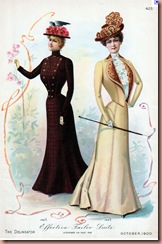
1900fashion Here we see the full sweep of the breast set low to a tightened corset below the bosom and also jutting the backside out. This was called the “S” curve and the older actress in this film in 1937 would have been this lovely lady in her 20’ in 1900. The last of the corset crew, really, and we can see, as would have been the norm. the older ladies would have held onto their corsets in many ways. In early 1930’s films we often see the 1930’s slim line natural waist-ed look simply built over this 1900 S curve corset in the larger older woman. But that older stout matronly woman was once the vibrant young Gibson Girl of her era:

I find it fascinating how ones youth fashion often carries over to the present. This, today, may no longer be the case as the actual ‘style or shared look’ of the time seems to have sort of left us in the middle 1970’s. Certainly we can see a film and identify it as 70’s 80’s or 90’s by the fashion, but the idea of a shared look all women strive for and a foundation to build that look on really left us after the 60’s, I think. There wasn’t, per say, a foundation look of the 70’s or 80’s most women shared.

So, the jury is still out, but I might find simply I wear a girdle some of the time, but I am determined to make a pattern to make some of these under things for myself.

Now, all this talk of clothing has made me feel a bad homemaker. Here we are five days in and I haven't even shared a recipe yet. Well, so many things to do and so much to write about, I do promise we shall get into the kitchen to talk about more than just decorating it. But, a gal likes to do a job thoroughly. While I am still on the topic of one’s appearance however, I have also been contemplating my hairstyle. And thinks something along the lines of this picture of Joan Bennet in 1935 would be lovely. I will, of course, share my hair cut/style with you which I am sure may be a first time mess, but I shall get the hang of it in time.

Just so I don’t feel a total lout of a homemaker, I will share one of the more exotic or actually really basic foods I am beginning to see in my older cookbooks. This is not canned, cheese whiz cooking of the 1950’s that is for sure. This recipe, Swedish in origin, is from one of my ‘new’ late 20’s cookbooks. It was put out by the First Swedish Lutheran Church of Brockton, Mass.

Despite its rather unfortunate sounding name,  it actually sounds quite good and I will try it. I adore liver, but I suppose one could substitute another meat. But I think offal is so rich that it often imparts flavors not quite achieved with muscle meat.

leverkakarecipe

Soon we can begin delving into more cooking and cleaning 1930’s style. And do excuse my initial days here in the hard hit Depression with flights of fancy concerning kitchen decor and fashion. But, I think, even the most hard hit had to have some joy and this often was simply dreaming for an hour in the pictures. It isn’t a surprise most of the films of the Golden Era of Hollywood dealt with the fun and frivolity of the upper class and elegantly rich. An hour of cooled or heated air and no worries must have been a much need balm to the fevered brows of many during these hard times.

goldendatebridge1 And, in the news, today in 1933, the Golden Gate bridge begins its construction in San Francisco CA. That must have been a sight to behold, I am sure. I want to begin recording more of the news and happenings of the day as well. Now, I must get back to work, there is much to do.

Happy Homemaking.

 Search The Apron Revolution