Thursday, February 17, 2011

17 February 1957 “The Tale of Youngstown Ohio: Is It The Tale of Modern America?”

One drawback to being a time traveler is that ones’ joy in the moment is often clouded by knowing the future. I can rather get lost in 1957 easily, but whenever I am researching various things about the day, I inevitable find myself going down a path I must follow. This lead to this lead to this; the “Alice down the rabbit hole” I have come to call it.

So, today I want to share such a journey I took. It started with some innocent findings of a town in Ohio, Youngstown.

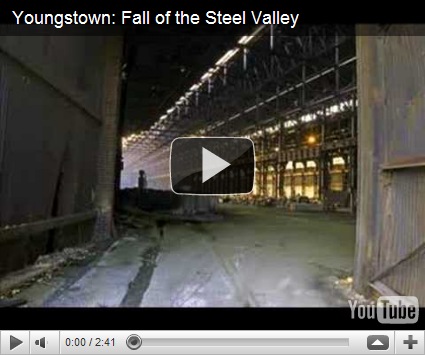
Here is a video about Youngstown from 1944

youngstown1850beforeindustry Youngstown Ohio in 1850’s before the industrial revolution really hit it. Here we can see how towns once existed. A mix of agriculture/housing/shops all within walking or easy distance. No cars meant we HAD to be green.

DowntownYoungstown1920ss Downtown Youngstown 1920’s. At this point the Steel industry had been going for a decade and the downtown grew and became the major area of local commerce and business.

1900coal By 1900 coal began to be mined in the area. This, of course, lead to Steel.steelmill And with the help of the automobile and the tripling of production during WWII it got bigger rather quickly.steelmillww2 And after the war, continued onward and upward stellmill50s And by the 60’s the mill and the surronding countryside was growing with the wealth of the country through steel. The USA was a powerhouse exporter of not only oil (which was beginning to run out at this point and we would see that result in the 1970’s)but auto, steel, industry.

steelmill77 By 1977, the steel works and large industrial complex had been a part of the area for decades now. It seemed a permanent fixture, providing jobs and economy for the area. Homes and town had built up from the wealth and jobs.

What I found very interesting was that in In 1952, during the Korean War, President Harry S. Truman attempted to seize United States steel mills in order to avert a strike. This led to the U.S. Supreme Court decision of Youngstown Sheet & Tube Company v. Sawyer, which limited presidential authority. Had Truman successfully seized control would this have set a precedent? And what, prey, precedent do you mean, 50’s gal, I might hear you ask. That government intervention might be needed when things get ‘too big’. “Oh no!” I hear the gasps, no government intervention. Yet, of course, because of this, the companies continued unhindered by policy into September 19, 1977. ON that day, now locally remembered as ‘Black Monday”, the company abruptly closed its Campbell Works and furloughed 5,000 workers. Closings continued through the 70’s and 80’s.


sheettubemetal2So this has become this

sheettubemetalAnd this bridge which once carried steel out of the area sits rotting.

youngstownbridge

rubberfactory    This image ( from THIS flickr stream) really hit home for me. The desolation and waste.

The people of the area were greatly affected. The population dwindled greatly with no major industry providing jobs. This is what happened to the neighborhoods youngstownoh

youngstown today Downtown Youngstown today. It seems almost a movie set of apocalyptic proportions. And this is happening all over the US, not just Ohio.

detroit Here is a ‘home’ in Detroit. Abandoned row houses in Baltimore baltimore North Carolinancarolina

Here is a local testament from 2011:

"When I grew up in the 1950s, the city was at its peak," said Father Ed Noga, who heads St. Patrick's on Youngstown's South Side. "There were kids everywhere and everyone converged on downtown. You went to eat, to shop and to go to the movies."

Today, downtown is positively sleepy and even somewhat derelict. Residents have to drive out of town to shop for clothes or house wares. And while foreclosures have long been a scourge in this city, they have recently skyrocketed along with the rest of the country, up 178% in February from a year ago.

But, we might ask, where has the steel gone? We still drive cars and have need of steel in this country, is that not so? Well, it must be made somewhere. Where have all the American Steel companies gone, they are still making so much money?

China has the world’s largest steel industry. Indeed, in 2005, China made more steel than the next four largest producers combined. From 2000 to 2005, China’s steel production increased by over 170 percent, as the Chinese industry added capacity at a furious rate. Between 1998 and 2005, China’s steel exports more than quadrupled, as China established itself as one of the world’s leading exporters. This explosive growth in both production and exports would not have been possible without the support of the Chinese government.


Now, I have no way of knowing if government intervention in 1952 could have set a precedent that would have helped such industry to be forced to stay in the country. But, certainly, something should have been done. The jobs are gone, the towns are gone, the industry is gone for the majority of the people. Yet the few who owned the steel mills make an even higher profit now due to the lower costs of production in China. Then, I ask myself, is it fair that they were allowed to leave? They are a private industry, but are we not private citizens? Perhaps had there been laws that said, “you may leave and take the industry, but you cannot sell in this country what is not made in this country without having this higher wage put upon you for bringing it back in” That is a fair idea for without such an idea, here we are now.

And it isn’t just steel. So much industry that is flourishing now here in 1957 is poising to leave over the next two decades. I feel we really had it right, we Americans, here in the 1950’s. We were given this opportunity to grow and build ourselves up while the rest of the civilized world was repairing itself from a destructive war fought in their backyards. We could have made a fair playing field for ALL Americans: workers and farmers. Because not everyone WANTS to be a captain of industry. Some people just want a nice home affordable, a home they can pay for, reasonable priced food and a chance to raise a family. And if we ALL wanted to be millionaires, how could we, it would make no sense as it could not happen. The idea of allowing freedom where it should not have been took it away from the freedom from most.

When I look at the happy faces smiling out at me in my vintage magazines. Listen to the happy songs and watch the funny sitcoms of the era and the bright and shiny movies, it sometimes makes me cry. I want so bad to really be here, 1957 and to shout out to the others around me. “Pay attention! What you have now is wonderful. Keep shopping downtown. You don’t need to grow bigger. Johnny doesn’t have to leave the farm, work to keep the farms small and local” but, I know very well, it would fall on deaf ears.

Much like the plot of any fictional time travel book, I could easily go to 1938 Germany and begin shouting to those around me, “Pay attention, don’t turn away as if nothing is happening. You can stop it now!” Of course they would not listen to me. It would fall on deaf ears.

In many ways this can of worms I have opened with this project has left me feeling much like a true time-traveler. I see myself sitting on the threshold of some great significant historical event seeing how it all happened, only no one can or won’t hear me. Was I better off before, when I didn’t know. When I thought the things the TV told me were true. When I believed that the government was full of people who cared about my freedom and not peopled with heads of the big 5 corporations? And, funny thing is, I had to put on a girdle, make a nice little home, kiss my hubby off to work and live in 1955 to realize it all. Irony, I think, is not a strong enough word for that situation, that my living decades away from my own time has made me the most aware of it than I ever was before.

So, where has that left me today?

To me, being Vintage isn’t just Pink kitchens, buying old things and wearing pretty dresses, its about looking back for the good and bringing it forward again. We have the opportunity to re-live the past in a way that puts aside any of the bad we had then, as we don’t need forethought when we look ahead. Then, with the old skills we can make a better future out of the past. I do know that we cannot, with any true success, just continue on as mindless consumers who don’t want to ask ‘WHY’.

It seems to me one of the main drawbacks to our American vast landscape what our extreme growth during the boom of industry and the automobile. Now, were there laws not allowing the companies not to leave the U.S. then these towns would still exist. Of course, we as consumers would have to pay a little more for our things, as they would be made by us who would cost more money. But, then we would put it all back into our own economy. What a difference would our country be today if products sold here had to be produced here. Yet, we happily buy our cheap products made elsewhere, drive our cars long distances to get these items, watch our downtowns fade and our vast agricultural belts become barren with overplanting of corn and watch the waters get polluted by their run off of chemicals.

I am not sure what would need to happen in this country to make it different. I think one thing would be that we just stop and look around and figure out why it is this way. But, as long as large companies are allowed to produce outside our country, and retailers to gut the market with cheap foreign made products and we all happily buy it all up, there is no change ahead until it will be too late.

There are some people who, much like those after a natural disaster or war, are going into these wrecked towns and trying to rebuild. The sad bit is, they were built around the very industry which is now gone. Is rebuilding that same structure the right answer? On what level can it really exist that way? We might make as many ‘cool art galleries and coffee houses’ but really, without any industry to support the economy really, then we are just playing house in an old city still supplying our needs from the big box stores.

There is a town, Braddock PA that is trying to come back HERE is their site.

But, again, is this the right way? To make this post-apocalyptic or I should say post-Industrial town alive again with what was built on that industry which left it the right answer? I don’t know.

In many ways I am beginning to think we might need to look back further than the 1950’s back to Youngstown in the 1850’s.youngstown1850beforeindustry When the town was made up of what it needed, food shelter, neighbors, and industry wasn’t a big machine that could come in and out as it wished leaving devastation like some great giant. ROUTETORECOVERY/ Leaving it much like a desolate post war world.

How did we allow ourselves to go from thishappy50sfamily To this:modernfamily Was it all worth it?

Tuesday, February 15, 2011

15 February 1957 “How To”

I thought today some simple vintage “How to” would be nice. I know I have seen these old cardboard letter files before, but not sure if they were at an antique store or just a stationary store. But, I like the ingenuity of this How To, as today one would just go and buy something like this already made up at a big box store. Here one is encouraged to make it themselves.filehowto I think it would be a great project for anyone who collects vintage dolls to make one of these with vintage wallpaper or shelf paper scraps.

 deskhowtoThis is a great use of an old door (for an antique look) or for a more modern mid-century version. Again, one might visit IKEA today for something like this. Here we see it is simple enough to assemble ourselves and then we can customize it as we like.howtodesk2

Happy Homemaking.

Monday, February 14, 2011

14 February 1957 “Valentine’s Day and 1950’s PINK PINK PINK!”

valentinespunch Today is Valentine’s day. As we still have sometime before this evenings romantic celebrations, i thought I would share some cute 50’s recipes for the occasion.

Here we see the valentine cake recipe  with some lovely punch to accompany it. If you have friends who are without partners, why not throw a Valentine’s day party and see who ‘ends up together’ at the end. Or just to let those singles feel a part of the fun!

valentineheartcakeHere is a recipe for 7 minute frosting I have shared before. Always a good ‘go-to’ frosting. 7minute frostening

valentinepunchI believe the ‘cherry instant soft drink mix’ in this recipe is Kool-Aid. You could easily use cranberry juice, but it might be fun just once to see what the authentic recipe tasted like. 

feb57valentinepage This Page is from one of my 1957 February magazines, so it is right on point for me. I have begun to notice as the magazines get closer to the end of the decade ‘recipes’ are increasingly calling for the homemaker to ‘use a cake mix, use a frosting mix’. But, now who doesn’t love colored coconut?

valentinespajamas Pajama’s for the whole family?valentinesday50s A night in alone?

Now, many of us do associate the color Pink with Valentines day. And certainly Pink is VERY 1950’s. So, for the fun of the day, here are some examples of how deep Pink is embedded in our lives here in 1950’s America:

57pontiacpinkOf course the latest cars still proudly wear the color. Probably since 1955, Pink is becoming one of the base 4 colors cars are often painted. White, Blue, Yellow, and Pink are the ‘norm’ for autos here. pinkTPadA lovely homemaker’s Pink day does not need to end with her lovely pink peignor, but can extend to her well appointed Pink bathroom with matching Pink Toilet Paper.  luxsoapad Even the soap may match or compliment the bath. This Lux ad says it all for the color palette of the 1950’s. Shell Pink, Soft Green, Buttercup Yellow, and Robins Egg Blue. You can’t go wrong with any of these for a 1950’s mid-century interior and they really compliment one another as well.

pinkkitchen2 Here is a wonderful Pink kitchen. What I love about this space it is not all matchy-matchy as much as one may think. For example the ovens are stainless steel as the counters (yes they used stainless in the 50’s too!) Yet, the icebox is pink. So, if you want to recreate a vintage kitchen you won’t feel the need to get all appliances the same color. In fact a pink oven, blue icebox and yellow stove could set the tone for the kitchen and those colors could be repeated in floor and cabinetry.

The cabinet bases are painted pink to match walls and doors, but the doors of the cabinets are painted 1950’s favorite pairing with Pink, Grey! This ties in the cool tones of the stainless steel. And I love that a secondary Pink/fuchsia is introduced in the backsplash and YES another Salmon pink is brought in on the floor. I love the idea of the classic checkerboard being in Pink and Grey and by doubling up the classic one foot squares the impact is greater in this space.

I also love 50’s blue and you can see how that is an acceptable complimentary color here, in the pots and pans. Lovely.pinkkitchen Here, the same kitchen is broken down. you can see how the black decorative painting around the window stands in place of curtains and is repeated in the piping on the dining chairs. The grey chair trimmed in crisp black gives it such a dignified clean look. Overall, Pink done very 50’s and very well, I think. Who wouldn’t smile while whiling away the hours in this room?

You will also notice that the TV is here to stay by 1957. Its place in the kitchen is beginning to happen.


pinkhouse And, yes, Pink even coats the exterior of some of our homes. This look of deep burgundy/brown with the soft pink is such a fresh color. It doesn’t appear tacky at all and has an almost Italian/Mediterranean feel to it.

So, have a lovely Valentines day and remember, Think Pink! and Happy Homemaking.

Saturday, February 12, 2011

12 February 1957 “Dinner Party with Chicken Cordon Bleu”

womanatdesk I feel I have rather been burning the candle at both ends of late. My children’s book deadline of the end of February has had me rather active and my mind is mush, to say the least.

Last night, however, we threw a little dinner party for some friends. One would think planning a dinner party in the midst of it all would  be the last way to ‘unwind’, but not for a 50’s homemaker like myself. I told myself, “Today there is nothing on my plate BUT cleaning and cooking followed by cocktails, dinner, and conversation.

I made chicken cordon blue. As a side I made a very 50’s feel side dish of egg noodles with mushrooms in cream sauce. Of course, the 1950’s version would probably have involved a can of Campbell's soup, but not for this cook. I made a white wine sauce with cream and garlic to coat the noodles and then baked it with some gruyere cheese on top.

For the chicken cordon bleu, they couldn’t be easier. It is that sort of meal one can make that impresses but really is not that involved. Here is what you do:

Take a chicken breast and slice in half, so it opens like a book. Then cut that into two pieces. With either a meat tenderizer or, failing that, some waxed paper and a good ole’ rolling pin, pound the halves to about 1/2 inch.

I have to say, I rather like pounding meat. Not only does it tenderize it, it allows for a shorter cooking time, extends the meat so you save money, and is a great way to ‘let loose any frustrations’ (see- mind mush from impossible deadline for writing, illustrating, and laying out a children’s book)

After that you simply take a slice of ham and a slice of Swiss cheese, place it on one of the halves, making sure it does not go beyond the edges, then roll it up lengthwise, like a sleeping bag. Insert two tooth picks. What is nice is you can roll up as many of these as you need for your guests. One of these per guests is plenty when you have a nice filling side dish and a good dessert. A few cocktails before dinner does hurt either.

Whip up an egg and have a bowl of breadcrumbs, or flour with your favorite seasonings in. I often save bits of heels of bread or even the crumbs from slicing bread in a little container. These are not garbage and they don’t even go into my compost, but used later for fried chicken and of course Chicken Cordon Bleu.

Dip in egg, dip in flour/breadcrumb mixture. Next, heat up about 2 TBS olive oil and butter. Then lightly brown your chicken and set in a baking pan. These can be made ahead in the morning and popped in the icebox until later when your guests arrive. You just have to pop them in the oven at 350 F for 20 minutes.

I also made a white wine cream sauce for these. What I do for that is mix up in a 2 cup pyrex glass measuring cup, one cup cream, one chicken bouillon or 1/2 cup homemade chicken stock (if you have some on hand) and 1/2 white wine and 2 tbs cornstarch. I mix this ahead as well. Then, as the chicken is out of the oven, the guests are busy with hubby and their drinks, I simply reheat the pan that I had cooked the chicken in, add some garlic and slowly whisk in the premixed cream/wine mixture. Then, this is poured over the chicken after it is plated, along with the egg noodles and a nice veg.

I like to plate meals in the kitchen and serve them prepared. Then I will have any extra, such as the noodles, on the table for anyone who wants to have seconds. I prefer this to a grab and pass situation, because I feel it makes one feel more as if they are at a restaurant and is more enjoyable. Also, I always have at least three or four  glasses (my good antique glasses to boot) at each plate for water, various wines and whatever cocktails have been brought to the table.

Now, the funny thing about this dinner party is I didn’t get any photos. As I said, with my brain mush, I was happily smiling and enjoying the simple home pleasure yesterday. I was only wearing my ‘homemaker hat’ and not my ‘blogging, documenting, writer’s’ hat so blissfully never even let it enter my mid. However, this morning I though, “Drat, now how will I share this with the gals and gentleman on the blog?”

cordonbleuSo, solution: I had to make hubby’s lunch so I simply threw together another cordon blue and plated it for this photograph. I have to say, it does not look as good as they did last night, as I served them sliced, so  you could see the wonderful cheese and ham inside, but you get the gist of it.

Hubby told me today when he unpacked his lunchbox and got out a plate, set this all out, there were many drooling co-workers. One of his co-workers said, “I want a 1950’s housewife”. I felt appreciated.

I hope all have a wonderful weekend and Happy Homemaking.

Thursday, February 10, 2011

10 February 1957 “Cleaning 1907, The Divided Skirt, and More Weed Recipes”

The past week I have been thinking about the past. Now, one must remember that the past to me, here in 1957, might not be the past to most. I am simply looking back a mere 50 years to 1907.

That year, well 1908 to be exact, is the year my Household Discoveries book was published. mrscurtisbook I had one of these in the Corner store but there is now only one available and it is going for $60. And any on eBay are similarly priced. So, a bit pricey. And, anyway, I occasionally share information from it. Though, it is worth having in a good ‘homemaker’s library’.

I am not sure what has brought me to contemplating the past more this week. You would think living in the past would be enough to get a handle on, but I suppose my natural curiosity of the past simply kicks in no matter where I am ‘living’. Were it “My Year 1907 I would probably be considering 1857! So, you can see how one can rather go a bit overboard.

Back to the book at hand and the time period. The early 20th century would have been one I was familiar with through my fictional mother and grandmother. Most likely my fictional grandmother would have had this book on her shelf and referred to it often or perhaps gave it as a gift to a much loved housekeeper. Either way, it would be to we 1950’s women as the 1950’s is to we 21st century. It would have its cute little idiosyncrasies and we would have Ooh-ed and Ah-ed over the lovely dresses but been thankful to be in girdles, not corsets, and have washing machines and dishwashers.

Today I was having a glance through the chapter on House cleaning. I have read through this many times, but somehow missed this bit about what to wear while cleaning:

While house cleaning, dress appropriately for the work. Some housekeepers wear a divided skirt of bloomers made of four widths of heavy dark skirting. These are gathered into bands and buttoned about the ankles and waist. They are valuable protectors for skirts, and facilitate climbing stepladders, scrubbing floors, etc.

I was unable to find any photos of said outfit. This is understandable because, though the Brownie camera was readily available for the middle classes of the America of 1907, the idea of documenting every little thing, rather a norm in 2011, would have never occurred to them. One had scrap books and photo books or nice photo’s in frames on pianos and mantles. There wasn’t really anyplace a homemaker would want documented her cleaning outfit. This is rather too bad, because we today would like to see it. At least I know I would, but then again I am a product of the 21st century and we want to SEE everything documented, don’t we?

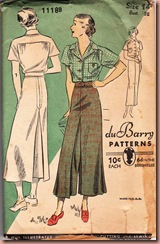
What I did find was these lovely bicycle bloomers.bikebloomersNow this darling outfit would certainly not have been for cleaning. It might, in fact, have even been made of heavy velvet or wool, as this drawing depicts. A quite possibly was put on like a coat or jumper, in one piece, stepped in and buttoned up over ones under things. But I am sure it looked more like that than these darling 1930’sdividedskirtversion. I have to say, though, these would be very good for golf. And, in a sensible serviceable easy to wash cotton or duck cloth, would fair very well for housecleaning. Especially with a pair of deep pockets. One could almost wear it in lieu of a cleaning apron.

Now, here is the rest of the advice for the 1907 homemaker before cleaning:

Pull the sleeves up as far as you want them to go, and put elastic bands on the arms over the sleeves. Trim the finger nails as short as can be borne with comfort. (the fashion for long fingernails NOT  yet in vogue)This prevents their being broken or torn when obliged to work without gloves. Wear a dust cap, a big apron, and loose gloves.

Half the disagreeableness of house cleaning is taken away by having a lotion to apply to parboiled and uncomfortable hands. Soak 2-3 ounces of quince3 seed over night, strain through cheese cloth, and add 2 quarts of water and 2 ounces each of glycerin, boracic acid, and witch-hazel. This is one of the best lotions.

I rather like that they were using quince seeds. Again, something we would consider trash or simply by pre-made the homemaker of 1907 would not have done.

Having cleaning items ready made were also not as prevalent and things, such as dishcloths and dusters, would have simply been made with spare wool and rags.

Here are two very easy crochet patterns for two versions of dishcloths:

  HERE is the pattern

moddishcloth HERE is the pattern for this one. It is rather 50’s and would easy to do up in colors coordinated with your kitchen.

I thought, as I mentioned the lotion from the 1907 manual made of Quince, that I would talk more about the ‘weeds’ in my last post.

chickweed Chickweed, which looks like this: chickweed2 Has a very long and useful list of eating and health uses:

Chickweeds are Medicinal and edible, they are very nutritious, high in vitamins and minerals, can be added to salads or cooked as a pot herb, tasting somewhat like spinach. The major plant constituents in Chickweed are Ascorbic-acid, Beta-carotene, Calcium, Coumarins, Genistein, Gamma-linolenic-acid, Flavonoids, Hentriacontanol, Magnesium, Niacin, Oleic-acid, Potassium, Riboflavin, Rutin, Selenium, Triterpenoid saponins, Thiamin, and Zinc. The whole plant is used in alternative medicine as an astringent, carminative, demulcent, diuretic, expectorant, laxative, refrigerant, vulnerary. A decoction of the whole plant is taken internally as a post-partum depurative, emmenagogue, galactogogue and circulatory tonic. It is also used to relieve constipation, an infusion of the dried herb is used in coughs and hoarseness, and is beneficial in the treatment of kidney complaints. as an astringent, carminative, demulcent, diuretic, expectorant, laxative, refrigerant, vulnerary. A decoction of the whole plant is taken internally as a post-partum depurative, emmenagogue, galactogogue and circulatory tonic. It is also used to relieve constipation, an infusion of the dried herb is used in coughs and hoarseness, and is beneficial in the treatment of kidney complaints. New research indicates it's use as an effective antihistamine. The decoction is also used externally to treat rheumatic pains, wounds and ulcers. It can be applied as a medicinal poultice and will relieve any kind of roseola and is effective wherever there are fragile superficial veins or itching skin conditions.

It also appears to be a good pain relief:

Chickweed tea is a very popular home remedy for pain relief, and one that usually works very well. Because of the anti-inflammatory properties that the herb has it can reduce any inflammation and help to relieve pain, both internally and externally.

Last time I had forgot to mention one fun thing we can do with dandelions and that is make wine! When you consider the amount of dandelions available anywhere. Even if one does not have a yard, they grow in sidewalk cracks, abandoned lots in urban areas, gutters. You name it and they grow there. And I am sure a neighbor would only be to happy to have you pick out those ‘darn weeds’.

HERE is a page that has a few recipes for that lovely wine. This is a very informative step by step process for making the wine.

These lovely and vitamin filled flowers can even be added to pancakes for a delicious taste treat.

I think, now that I have opened this can of worms, that I want to see what else I can find out about using weeds this way. I would also like to find any 1950’s books that might still have had some of this information as it would have been used quite a bit in the early 20th century I am sure.

Happy Homemaking (and weed gathering!)

Tuesday, February 8, 2011

8 February 1957 “Eggless Cupcakes, Those Pesky Weeds or Easy Food and Cheap Medicine?”

I thought I would share two eggless cake recipes I enjoy. Now, I have a generous supply of eggs from my lovely hens, but sometimes I might be low.

The other day was a baking day and I had used up many eggs for breakfast and other things and had only enough eggs for next day’s breakfast (as my hens fresh eggs wouldn’t be laid until later the next day)

chocalmondcupcakeThis chocolate cupcake recipe is SO moist and wonderful. I often use this even when I have eggs available. You can see I made a very rough and natural frosting and it was very delicious. These may have to be sold this summer at the farm fair for pin money.

Eggs Chocolate Cupcakes

2 1/4 C.  unbleached flour

2 C.  sugar

1 C.  unsweetened cocoa powder

2 teaspoons baking soda

1/2 teaspoon salt

2 TBS vanilla extract

2/3 cup oil

1 1/2 Tsp. white vinegar

2 cups cold water

Preheat oven to 350 degrees F.

Sift the dry ingredients (if you don’t have a sifter, put dry ingredients together in bowl and then whisk until blended).

In a large bowl, sift the dry ingredients together.  Set aside.

I mix the oil, water, vanilla extract and vinegar in my Pyrex 2 cup measure, as there is room enough. Give it a good stir.

Slowly whisk the wet ingredients into the dry ingredients. Don’t mix too much, it is okay to be lumpy.

Pour in Cupcake cups and bake about 20-25 minutes. Check with toothpick for doneness.

Now, I used an almond-butter frosting. This works with peanut butter as well, but Gussie (who works on a local farm) had some expired almond butter when their farm store closed for the season. I happily took it. Waste not, want not, as they say.

Almond Butter Frosting

1 C.  butter softened

1 C. chunky almond butter

3 C. confectioners sugar. (You could use more up to 5 cups depending on how sweet you wanted it, but the cupcakes are nice and sweet so I prefer a less sweet icing)

1 TBS milk or Cream

Simply whip butter and almond butter until nice and fluffy (think of how you want your frosting to look) then mix in sugar and milk.

This makes more than enough for the cupcakes, so I put the rest in a mason jar in the ice box and use it as a spread on toast or scones. It also goes wonderfully on a jam sandwich!

Now, here in the late 1950’s we are prone to excess. We seem to be living in a world of plenty. Many things are becoming more affordable and there seems to be a vast endlessness to what we can have at our fingertips. Such bounty, therefore, often leads to a feeling of security.

Such a feeling I found when perusing this little article in one of my magazines about those ‘pesky weeds’ and how they stand in the way of our desire for that ‘perfect lawn’.

As I have said many times, being an older homemaker I cannot but help to think I would sometimes question these motives. There was a time, not long ago (12 years or so prior) that I would  have recalled being hungry and knowing of the want and need of food especially in the war ravaged homes of Europe and Britain. My own lawn, as many other’s had done, may well have given way to veg and other edibles. Today, here in 1957 however, my plantings would seem to be more focused on appearance to actual usage.Fast forward to 21st century and we are well aware of the affects of these ‘weed killers’ to pets, children, the soil and so on.

weedarticle Here, however, I find it interesting how this article points out these various ‘bad weeds’ and the appropriate chemical to do away with them. Let’s take a look, however, at what these plants actually provided for our ancestors when times were tough. Also, before medicine as we know it some of these weeds were also used, by our Victorian and earlier ancestors, to treat ailments.

dandelion First, we have our old friend the dandelion. Probably the most belligerent and determined plant that has fought with the lover of lawns for years. Yet, by its very hardy nature and ability to grow in affect without any aid from us, should tell us that we might want to consider it as part of our food supply.

First let’s look at the suggested aid in destroying this plant 2 4 D. Here is an interesting bit of info on this pesticide, which is STILL used widely today in our country (though I believe it is banned in Europe).

2,4-D was originally developed in 1941 to increase plant growth. Soon, it was discovered to have an even more useful role in agriculture as an herbicide to control weed growth. A mixture of 2,4-D and a related chemical called 2,4,5-T was found to be a more effective herbicide than 2,4-D alone. This mixture was called Agent Orange and was used by the U.S. during the Vietnam War to increase the visibility for war planes by destroying plant undergrowth and crops. The usage of 2,4-D and 2,4,5-T increased through the next 15 years. In response to its potential to cause cancer, and other health concerns, use of 2,4,5-T was banned by the U.S. Environmental Protection Agency (EPA) in 1983. Although 2,4-D use has been allowed to continue by the EPA, its health effects are under review.

Now, the dandelion itself has so many uses and edible bits. The leaves are quite good in any salad or in place of lettuce. The roots can also be toasted, ground and used as a coffee substitute. There are endless uses of the plant. And, surprisingly, a natural plant food for other plants can be drived from it.

Here are the medicinal uses of the plant:

Dandelion is also used for the treatment of the gall bladder, kidney and urinary disorders, gallstones, jaundice, cirrhosis, hypoglycemia, dyspepsia with constipation, edema associated with high blood pressure and heart weakness, chronic joint and skin complaints, gout, eczema and acne. As a tonic, Dandelion strengthens the kidneys. An infusion of the root encourages the steady elimination of toxins from the body. Dandelion is a powerful diuretic but does not deplete the body of potassium.

Research is revealing that the many constituents of Dandelion including Taraxacin, Taraxacoside, Inulin, Phenolic acids, Sesquiterpene lactones, Triterpenes, Coumarins, Catortenoids and Minerals, mainly Potassium and calcium, are very valuable in curing a number of disorders and illnesses. Dandelion is traditionally used as a tonic and blood purifier, for constipation, inflammatory skin conditions, joint pain, eczema and liver dysfunction, including liver conditions such as hepatitis and jaundice.

Another interesting use of the plant is when the flowers and leaves are placed in a closed brown bag with unripe fruit, the  flowers and leaves of Dandelion release ethylene gas which ripen the fruit. You can also make a dark red dye from the roots and a cosmetic skin lotion made by distilling the leaves at the base of the plant in water are suppose to help with freckles.

This is knowledge that our ancestors would have known by course and certainly would have preferred all that from an easy to grow plant over lush green lawns.

plaintain Next, we have the plantian. Now, I don’t know about you, but my yard often produces these, even is spots where little else will grow. They are actually a pretty plant and I have used the leaves in arrangements for my kitchen and dining room table. However, they have many uses.

The herb has a long history of use as an alternative medicine dating back to ancient times. Being used as a panacea (medicinal for everything) in some cultures, one American Indian name for the plant translates to "life medicine."

The young leaves of the plant are great in salads and also lightly cooked with other foods. They are very rich in vitamin B1 and riboflavin. It is interesting to note that things such as riboflavin are now, here in the 1950’s, being added to our wonderful white pre sliced bread, while out in the yard we are killing a natural source of it with military grade poison. We, however, are unaware of this here in 1950. We believe that our government would never let a product be sold that could hurt us. Of course, we also are constantly bombarded by ads for cigarettes, but that is another story altogether.

I have rather found this an interesting idea, these weeds, and will continue talking about these next post. But, imagine, if it were war time or any crisis and we were left to look about us for food and food production. Here we see many plants that, despite our chemicals which in fact hurt us more than the plant, continue to survive. That is an easy source of vitamins, nutrients and ways to fill our belly. Many of these, as well, make wonderful teas or coffee substitutes. Though I am over a decade away from the War, my natural ‘make do and mend’ instinct of the WWII bride would often shake my head at the ‘young people today’ and wonder ‘what a waste, what a shameful waste’ as I save my slivers of soap in old stockings. Garbage and waste would be as sinful to me as anything.

 Search The Apron Revolution