Showing posts with label commercials. Show all posts

Monday, December 13, 2010

13 December 1956 "Britain's First Female Judge, Japan in the UN, Christmas Commercials and Christmas in Copenhagen"

Dame Rose Heliborn became the first Woman Judge in Britain on the 8th of this year, 1956. She would later become many 'firsts' in that country for women, including: she was the first woman to win a scholarship to Gray's Inn, the first woman to be appointed King's Counsel in England, the first to lead in a murder case, the first woman Recorder, the first woman judge to sit at the Old Bailey and the first woman Treasurer of Gray's Inn.

I think it also interesting to point out that last year, '55, England did away with the death penalty, while we still, here in the USA, still hold onto that practice. Just an intersting note during this, our time of peace at Christmas time.

Yesterday, the 12th, Japan joined the United Nations. This shows the change of direction of that country. Once our sworn enemy, after the atomic bombs that ended the war with that country, Japan's entire view of itself and its very 'warrior' persona changed. They almost overnight gave up the concept of warrior strength and pride (some great generals committing suicide due to this change) and moved towards production and trade. During the 1950's this war ravaged country was the cheap labor for the US, not unlike CHINA is to us today. Made in Japan was stamped on many cheap goods and things such as Barbie and other toys were mass produced there. Though, our connection with China today is much more ominous than our use of Japan after the war years, but that is an entire post on its own.

I thought I would share some interesting Christmas time and toy commercials from the 1950's.
This first is for the 'gift' of cigarettes.
 The sad story of this lovely lady, is that she did not, herself, smoke. She was encouraged to do so as she became the spokesperson for the company. Today she has had her voice-box removed to cancer related to smoking.

Here is a fun Holiday jingle for Coke:


Here are some of the toys kids may have wanted to see under the tree this year


And finally, I found this lovely video of Christmas in Copenhagen. Wonderfully showing the making of treats and I love that they have real candles on the tree. I love to see the traditions in other countries.

Sunday, December 5, 2010

5 December 1956 “Q & A Sunday: 1950’s Diet and Health”

familycooking This weeks question from one of my fine followers is as follows:
  I have a question about a comment you made in your Lard post.  The way you describe how your eating habits have changed since going back to 1955 is impressive.  Not to mention lowering your grocery bill by doing so.  Have you or your husband received any positive test results or positive feedback from your doctor, if you've discussed this with him/her.  I'm not trying to pry, just wondering for my own health needs.  Seems like we Americans need to get back to real life AND real food.
If you think this would make a good Sunday question/answer post I'd love to see you expand on the topic.

I thought this a good question to deal with as we approach the Holidays. We American’s are now officially over-eaters in our normal day to day life, but add the Holiday to this and look out! Therefore this seems a good time to discuss this.
When many people today consider the 1950’s and food, they often think, “Oh, Bacon and Butter; everything is dripping in butter and lard; Steak and Red meat” and so on. There are even modern commercials that play on this stereo-type. Here we are to “Meet the BUTTERTONS”
This commercial is the perfect example of modern propaganda. It is false in many ways. The first being that in 1950 entire sticks of butter were spread all over everything. First and foremost food in 1950’s was MUCH more expensive than today. Today’s food IS cheaper and more plentiful mostly attributed to corporate farming and the high percentage of imports of goods from foreign markets.
Secondly it is false in its dietary claims. To say that “I can’t believe it’s not butter” (Which I bet were I to taste it I COULD believe it was NOT butter) is better than butter is ridiculous. It is a margarine type spread. It is processed from a variety vegetable fat and is actually grey in color. It is often made from the least nutritious oils, such as cotton seed, which is also used as pesticide. The ‘butter color’ has to be added to give it the appearance of actual butter.
It is also whipped in a can which contains much air and you therefore get less than you would in a solid stick of butter. This is also true of whipped butter. Therefore,  anyone who buys whipped butter : you are paying for air. If you like whipped butter, make it yourself with your mixer and even add a little cream or milk, whip to the consistency you like and store in the ice box! You can even add herbs, garlic or make honey or cinnamon whipped for the breakfast table. But start out with a good solid stick of butter. I actually buy butter in a 1 lb block and simply cut it into the quarters you get when you buy the pre-packed pound with four 1/4 pound sticks. IT is less to throw away and cheaper to buy. But I digress…
Rather than describe the production of margarine in my own words, I found this which does a better job. Here is what we ‘smart modern families’ are eating when we eat margarine (and many other products that contain margarine in them any ‘cream based’ soups, packaged cheese/gravy sauces you name it)
How is margarine made: Step 1
Margarine makers start with cheap. poor quality vegetable oils, such as corn, cottonseed, soybeans, safflower seeds and canola.
These oils have already turned rancid from being extracted from oil seeds using high temperature and high pressure. Rancid oils are loaded with free radicals that react easily with other molecules, causing cell damage, premature aging and a host of other problems.
The last bit of oil is removed with hexane, a solvent known to cause cancer. Although this hexane subsequent removed, traces of it are inevitably left behind.
Unfit for consumption
Moreover, some of these oils are not suitable for human consumption to begin with.
Cottonseed oil, one of the most popular margarine ingredients, has natural toxins and unrefined cottonseed oil is used as a pesticide. The toxin, gossypol, is removed during refining.
Cottonseed oil also contains far too much Omega-6 fatty acids in relation to Omega 3. While both Omega 6 and Omega 3 are essential fatty acids, an imbalance between the two is widely believed to cause various health problems, including heart disease.
Most experts on the subject believe that a healthy ratio of omega 3 to omega 6 is between 1:1 and 1:2. Cotton seed oil, however, has over 50 percent omega 6 and only trace amounts of Omega 3, giving a ratio of 1: several hundred or more.
As cotton is one of the most heavily sprayed crops, there are also concerns that cottonseed oil may be highly contaminated with pesticide residues. However, insufficient testing has been done.
Canola oil, which is widely touted as the healthiest oil of all, has problems as well. Consumption of Canola has been linked with vitamin E deficiency as well as growth retardation. For this reason, Canola oil is not allowed to be used in the manufacture of infant formula.
The oils used for making margarine are also among the Big Four genetically modified crops – soy, corn, rapeseed / Canola and cotton.
----------------------------------------------------------​----------------------
How is margarine made: Step 2
The raw oils for making margarine are steam cleaned. This destroys all the vitamins and antioxidants.
However, the residues of pesticides and solvents – that is, hexane – remain.
How is margarine made: Step 3
The oils are mixed with finely ground nickel, a highly toxic substance that serves as a catalyst for the chemical reaction during the hydrogenation process.
Other catalysts may be used, but these, too, are highly toxic.
----------------------------------------------------------​----------------------
How is margarine made: Step 4
The oils are then put under high temperature and pressure in a reactor.
Hydrogen gas is introduced. The high temperature and pressure, together with the presence of nickel catalyst, causes hydrogen atoms to be forced into the oil molecules.
If the oil is partially hydrogenated, it turns from liquid into a semi-solid.
Trans fats are formed during partial hydrogenation. These are fat molecules that have been twisted out of shape. In liquid oils, the molecules are bent, with the hydrogen atoms on opposite sides of each other.
During partial hydrogenation, the molecules are somewhat straightened and now all the hydrogen molecules are on the same side.
If the oil is fully hydrogenated, it turns into a hard solid that cannot be eaten. It no longer contains trans fats because the "out of shape” oil molecules have all been broken up to form straight chains. But this does not mean they have become healthy again because of all the unnatural steps above.
----------------------------------------------------------​----------------------
How is margarine made: Step 5
What comes out of the partial hydrogenation process is a smelly, lumpy, grey grease.
To remove the lumps, emulsifiers – which are like soaps – are mixed in.
----------------------------------------------------------​----------------------
How is margarine made: Step 6
The oil is steam cleaned (again!) to remove the odor of chemicals. This step is called deodorization and it again involves high temperature and high pressure.
----------------------------------------------------------​----------------------
How is margarine made: Step 7
The oil is then bleached to get rid of the grey color.
----------------------------------------------------------​----------------------
How is margarine made: Step 8
Synthetic vitamins and artificial flavors are mixed in.
A natural yellow color is added to margarine, as synthetic coloring is not allowed!
In fact, early last century, all coloring was not allowed and margarine was white. This was to protect consumers so that they do not get butter and margarine mixed up.
----------------------------------------------------------​----------------------
How is margarine made: Step 9
Finally, the margarine is promoted to the public as a health food – with the full endorsement of many scientists, doctors, nutritionists and health authorities.
Another aspect of the 1950’s diet that is interesting and tied to the higher costs, is the amount they ate compared to we modern people. Food cost more, you had to prepare more from these basic foods and needed to stretch it. So, you ate less of it.
I was at our local farm yesterday at a craft/Christmas fair selling my homemade brittle (made with real butter and no high fructose corn syrup I might add!) when I noticed the sign for the home-made ice cream. They have their quarts marked down to $7 from the usual $8 in the summer. Now, one might think, “Eight dollars for a quart of ice cream! I can go to –insert big chain grocery or Wal mart here- and get it for 2 dollars” But, we must remember, this is made locally with local sourced products. This would be the case in many ways even in the 1950’s. Even as production from the war years turned to creating the home-front 1950’s luxuries, milk and cream were from smaller farms and made in this country. The cost was higher to the customer because of those factors. However, this results in a Better product which we WILL eat less of because of the cost.
It is not a coincidence that the obesity in our country coincides with the low cost bounty of cheaply made and overseas imported products we can get for pennies at Wal-mart and other Big Grocery chains.
And the idea that those in 1950’s ate red meat morning, noon, and night is also a myth. The average middle class diet contained smaller amounts of meat (smaller portions) and things such as Steak were considered a ‘special occasion’. Even the Sunday Dinner roasted chicken was a sort of culmination of the week as a special dinner. The leftovers of which would probably be seen in a meat pie or casserole on Monday’s dinner table and a soup later in the week.
Even as packaged soups and meals became available in the 1950’s they were not as prevalent or the norm as they are today and often served to aide the homemaker in meals rather than stand alone as the entire meal. If mother bought a boxed pizza or spaghetti, it might be for a fun special night for the kids when they were off for a bridge night at friends. Or when the gang was over for soda’s and a night of listening to records. Here this 1953 commercial for chef boyarde (an actual person) even mentions it helps to aid dinners and keep the cost of meals down. Hardly meant to be eaten every night.
A steak dinner would be a special occasion eat out meal, or possibly at a neighborhood or party outdoor Barbeque function. Many nightly meals for the American Middle class were stretched amounts of meat purchased by mother. These cuts of meat cost more, as did the veg, but they more than likely were grown closer to home and not shipped as far. Certainly they were not eating apples and lamb from New Zealand.
Meat consumption is much higher today:
Meat Consumption at Record High
Now more than ever, America is a Nation
of meat eaters. In 2000, total meat consumption (red meat, poultry, and fish)
reached 195 pounds (boneless, trimmedweight equivalent) per person, 57 pounds
above average annual consumption in
the 1950s (table 2-1). Each American
consumed an average of 7 pounds more
red meat than in the 1950s, 46 pounds
more poultry, and 4 pounds more fish
and shellfish. Rising consumer incomes,
especially with the increase in two-income households, and meat prices in the
1990s that were often at 50-year lows,
when adjusted for inflation, explain
much of the increase in meat consumption. In addition, the meat industry has
provided scores of new brand-name, value-added products processed for consumers’ convenience, as well as a host of
products for foodservice operators.
meatconsumption
There is also this idea that we had very little nutrition back then. If I refer to my cookbooks and magazines and homemaking books of the time, as I do, I am told fresh fruit to be served with breakfast raw. I also am told raw fruit such as carrot sticks, celery, tomatoes and the like are to be provided at meal time along with the cooked vegetables. We eat more raw fruit and veg now with our 1950’s diet than we ever did with our modern, milk cereal fozen pizza diet of the 21st century. How many raw fruits and veg do you eat today with meals as a modern family? Do you have children who ‘won’t eat this or that’. Because, that almost did not exist either in the 1950’s. You were expected to ‘clean your plate’ because there were others worse off than you (particularly the staving children in the remnants of war torn Europe.)
What does this mean for us today? Well, if we could wrap our heads around not expecting impossibly low cost foods and therefore allow local farms and in-country production, we could learn to stretch what we have and make more at home. This would also mean restaurants would make more good and local and though it would cost more, we would not over-eat. Then McDonalds and other fast food chains who make 99 cent meals could keep their ill conceived food and we would eat healthier and support our own towns and country and lose weight. The higher cost does not mean more money spent on food, but actually can be less. As we learn to make more ourselves and demand less food per meal, we buy less and better. So, I have found for us, that I spend less than filling the cart with cheap on-sale packaged pizzas, fried chickens, dinners, burritos and so on. And the amount of chemicals in the food is staggering.
Now, add to this the waste and garbage. The amount of packaging from a normal modern American’s diet is immense. The 195o’s counterpart had much less garbage. I found, since 1955, that our over three bags of garbage a week has become one small bag. Much gets composted and there is just not that much packaging. When I make many things from key ingredients there aren’t boxes and boxes of cereal, pre-packaged foods, and packaging for desserts and treats.
Therefore, I think it is safe to say that many eating habits of the 1950’s can even effect our general environment with the amount of waste we create. Now, when we buy less of these things, the market for them decreases and then they will need to make different or market differently to us. It is very much a pebble dropped in a vast pond whose ripples reach far and beyond.
With concern to our health, my hubby’s and mine, we are actually better fit than when I started 1955. Particularly when you consider the current cholesterol myth. Our family physician as well as our best friend who is an ER doctor, have told us that they now have found the cholesterol levels are more associated with ones genetics and that cholesterol levels should not be lowered in many cases. Some people who currently take cholesterol lowering medication (including my Father who has now been taken off it) are actually at risk. I will not go into it now, but the drug companies are tied into the food production companies and the Food/Seed creators such as Monsanto and there is much money to be made in medicine for ‘ills’ such as ‘high cholesterol’. And any Tom, Dick or Harry could get cows, and raise them to sell butter, but if we believe butter is bad that stops that. Then add to that the FDA regulations which continually increase the high cost ‘needs’ of farming which small farmers cannot afford to keep up with. (as an example a law recently passes which resulted in our local farm having to change the way they process their greens by adding 15,000 dollar septic system in lieu of the system they had which drained the water used to clean the greens outside to an area specifically planted with a crop that was meant to use the water and grow vegetation and return nutrients to the soil. Now, instead, they have a huge cement receptacle in the ground that takes the water and keeps it there, not replenishing the soil and basically wasting the water as well as making expenses some farms can’t keep up with. These farms would then find themselves performing ‘illegal’ acts in selling greens to their community.
But, that in and of itself is more than one post. So, back to our health: My hubby, who was never overweight, had actually put some weight on before 1955. Since then he has gone down a pant size and is much leaner. He eats three meals a day prepared by me. A large breakfast of eggs, bacon, toast or pancakes, water, coffee, butter and jam. He then eats about 4 oz of meat with veg and usually cookies or a slice of homemade pie or cake for lunch with water or coffee. (We stopped drinking soda when we saw the cost as well as the soda available in the 1950’s was sweetened with sugar not high fructose corn syrup. Also the soda of 1950’s was often in a 4 or 6 oz bottle. These bottles can sometimes be had made with sugar during one of the Jewish holidays. After waiting to find them we simply found we just didn’t need or want soda. Now when we might have one occasional it might be a treat. Though, I find now, I can’t stomach the stuff. It is too fizzy for my digestion and far too sweet!)
Our portions are 1950’s portions. We eat desserts made with butter and lard, such as pie’s and cakes and biscuits and cookies, but in moderation. I have not lost as much weight as I would like I (as I have the ability to nibble being home all day while hubby cannot as he is at work) But I weigh less than when I started my 1955 project.
I also suffered from a digestive issue which my doctor could not pin down. I had been tested for IBS but was found to not have it. After the first 8 months or so of 1955, I suddenly found I was no longer suffering from my odd digestive feelings. I also used to have odd ‘attacks’ where I would feel almost an anxious panic attack and then feel rather ‘shaky’. These were similar to someone with hypoglycemia or a diabetic who is crashing from too much sugar. These have not made an appearance in over a year now. The only think I have changed is my diet.
I also now find the taste of processed foods, if I am at someone’s home say, is odd. There is a chemical taste I find when I eat a store bought cookie or chip. I also find, if I eat modern potato chips, I cannot stop eating the. The same with Cheese Crackers. Yet, when I make my own cheese crackers (which are SO good) I could never eat more than say 10 or so, as my stomach feels quite full. Mine are made with butter, un-bleached white flour, grated cheese and seasoning. The store bought has so many chemicals I wonder if some of these are set to ‘trigger’ your eating response and therefore one could eat an entire box of cheese crackers without much hesitation.
I am not a physician nor a dietician. I can only share with you what I have found for myself and my family in the past two years of a radical diet change. It seems the more one gets to the source of their food and can create or control what goes into that food, the healthier one feels and the cheaper it becomes. I now can look at eggs, flour, milk, butter, lard, sugar and various baking things as salt, baking soda, baking powder and know I can make a vast variety of things from pies, to breads, to snack foods, and a variety of meat dishes. I even make my own Tortilla’s and find them an easy to make last minute bread to have at any meal.
I really feel if we can manage to embrace modern technology in a healthy way in which it serves us and we remain its master and not the other way round and combine this with a more ‘back to nature’ approach to our food. Now, there may certainly be many 1950’s food that might not be considered healthy but we do not have to live a black or white life. We can take the meal portions, the purer diet of the time and infuse it with modern realizations about food and vitamins.
I think a real look at ‘how we used to eat’ can only benefit our modern approach to diet. If we blindly believe cheaper is better, listen to ‘what is better for us’ by the commercials made to sell corporate made products, we will only continue down our path of obesity and increased diabetes. Just the amount of ill-health we now have due to the calories we drink is staggering to what a 1950 diet would have contained. Children literally drink a day’s worth of calories in just soda alone, now add to that packaged foods such as breakfast cereals, the poor diets in public schools and the fish finger/pizza/batter fried no veg diets of their dinners and you can see we DO eat more poorly than they did in the 1950’s.
Again, looking back to look forward proves to be a good idea. I think this conversation could continue and there is much to learn in the realm of our diets with regards to the past. I don’t think ‘it was all perfect and rosy back then’. But, I also know that there is much wrong with today’s food and diet and the more passive we become, the more we become ‘plugged in’ the easier we are to be sold to. And those who sell to us simply want our money and care little for our health.
Have a wonderful Sunday and Happy Homemaking.

Tuesday, November 16, 2010

16 November 1956 “Dreaming of Christmas”

I have been in the “Christmas Mood” of late, so just a few fun Christmas videos.
Toys for the young ones:
Christmas images:
Maybe mother will get a new “Frigidaire” under the tree this year. ( I like how they mention that now mother can shop only once a week!)
This last video is from here in Massachusetts, in Quincy at the Christmas Parade. It is fun to see the young girls getting ready (some in their dungarees). The ladies in their head scarves watching the parade. The school of Nursing, so proud in their lovely white uniforms, navy capes and nurses caps.
Get that Christmas Spirit going and Happy Homemaking.

Thursday, November 11, 2010

11 November 1956 “I Want Candy”

S101858 Candy in the 1950’s, and earlier, was often a treat to a child. The level to which sugar is available to children today was only just beginning in the mid 1950’s.
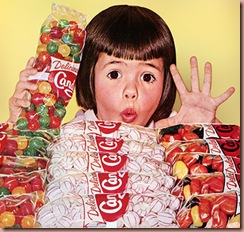
After war-time rationing of sugar, candy (with many other products) had a boom. And a new market: The child themselves. While mummy and Granny may recall tootsie rolls and penny candytootsierollad  amid jars of candy sticks and penny candy, it was a sometimes treat. By 1950’s this same treat was made much more appealing to its target audience.
The bright shiny plastic world of children's candy really started in this decade.
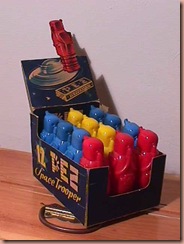
santapexbox  pezrobot Here are the first pez, introduced in 1955. They featured a full bodied robot or Santa.santapez
And not only were candies more exciting and placed for children’s reach in stores, they also began to be specifically marketed to them. From 1949 –1952 Snickers was the sponsor of the Howdy Doody show. Other candy was also advertised at this time. What is interesting is how commercials once began in the late 40’s early 50’s, as part of the programming rather than a separate commercial break, is what many advertisers are now going back to. Here is Howdy and friends extolling the wonderment of the Three musketeers bar
Soon sugar, er that is, Candy began sprining up in all sorts of places. Sure, one could have a coke, but they could be expensive, but if you wanted that sugar rush in a glass, why not get mummy to buy Fizzies!fizzies These would be introduced next year, 1957. Made by the bromo company, that used to offer ‘upset stomach relief’ now they were a kids treat.
And, to be more adult, one had candy cigarettes.candycigarettes Even I recall these as a child in the late 70’s. I remember there were both candy and gum cigarettes. We always preferred the gum variety, as they were coated in powdered sugar under the paper wrapper, and one could blow out and it was like a puff of smoke. Of course, the gum’s flavor suffered for its sugar loss, but we didn’t care. It was fun to play ‘movie star’ and be glamorous. This, however, never made me want to smoke in real life. I have, on occasion, smoked filter less cigarettes for fun, but never more than possibly three individual cigarettes in one month, so I think I could safely say I was not addicted.
Candy even influenced our music. Candy Floss by British Terry Dene. Though somewhat lost on US audiences, as we call it “Cotton Candy”, at least we did in the 1950’s.
And the lovely Chordettes with Lollipop
Now, while searching for the Chordettes version of Lollipop, I found this modern version of a song called lollipop by Lil Wayne. I just put the link as you can decide if you want to watch it. HERE IT IS. I suggest, if you watch it, be cautious of your children in the room. It isn’t as racy as some, but what is amazing to me is the blatant objectification of women. What really burns me is how so many will go on and on about how women were ‘so oppressed’ in the 1950’s and yet feel fine that their teenage sons and daughters watch a rapper as he shows his great wealth. Why look at all he owns, many diamonds (which always surprises me when you consider the amount of young African children who literally die to mine them) big cars and, of course, tons of women, just for him. What a great message for our daughters, you value is in your looks, the amount of possessions you can get from your man. I would put Gentleman Prefer Blondes up against this any day, at least that has a cute moral ending. 
I honestly feel for the current and coming generations. I wish they could have the innocence and the beauty of the old days. Some may think having a door held for one is oppression, I think it good manners. And having a date feel the need to dress up and take you dancing, dancing where you can talk and where beautiful gowns,not bumping and grinding in a loud club that is so boring one needs overt amounts of alcohol and drugs to deal with it.
It might not seem cool now, but I know a girl would love to be treated like that. Why do you think the Disney Princess and the Vampire novels where the young man has ‘old fashioned ways’ and can’t actually do anything to you are so popular? Girls miss romance, but don’t realize it because there is no romance left in the world. They can’t really see it but somehow feel it missing. And the ‘romance’ of modern ‘chick flicks’ are often false tales of some ‘bad boy’ or someone who just happens to ‘turn himself around’. When, really, there are plenty of actual gentlemen in the world that girls could consider right off, but they may not be ‘cool’.
With good manners and consideration, women have lost their place of courteousness in men’s eyes. It is good that we can be seen to be equal in the work place, let’s not go away with that, but this subtle woman as object or something to be conquered attitude that silently permeates our society is rather scary, I think. I don’t know how I would feel if I had a teenage daughter, rather worried I would think.
I promised myself to try and stop the comparison of then and now and continue to focus on only the good of the old days, but in a way, its the good I find that makes the bad today seem so wretched. And somehow it all seems so propagated by a few simply to make money and keep us wanting more. But, I digress…
My point to mention candy today was to do a two or three part post in which I talk about candy making. Something I am now doing, to sell at a local fair with a friend. So, all of that to get to some fun candy recipes tomorrow. My mind does go off on tangents!
Well, tomorrow I will share some recipes and fun images of candy making. Get your candy thermometers out ladies and gents…
Happy Homemaking.

Wednesday, September 22, 2010

22 September 1956 “TV for Australia, the 1956 View of Tomorrow, and Fun Well Behaved Teens”

This month, on the 16th to be exact, Australia finally joined the ranks of TV viewers. It began on the 16th this year, 1956, broadcasting from TCN-9 Sydney. That is where the first TV tower was built in Australia.
Here is an example of some of the opening night sort of Australian Programming. ( I think this must have been from some modern Australian programming looking back to 1956. I thought it almost rude of the native gentleman at the end to laugh and make fun of the woman. I think for a white woman at that time, it is rather fine of her to care about the native culture and to want to study it. We may speak a language not our own with an accent, but it is hardly fitting to poke fun at it.)
While we are on the subject of tv, I thought I would share this little short. It was made by GM, but has some interesting fashions, home and cars. There is a fun part where she is in the ‘kitchen of tomorrow’ so space age. And her costumes for tennis, golf and swimming are adorable. Just a fun little piece to watch.
Here is also a darling film about auto safety. It is worth a watch to see the kitchen (wonderful red stove) great outfits and really well-behaved people, especially teens.
Until tomorrow, Happy Homemaking.

Thursday, September 2, 2010

2 September 1956 “The Telephone”

First off, I am sorry to be posting so late today. But, Hurricane Earl is heading now towards the Cape and will maintain a 2 Status. This requires us to prepare for some very damaging winds and possible multiple days of power outages. I have been to the market and stocked up on a few extra canned goods. We have secured what we could in the yard and have tested all our oil lamps. Hubby has just cut and singed the new wick ends. We are as prepared as we can be.
The telephone has gone through major changes in the past 100 years. Let’s see how those changes are affecting our life here in the 1950’s with this film.
At one point phones did not even have dials. You simply lifted the lever, tapped for attention and then talked to someone to connect you. One day that changed and here is how we were taught to ‘Learn To Dial A Phone” new phone numbers and directories were suddenly issued. And the ‘dial tone’ was born:
By the early 1960’s many new features were being considered.
Now, here in 1956 this is what our lovely new house phones look like. Beautiful colors and much more modern sleek design than 10 years earlier. banjoyellowphone56 (These phone images thanks to vintage rotary phones.)bellad bluephone This color is dreamy and I can picture it on the nightstand in a white and blue and gold bedroom or in the master bath perched on a white and gold ‘French Provencial’ stand.sidetables Something like these, maybe with a pair of these lovely equestrian lampshorselamp It would be dreamy.
pinkphone Of course pink is also lovely.
The phone in 1940’s were more of what we think of when we think of vintage phones. 40sphone They could be had in white/creams but many colors were not really available.
It was interesting to find out that even as late as now, in the mid 1950’s, some rural areas were still in a very antiquated phone system. I found this about the phone system in PA.
Those of you who grew up in cities may be surprised to be told that here in rural Tioga County PA we actually had wall phones with cranks well into the mid 1950s. We had party lines with several households on a line. Each household had its own ring - Ours was a short two longs and a short. People on the party line could call each other by ringing directly, using the crank and the right short - long code. Other calls came through the telephone operator. In Mainesburg, Gladys Smith was the operator and she lived in a house right next door to the store. She was tied to that switchboard 24-7-365, The store delivered her groceries. She had the switchboard in a room right by the kitchen with a cot in the same room. The following article reflects the sense of celebration these communities experienced when dial phones came into their world.
56switchboard This image is from 1956 newspaper: FAITHFULL SWITCHBOARD—Mrs. Bessie Updyke sits by the Millerton central switchboard which she has operated in her home for 11 years. The North Penn Telephone Co. will change over to dial operation in Millerton, and late, in Bentley Creek area (Star-Gazette Photos by Peggy Gallagher)
relays Here the automated relays are being installed and will replace faithful Bessie Updyke.  RELAYS—Howard Selleck, switchman for the North Penn Telephone Co. tests the all-relay dial equipment being installed at Millerton.
Such a change must have really greatly affected peoples lives. To have a system where one is calling a local person, such as Mrs. Updyke, who literally is sitting in her home and knows all in town, to a system run by a machine must have seemed cold. Much like the past decades when our own phone systems became more and more automated. In 2010 it is rather hard to actually speak to a person and when you do they are often in India at call centers. (That really burns me, as well, as if we need even MORE loss of jobs in our country that we even sub out our service calls!) But, I digress. Back to the phone…
We even have a ‘Phone Princess’ here on Cape Cod.phoneprincess This fun image is from a great BLOG about vintage rotary phones.
 teenonphone Of course we cannot forget the latest fad of the teen, far too much time on the phone. This seemed to mostly be a character trait of girls, though I am sure boys did their fair share. Many father’s here in 1956 are often concerned about these ‘long phone conversations’ because their may be a boy on the other end.
Of course, in true 50’s Madison Avenue style, if one phone is good, THREE is better! phonead2
I recall in the 1980’s when answering machines were coming out. That and ‘call waiting’ was seen rather rude by many people. That technology seems like a dinosaur now.
And, of course, we now know in 2010 that a phone is not a phone but a way of life. Text, camera, movie camera, tv, internet, computer, everything rolled into one. This is a common scene I am sure.teenstexting No longer sitting in the front hall on the phone, you are Always on it.
 modernphoneAt least it seems some people are still interested in the past style enough to try and make a compromise.
We have come a long way, but have we gone too far? Is the need to always be online and in contact with everyone actually making what we have to say or how we say it or think it less interesting or intelligent? Letters are gone and now every daily activity is texted and shared. Is it better, I don’t know.
I think a nice phone in the home that rang and was either answered or ignored, may have actually been far enough. I suppose for emergencies it is nice, but didn’t people have emergencies before cell phones? What did they do? How quickly we become so used to our technology that to live without it would be like living without oxygen.  I wonder if there could be a happy medium of a ‘docking station’ in an old phone that your cell phone lives in at home and is treated like a land line. And when you go out, it can be turned off and used only for that emergency? It might be a nice vintage alternative.

Sunday, July 25, 2010

25 July 1956 “Cooking and Life : The New and Old Way.”

56woman'sday This image from June 1956 Woman’s Day shows the Old and New way of cooking (Click to enlarge and Read).
I found it interesting on many levels. First off, we have the comparison of the Old way with an older woman who ‘has the time’ to prepare all her food from scratch. While the ‘new’ way by the younger woman mentions that she most likely is a working woman. So, even here in 1956 it is not completely uncommon to hear of or know working women. I think the idea that all women are at home is probably not true, but it is true that many woman do see being at home with a husband as an actual goal. To modern women this seems an affront or somehow shocking. Yet, I think there are many busy working wives who would gladly become a stay at home, so not sure why we have such a taboo about that.
Secondly, what I found interesting is that myself, since my trip back to the 50’s, have begun to move away from the ‘new’ way shown here to the old way. Surely in 1956 I am older than the young 20 something woman in the article, but I am not as old as the grandmother image. So, I wonder if I would truly, having come through what  I would have come through in history, would probably have a mixture of these two.
It has only been since my voyage back that I have learned to bake bread and cakes from scratch. That I take it in a matter of course to whip up homemade pancakes or waffles for breakfast without Bisquick. Even my veg is more often than not cut up from fresh (especially now that it is summer, come fall and winter I will have more  of my own canned to access).
In the beginning of my project I was all Wonder Bread and Jell-o. I mean, I felt the need to try and use and make the old pre-packaged things available. What I now think is rather spot on, is that in so doing I probably did recreate what I would have done. I would have been intrigued by the new. I would have tried it and found that it was okay, but not comparable to homemade, which I would have been used to and grown up with. So, I gradually moved back to the ‘old way’. Of course in reality I was just learning the way to make more things from scratch, but you know what I mean, the 50’s me was simply, “returning to the old way”.
wonderad It’s very easy to cook the NEW way here in 1956. There are so many things pre-made for my convenience.hashad miraclewhipad
nescafead I don’t even have to wait to brew coffee the old fashioned way if I don’t want (though the flavor is different as is the price). Even our sweet drinks are easy and plentiful, no squeezing lemons or crushing fruit to make summer drinks. Of course the result, they are easier to have and will increasingly be in our children's hands as time goes by and so increases their waistlines and diabetes. Yet, simply being responsible with such easy products could be useful and not harmful, but with ease comes disinterest and laziness. Who knows what kids are drinking, I can’t be bothered, I have to work and get home and nuke dinner.
So, what I really see happening here in 1956 is rather similar to 2010. There is a new crop of young wives and teens who are going to grow up with this instant world. Here they will become used to such ease and will slowly leave off the domestic arts. Today in 2010, the young do not know a world without the internet and digital devices. The old way for them, talking to someone in person rather than texting, or writing a paper after reading a book or going to the library rather than cutting and pasting info from websites and sites such as SPARKNOTES so they don’t even have to read the entire book. Again, I find the parallel between then and now. The threshold to the modern world truly lives here in 1950’s. The choices we make, however, leads us to where we are now, but if we go back and try new choices, reset the clock as it were, can we change our own modern reality and the way we make choices? It seems, at least by my reckoning, that we can.
I think the happy medium I have now between these Old and New way of cooking described in this article is a good balance. I honestly enjoy taking the time to steam my own asparagus and make hollandaise from scratch as described in the old way, but if I were in a rush and many things planned, I could easily use frozen veg, but instead would have made my own homemade ahead of time and kept it in the ice box. And I think that is the glaring difference. I have learned, as my 50’s counterpart would have inherently known, to plan for that rainy day.
There is no prep work any more. We don’t think ahead about our savings and retirement, let alone our dinners. Even our government these past ten years has been so shortsighted and has planned for nothing to the point that we are now borrowing to pay for the care of our elderly in Medicare and Medicaid. So, when even our own government and parents are completely oblivious to the adage “a penny saved is a penny earned”. So, if we are all happy to live in debt and to simply exist from moment to moment with no thought of tomorrow, no wonder it is so easy to slide into this ‘new way’ of cooking. It is in comparison not as extreme here in 1956, but I can tell you as an older homemaker, I would most likely look at my younger married nieces or friends and think, “Hmmm, this must be from a box” or “In my day, we’d have shucked our own peas and used butter not margarine”.
There will always be the contrast of the old vs. the new, but what I have come to realize is that rather than it be a war of who wins, it if it is a great learning experience of what works best for me and for our future (and not just my future, the world  for others as well) then that is the right path. We like to think there is no ‘right path’ and that we can, we modern people, do whatever we like. I think we are coming to find in our environment, politically, financially, environmentally, and in the family unit, that is not true. That same lesson keeps coming back to me again and again:REPSONSIBILITY. Every time I uncover more aspects of 1950’s it is always there, staring up at me with its knowing eyes. Be responsible for yourself and your actions and the world around you will be better.
That’s a lot of realization from plucking your own chicken, I know, but that is how it comes to me here in 1956. And, now I am even considering the older old way, the way of my own fictional grandparents here in 1950’s, raising my own chicken to kill and pluck. It all leads down a path of what is doable and makes sense for you and also helps out the bigger picture. Whenever I stop and think about the modern world and our current financial situation of debt both amongst our people and the insanity of our government, I can feel helpless. I can almost feel that modern, “Oh well, can’t fix it, just use up what you want, get a joy ride and go out in a ball of fire” attitude that seemed to prevail from the late 1960’s to now. Yet, I realize, my own actions can make a difference in my sphere and if it is infectious enough to bleed out to others, than one never knows. At the end of the day, when I am stuffing my chicken and making my potatoes from scratch, I feel connected to my home and my food. I feel the positive result in my bankbook, as it really is cheaper to cook from the basics, and I feel a sense of accomplishment and a hope. That is another main element I have learned here in the 1950’s, HOPE. There is a joy to a new day to learn more and want to keep growing both in my skills and in my education. The Old modern me would often face a day with ‘well, what do i do today’ even when I was a busy working woman, my free time was often just spent wasting away in front of the tv or buying things I didn’t need and couldn’t use because I was too busy working anyway.
So, take what you will from this article on the New and Old way of cooking, but do consider Responsibility and Hope, no matter what decade you live in,  as a good recipe for a happy life.
Happy Homemaking.

Thursday, July 1, 2010

1 July 1956 “Oh, You Beautiful Doll”

I thought today, in honor of our July Apronite of the Month on the Site, (Yes, we are back to honoring Apronite’s, so check that out on the site’s main page) I would post some adverts for 1950’s dolls, Enjoy.
dollad1 This appears to be a knock off Barbie (who came to life in 1959 at the end of the decade)dollad2
dollad3 dollad4
dollad5 This is a doll of a character from the popular children’s show, Howdy Doody,  Princess Summerfall Winterspring
Wouldn’t YOU like to have a Shirley Temple Doll?
Paper dolls, too!
And of course, who can forget Barbie? Though she really only appeared at the end of the 1950’s. Just imagined if she started in 55, the clothes would have remained wonderful.
Did you have a favorite doll or toy as a child?

Sunday, February 14, 2010

13 February 1956 “My ‘New’ Best Friend, Dress Planning and Some Recipes”

I would like to introduce you all to my new best friend:singer5001 singer500 Isn’t she a beauty? Since my sewing machine breakdown in January (which resulted in my borrowing a friend’s machine so I could do my January Dress Challenge.) I began researching the ultimate Vintage Machine.
In my research I found that the Singers up until the mid 1960’s were all steel work horses made in the USA.
I had at first thought to get the coveted Singer 401.singer401 These were from the mid 1950’s and are a coveted work horses. It’s abilities to sew through layers of leather and heavy sailcloth, the strong steel construction and the amount of various feet for different jobs keep that at around $300.00 or so in good condition on eBay ( or cheaper if you are lucky to find one locally at a yard sale!) I began to see the 500, which was called the “ROCKETEER”. I found, for some reason, that these tended to sell for less, despite the fact that they are the same machine inside and out (though I actually like the exterior Design of the Racketeer) and that it has a few more stitch abilities than the 401.
I had been squirreling away money here and there from grocery shopping and my ‘weekly allowance’ (I do the books for our marriage and give, based on my budget, a weekly ‘allowance’ of cash to hubby and I to spend or save for ‘niceties’ as we like). I finally came across a 500 at an incredible price (they are usually around the $200 range on eBay) with all the feet, the cams(that let you do different stitches etc) and original instruction booklet. So, I ordered it and have been waiting patiently for a week. I have even kept my mouth shut here on the blog and the forums, as I did not want to talk about it until it was in my hands!
I have to say, so far, I am not disappointed. It is a beautiful machine. I read an article that said to get a modern machine of this quality and abilities today would be around $2000.00. And to think my machine was made around 1950/60 and it still works wonderfully is a lot to say about its construction. There is not ONE plastic part. IT is all steel built in the USA. Even the feet are of such quality metal it feels as if they may have used silver in their makeup (they have the feel of an old quarter compared to a modern quarter).
You can really see why a homemaker of yesterday really appreciated her sewing machine. This machine was the top of the line in its day and would have been close to 1400 dollars, so would have been a major investment like a car. But, when you consider what you could do with it. There was no Old Navy to go to, so clothes handmade were a savings as were house goods, as curtains, tablecloths, you name it. We are lucky today to have at our disposal the well made wonderful machines of yore to be had at affordable prices. The sewing machine was really a tool that gave a woman endless creative outlet as well as the power to clothe her family and dress her home and anything her little heart could desire. An entire art school/studio space all rolled into a few pounds of steel!
Besides basic stitching, there are endless ‘specialty’ stitches for decorative as well as bindings etc. I was also lucky to get all the feet it came with as well as a specialty foot for embroidery, that I am very excited about. Though I have only tried it a bit, I think it will really be a great way to do pockets and decorations on aprons, skirts pillows etc. I also can envision some fabric art happening. Here it is, you can see it has a little spring and a guide to help hold things in place. embroideryfoot I really just  did a little filling in for practice, but it works wonderfully. The little foot bed under the needle raises up for embroidery work and for darning of socks/sweaters any thing that needs mending (there is even a mending setting which shows how much this type of machine would mean to a homemaker).
Here are two feet that I am excited to try: First is the Binder Foot.binderfoot (click to enlarge) this is a wonderful attachement, as it not only makes a folded roll hem, but you can feed bias tape over the edge as well. This allows for there to be a finished hem edge of bias tape with a decorative stitch if you wish. Wonderful possibilities for this.
The second foot is the Ruffler foot: rufflerfoot This contraption looks like something out of science fiction. Here are the wonders it can make: Ruffles (obviously, hence the name)rufflerfoot2 And these lovely pleats:rufflerfoot3 I have made a few skirts with simple pleats, but I had to hand pin all of them. I also think the second picture with the ‘group pleating’ would make a lovely Valence/Pelmet for a curtain topper, don’t you think?
I promise myself to slowly learn the intricacies of this machine. Right now my sewing skills involve, sewing a straight stitch back and forth. I have never even used a zipper foot (just the standard foot, but looking at the zipper foot, I can see how much easier it shall be). This also came with a wonderful Buttonholer, which seems an interesting machine. But, I want any of you out there who have not sewn before to realize, you can do it. I have had NO ONE teach me to use the machine. I have taught myself the simple things I can now do with it, yet have made dresses and skirts and aprons for myself. I want, know with my wonderful Singer ROCKETEER, to be able to make curtains and slipcovers and better tailored clothes with details etc.
In fact the first ‘challenge’ with my machine is to use the Ruffler foot to so pleats in my February Dress Challenge and to also make ruffles and make myself a new bathroom curtain. I shall share, of course, the success or failures and the ‘how to’ with you.
For my February Dress Challegne (as I want to keep them somewhat simple how-to’s for beginners, as that is what I am) will be taking a men’s shirt, here I bought this lovely chocolate brown one for 5 dollars at a local shop.brownshirt and these few yards of this lovely pink and brown cotton.pinkbrownfabric Here, for scale, you can see the print and the shirt cuff together.pinkbrownfabric2 So, my plan is to take the shirt and the fabric and make a dress. I will add darts to the shirt as need be to make it ‘fitted’ and the skirt will be hemmed and attached to the shirt. And to tie the dress together I will take excess pink fabric and either add to the shirts cuffs or collar and possibly a pocket square. IF it turns out is should be similar to this.shirtwaist1 I could even shorten the sleeves, as they have them here  and add the skirt trim as the shirt cuffs.shirtwaist3 Here you can see a darling belt. I might make one with the pink fabric and can use one of the buckles I got in my goodies from Ann’s Estate Sale.  So, I am hoping this turns out. I think if it does, I will be scouring resale shops for nice men’s shirts and can have an arsenal of easy to wear clothes for ‘daywear’ or even good ‘housedresses’.
Now, onto some cooking.
fannie farmer
I have often referred to  and used my Boston Cooking School Cookbook in 1955 and this year as well. My copy is from early 50’s but I just found online HERE that this original book is free to read online! You should check it out.
Last night I made my own soup invention. “What Came First Soup” Hubby named it, as it is egg drop soup with chicken in it, so both the chicken and the egg.
“what came first soup” (named by hubby)whatcamefirstsoup
4 cups chicken broth, divided (so easy to make your own broth by boiling chicken-even better with bone in-in water, add spices, then you have the chicken and broth to make the soup.
1/8 teaspoon ground ginger
chopped and cooked in butter garlic ( a few cloves)
Broccoli
(This is REALLY good with chives, but I had none in the house)
Dash of cayenne pepper
Salt and Pepper to taste (about 1/4 –1 tsp each)
1 1/2 tablespoons cornstarch
3 eggs
cooked chicken

Directions
  1. Reserve 3/4 cup of chicken broth, and pour the rest into a large saucepan. Stir the salt, ginger, garlic, broccoli  into the saucepan, and bring to a rolling boil. In a cup or small bowl, stir together the remaining broth and cornstarch until smooth. Set aside.
  2. In a small bowl, whisk the eggs together using a fork. Drizzle egg a little at a time from the fork into the boiling broth mixture. Egg should cook immediately. Once the eggs have been dropped, stir in the cornstarch mixture gradually until the soup is the desired consistency. Pouring the egg through the fork gives it the long strands you see in restaurant egg drop soup. I usually give a good stir to the pot to get it going in a circular motion and then pour the eggs through the fork.
I served this with these lovely biscuits. They rise so wonderfully. I can’t even remember where I got the recipe, but it is a great one, so give it a try. I take the extra dough when I make these and roll sugar into them and shape scones and brush them with cream and sprinkle sugar and they make a great breakfast scone as well. biscuits2
Best Biscuits
Ingredients
  • 2 cups all-purpose flour
  • 1 tablespoon baking powder
  • 1 teaspoon salt
  • 1 tablespoon white sugar
  • 1/3 cup Butter (5 1/3 TBS)
  • 1 cup milk
Directions
  1. Preheat oven to 425 degrees F (220 degrees C).
  2. In a large bowl, whisk together the flour, baking powder, salt, and sugar. Cut in the butter until the mixture resembles coarse meal. Gradually stir in milk until dough pulls away from the side of the bowl.
  3. Turn out onto a floured surface, and knead 15 to 20 times. Pat or roll dough out to 1 inch thick. Cut biscuits with a large cutter or juice glass dipped in flour. Repeat until all dough is used. Bake on a paper lined baking sheet.
  4. Bake for 13 to 15 minutes in the preheated oven, or until edges begin to brown.
So, I hope you are ready for some new sewing challenges ladies! Until next time, keep those aprons on and march into ACTION!
 Search The Apron Revolution