Wednesday, February 17, 2010

17 February 1956 “Waste Not Want Not, A New Movie and Composer, The BREAD Quest”

womanwithbread I have started baking more of my own bread. It has been something I have wanted to work into my normal weekly routine. So, since this has been happening the past two weeks, I have not bothered to buy any new bread. Then, this morning, as I was retrieving the homemade bread (this one is a whole wheat bread, recipe below) I realized I had somehow forgot to remove the leftover store-bought bread in a bag in the bottom of my large tin bread bin.

I took it and and there was a bit of mold, so I simply took a knife, cut off that bit and tossed it into the yards for the birds and proceeded to cut up the rest into little chunks. I put it back into its original bag and popped it into the fridge to use. I figured, I will make a meat loaf tonight and can use that as filler.

This was all a simple little act that took not much decision and a few seconds of my morning. But, in the middle of it I was suddenly struck by what I was doing. I imagined myself a year ago, 1955, first learning and just getting my toes wet into the ‘ways of the Homemaker’. I think it very nice that such things are more natural or second nature. Really, it took very little more time that just tossing it away and it also made me think ,”How shall I use it? Stuffing? Filler? Croutons?” and that helped me to cement my dinner menu plans.

The old me would have tossed it without thinking. I sometimes shudder when I think of the amount of waste I used to create. It isn't’ even an issue of ‘being green’, but really just common sense. Even if bread is cheap and readily available at any store, why should I toss out any good bread and have to spend more money? But, we modern people, as a whole (I know most of you, my readers, are very smart Homemakers that could probably teach me a thing or two and believe me, I would be glad for the lesson)but as a whole we are a wasteful lot.

Now, I don’t want to go off on some tangent about how we are such bad modern people and we should do this or that. I just really thought it an interesting observation I had while about my ‘busy’ work this morning in my kitchen. I am often finding myself going along as if I have always lived this way and then little memories of ‘before 1955’ slip in and I think, “Wow, I have come a long way”.  I am still amazed at how completely we can change our view and actions. Persistence, determination, work seem to result in real change. That makes me feel good and more in control of my life.

Yesterday the 16th, here in 1956, the movie Carousel opened.

This Rodgers and Hammerstein play had great success on the stage and this was it’s film debut staring Gordon MaCrae and Shirley Jones.

Today, The Second Symphony of Chilean composer Juan Orrego-Salas receives its world premiere in Minneapolis, Minn. I could not find the second symphony, but this is nice and you can hear both the discordant sound of a ‘modern’ composition, but mingled with a sweet promise of the piano that seems to me often true of the 1950’s. The shattered way in which it came about from the war, the continued rationing, housing shortage and yet the promise and hope of a new tomorrow.

 craftmag56 This 1956 Craft Horizons magazine from this month, ‘56, seems so modern. The organic shapes and the lightness of material could easily be seen in any up market shop or gallery today.


As mentioned at the beginning of this post, I have been on a sort of ‘Bread Quest’, making and trying every recipe for bread I can get my eager little fingers on. As with most things I have discovered from 1955, once you just try a thing, just set aside the modern notion of, “Oh, when I have time” or “Well, when I get around to it I  will…” and fill in the blank. That was me very often. Now, I often find myself saying I want to try something and then the modern me might chime in and say, “well, after this or that” and then I turn and say to that part of me, “Now, come one. No time like the present, just get in there and do it!” I often have to be rather stern with myself, but I do learn in the end and anyway, my reward is a warm piece of bread!

Well, this ‘Bread Quest lead me to the recipe. It was a whole wheat bread and was really dense and wonderful, but it did not rise properly. I was not familiar with this form of bread recipe and was confused by its directions to make the ‘sponge’ and wait until it was bubbly.

Well, the sponge was the yeast and some white flour and warm water set in a warm place “ ‘till bubbly and light” which is certainly open for much interpretation. The recipe was rather vague about directions and it’s method called the yeast flour mixture a ‘sponge’ and I think I did not let that get ‘bubbly’ enough. It did get a little bubbly, and the this was a ‘no-knead’ bread, so I already felt as if I was cheating somehow. It did rise, but I don’t think I let it rise enough. However, the resluting little dense rectangular loaf was lovely!

My hubby even told me he shared half a slice with a co-worker who was eyeing his lunch. This happens a lot to hubby and he often gets a few people anxiously asking, “Oh, what did you get today?” recalling days of childhood sat at long tables littered with little brown bags and trading of Twinkies and ho-ho’s with the kid whose mother ‘baked’. The coworker took a bite, looked at hubby and said, “This is the best bread I have ever eaten”.

woman with sliced bread This made me smile, because I certainly knew it was NOT the best bread I have ever baked and I really have only been baking bread a few months total. I would sporadically try it in 1955, but was often left telling myself my 1955 counterpart would have happily filled her cart at the new Grocery stores with sliced bread. Even the saying, ‘better than sliced bread’ told of the greatness of the enriched pre-made loaves of the day. But, I digress…

The bread, though not properly risen, was good.

Here it is.wholewheatbread It is a sad little rectangle loaf, but really good. It made me think of images I had seen of the ‘national loaf’ they had used in the UK during the war which was made from potato flour and was suppose to be in taste, similar to cardboard. Mine, however, was really good.

Here is the recipe I used:

EASY WHOLE WHEAT BREAD
1 c. warm water
1 1/2 c. flour
1 tbsp. sugar
3/4 tsp. salt
1 env. yeast
1/4 c. hot water
1/4 c. brown sugar
1 1/2 tbsp. shortening, melted
1 1/2 c. whole wheat flour
Mix hot water with brown sugar and shortening and cool to lukewarm.
Mix first 5 ingredients and beat until smooth. Set in warm place, free of drafts, until light and bubbly.
Add the lukewarm mixture to the sponge and mix well. Add the whole wheat flour and beat smooth, but do NOT knead. Place in one greased loaf pan and let rise until double in bulk. Bake at 350 degrees about 45-50 minutes.
As this is a sponge type of dough, be careful not to move or shake the pan while rising.

So, I began, as I often do, to do some research. What was this ‘sponge’ of which the recipe spoke? So, I did some research and found an answer in another bread I have been wanting to try: Sourdough Bread.

Now, the making of bread for me has a three fold directive. First, I enjoy it. The making of food, I have found, is not unlike the creative process in a studio or art class. It is both tactile and cerebral. Secondly, the taste is far superior to anything I can buy and the quality is good and healthy as I know what is going into the food. And, finally, cost effective. I often find homemade can mean less money. Yet, with bread, the cost of each loaf would always be so highly affected by the cost of yeast, it does not seem to come cheap. So, with my research into the infamous bread “sponge”, my piqued interest in the realm of sourdough, I found the answers to both those questions.

First, the SPONGE: this is for all intents and purposes a bowl of warm fermented batter. Setting a bowl of this ‘sponge’ in a warm place to let it ferment or ‘proof’ is what was needed for my bread recipe. It was not clear about the time and I see now I did not let it ‘proof’ long enough. It can take only an hour or two or up to 6-8!

Now, my sponge was made by using store bought yeast added to flour and warm water. As I researched the sponge I found I had stumbled onto sourdough bread making. Wonderful, one path hooks to another trail I had hoped to follow ( I find this happening a lot in homemaking skills).

Now, I love sourdough bread and really had no idea what it was made from. I assumed, sour milk? Well, I was wrong. The wonderful thing is you make sourdough bread with a ‘sponge’ and the ‘sponge’ is a living thing you create and keep and feed. The best part is, you don’t need to start with store bought yeast.

Basically, from what I understand, it is a cup of warm water and flour and then over a few days your ‘feeding’ it gives you the starter that you then can keep and use and add to forever! This was an exciting find. This would and could help in overall cost and also be rather fun. Like a little helper, quietly growing in my icebox.

So, I have not made this sourdough starter to make my ‘sponge’ as of yet, but it is the next bread quest. I shall share my results and pictures of it and if it works, I may have a new little friend around the house, my little ‘starter’ happily residing in an old crock in my ice box that I can occasionally feed.

It really does begin to bring you closer to our connection with food. We modern people really are separated from the source and chemistry of what we eat. It is probably good we are, because when we begin to look at what is in what we actually eat, all the store bought pre-made, it can be a bit disconcerting. I am not sure, in this case, if ‘ignorance is bliss’. But, just as keeping your own chickens, gathering those eggs and using them makes a connection and a realization between animal and food, so to does bread making. I begin to see how with a small arsenal of flour, butter, eggs, milk etc you have the key ingredients to so many things. At one point in our distant past, this was our arsenal of food. We needed food, we didn’t just want to eat the grass and raw kill, so we, (We women I might add!) began to mix and meld and create. Food was born. Dishes made and created. The fresh smells of bread and food cooking, the very basic nurturing scent that makes all of us, close our eyes, inhale and think, “Ahhhhh”.

Forget aromatherapy candles and odd bamboo sticks sat in glass bottles filled with odd oils to soothe your frazzled nerves. Take two minutes to throw together an easy bread recipe (This one is good) and when it begins to rise and then bake, grab that magazine, a cuppa and sit back and let the relaxation begin.

Sunday, February 14, 2010

13 February 1956 “My ‘New’ Best Friend, Dress Planning and Some Recipes”

I would like to introduce you all to my new best friend:singer5001 singer500 Isn’t she a beauty? Since my sewing machine breakdown in January (which resulted in my borrowing a friend’s machine so I could do my January Dress Challenge.) I began researching the ultimate Vintage Machine.
In my research I found that the Singers up until the mid 1960’s were all steel work horses made in the USA.
I had at first thought to get the coveted Singer 401.singer401 These were from the mid 1950’s and are a coveted work horses. It’s abilities to sew through layers of leather and heavy sailcloth, the strong steel construction and the amount of various feet for different jobs keep that at around $300.00 or so in good condition on eBay ( or cheaper if you are lucky to find one locally at a yard sale!) I began to see the 500, which was called the “ROCKETEER”. I found, for some reason, that these tended to sell for less, despite the fact that they are the same machine inside and out (though I actually like the exterior Design of the Racketeer) and that it has a few more stitch abilities than the 401.
I had been squirreling away money here and there from grocery shopping and my ‘weekly allowance’ (I do the books for our marriage and give, based on my budget, a weekly ‘allowance’ of cash to hubby and I to spend or save for ‘niceties’ as we like). I finally came across a 500 at an incredible price (they are usually around the $200 range on eBay) with all the feet, the cams(that let you do different stitches etc) and original instruction booklet. So, I ordered it and have been waiting patiently for a week. I have even kept my mouth shut here on the blog and the forums, as I did not want to talk about it until it was in my hands!
I have to say, so far, I am not disappointed. It is a beautiful machine. I read an article that said to get a modern machine of this quality and abilities today would be around $2000.00. And to think my machine was made around 1950/60 and it still works wonderfully is a lot to say about its construction. There is not ONE plastic part. IT is all steel built in the USA. Even the feet are of such quality metal it feels as if they may have used silver in their makeup (they have the feel of an old quarter compared to a modern quarter).
You can really see why a homemaker of yesterday really appreciated her sewing machine. This machine was the top of the line in its day and would have been close to 1400 dollars, so would have been a major investment like a car. But, when you consider what you could do with it. There was no Old Navy to go to, so clothes handmade were a savings as were house goods, as curtains, tablecloths, you name it. We are lucky today to have at our disposal the well made wonderful machines of yore to be had at affordable prices. The sewing machine was really a tool that gave a woman endless creative outlet as well as the power to clothe her family and dress her home and anything her little heart could desire. An entire art school/studio space all rolled into a few pounds of steel!
Besides basic stitching, there are endless ‘specialty’ stitches for decorative as well as bindings etc. I was also lucky to get all the feet it came with as well as a specialty foot for embroidery, that I am very excited about. Though I have only tried it a bit, I think it will really be a great way to do pockets and decorations on aprons, skirts pillows etc. I also can envision some fabric art happening. Here it is, you can see it has a little spring and a guide to help hold things in place. embroideryfoot I really just  did a little filling in for practice, but it works wonderfully. The little foot bed under the needle raises up for embroidery work and for darning of socks/sweaters any thing that needs mending (there is even a mending setting which shows how much this type of machine would mean to a homemaker).
Here are two feet that I am excited to try: First is the Binder Foot.binderfoot (click to enlarge) this is a wonderful attachement, as it not only makes a folded roll hem, but you can feed bias tape over the edge as well. This allows for there to be a finished hem edge of bias tape with a decorative stitch if you wish. Wonderful possibilities for this.
The second foot is the Ruffler foot: rufflerfoot This contraption looks like something out of science fiction. Here are the wonders it can make: Ruffles (obviously, hence the name)rufflerfoot2 And these lovely pleats:rufflerfoot3 I have made a few skirts with simple pleats, but I had to hand pin all of them. I also think the second picture with the ‘group pleating’ would make a lovely Valence/Pelmet for a curtain topper, don’t you think?
I promise myself to slowly learn the intricacies of this machine. Right now my sewing skills involve, sewing a straight stitch back and forth. I have never even used a zipper foot (just the standard foot, but looking at the zipper foot, I can see how much easier it shall be). This also came with a wonderful Buttonholer, which seems an interesting machine. But, I want any of you out there who have not sewn before to realize, you can do it. I have had NO ONE teach me to use the machine. I have taught myself the simple things I can now do with it, yet have made dresses and skirts and aprons for myself. I want, know with my wonderful Singer ROCKETEER, to be able to make curtains and slipcovers and better tailored clothes with details etc.
In fact the first ‘challenge’ with my machine is to use the Ruffler foot to so pleats in my February Dress Challenge and to also make ruffles and make myself a new bathroom curtain. I shall share, of course, the success or failures and the ‘how to’ with you.
For my February Dress Challegne (as I want to keep them somewhat simple how-to’s for beginners, as that is what I am) will be taking a men’s shirt, here I bought this lovely chocolate brown one for 5 dollars at a local shop.brownshirt and these few yards of this lovely pink and brown cotton.pinkbrownfabric Here, for scale, you can see the print and the shirt cuff together.pinkbrownfabric2 So, my plan is to take the shirt and the fabric and make a dress. I will add darts to the shirt as need be to make it ‘fitted’ and the skirt will be hemmed and attached to the shirt. And to tie the dress together I will take excess pink fabric and either add to the shirts cuffs or collar and possibly a pocket square. IF it turns out is should be similar to this.shirtwaist1 I could even shorten the sleeves, as they have them here  and add the skirt trim as the shirt cuffs.shirtwaist3 Here you can see a darling belt. I might make one with the pink fabric and can use one of the buckles I got in my goodies from Ann’s Estate Sale.  So, I am hoping this turns out. I think if it does, I will be scouring resale shops for nice men’s shirts and can have an arsenal of easy to wear clothes for ‘daywear’ or even good ‘housedresses’.
Now, onto some cooking.
fannie farmer
I have often referred to  and used my Boston Cooking School Cookbook in 1955 and this year as well. My copy is from early 50’s but I just found online HERE that this original book is free to read online! You should check it out.
Last night I made my own soup invention. “What Came First Soup” Hubby named it, as it is egg drop soup with chicken in it, so both the chicken and the egg.
“what came first soup” (named by hubby)whatcamefirstsoup
4 cups chicken broth, divided (so easy to make your own broth by boiling chicken-even better with bone in-in water, add spices, then you have the chicken and broth to make the soup.
1/8 teaspoon ground ginger
chopped and cooked in butter garlic ( a few cloves)
Broccoli
(This is REALLY good with chives, but I had none in the house)
Dash of cayenne pepper
Salt and Pepper to taste (about 1/4 –1 tsp each)
1 1/2 tablespoons cornstarch
3 eggs
cooked chicken

Directions
  1. Reserve 3/4 cup of chicken broth, and pour the rest into a large saucepan. Stir the salt, ginger, garlic, broccoli  into the saucepan, and bring to a rolling boil. In a cup or small bowl, stir together the remaining broth and cornstarch until smooth. Set aside.
  2. In a small bowl, whisk the eggs together using a fork. Drizzle egg a little at a time from the fork into the boiling broth mixture. Egg should cook immediately. Once the eggs have been dropped, stir in the cornstarch mixture gradually until the soup is the desired consistency. Pouring the egg through the fork gives it the long strands you see in restaurant egg drop soup. I usually give a good stir to the pot to get it going in a circular motion and then pour the eggs through the fork.
I served this with these lovely biscuits. They rise so wonderfully. I can’t even remember where I got the recipe, but it is a great one, so give it a try. I take the extra dough when I make these and roll sugar into them and shape scones and brush them with cream and sprinkle sugar and they make a great breakfast scone as well. biscuits2
Best Biscuits
Ingredients
  • 2 cups all-purpose flour
  • 1 tablespoon baking powder
  • 1 teaspoon salt
  • 1 tablespoon white sugar
  • 1/3 cup Butter (5 1/3 TBS)
  • 1 cup milk
Directions
  1. Preheat oven to 425 degrees F (220 degrees C).
  2. In a large bowl, whisk together the flour, baking powder, salt, and sugar. Cut in the butter until the mixture resembles coarse meal. Gradually stir in milk until dough pulls away from the side of the bowl.
  3. Turn out onto a floured surface, and knead 15 to 20 times. Pat or roll dough out to 1 inch thick. Cut biscuits with a large cutter or juice glass dipped in flour. Repeat until all dough is used. Bake on a paper lined baking sheet.
  4. Bake for 13 to 15 minutes in the preheated oven, or until edges begin to brown.
So, I hope you are ready for some new sewing challenges ladies! Until next time, keep those aprons on and march into ACTION!

Friday, February 12, 2010

12 February 1956 “Lucy’s Connecticut Kitchen, More Kitchen Ideas, and Some Bread Recipes and Results.

After my last post I didn’t want anyone to think I don’t enjoy and appreciate the value that entertainment, such as TV and movies, can have. I do enjoy that form of entertainment, but before 1955 I found myself using it as a means to ‘forget about not doing anything’ rather than as a means of pleasure and learning.
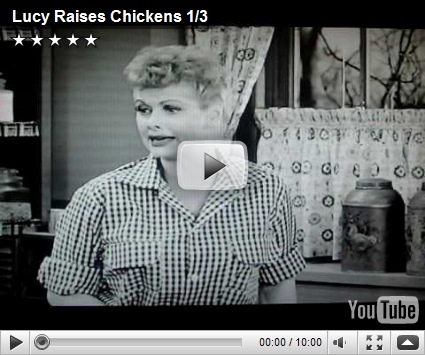
On my kitchen post the other day, someone reminded me of one of my favorite I Love Lucy episodes, where she raises chickens. Those episodes, when Lucy  and Ricky move to Connecticut, are my favorite. It also made me realize how I DO want to use mid-century Early American in my own Kitchen Redo. Here, let’s look at part of the show.
Obviously this IS a 1950’s kitchen, as this is the 1950’s and they are in a designed kitchen space. I love the toile work cannisters on the window sill. The fabric is very Early American. The shelf paper in the open cabinets and clear glass jars. The old cookstove for heat and ambience. The lovely big round farmers table with a built in lazy susan. Even the wrought metal “L” brackets and handles on the cabinets. I would LOVE to know what color those cabinets were painted. I bet either a ‘colonial Blue’ or a ‘Buttercup Yellow”.
In one of my American Home magazines from mid 1950’s there was a lovely article about just such an “Early American” style kitchen. The owner was a happy grandmother, who collects Colonial antiques adn so wanted her kitchen to be authentic looking but modern and functional. It is an interesting look on their take on mixing old and new in mid 1950s.
countrykitchen1 Here you can see her with the item I have been contemplating, wall ovens. It is true you would need to stoop for the bottom oven, but for the most part you would use the top. It would be nice to have a cake, roast and bread all cooking at once and this does happen to me at times, though I have to have things wait ‘their turn’ to bake. I love that she has a working fireplace in the kitchen.
countrykitchen2 This same kitchen also has a main working area for dishes and ice box, table and where the cook top resides is a darling bar where she served her grandchildren lunch. This sort of separation between the cooking and prep areas with a view of the fire at the kitchen table is rather a nice set up. I love the wall and trim color she used and you can see it is matched in the Formica counter tops. I know they are Formica, because as I was thumbing through another magazine, I saw what looked very familiar to this kitchen. So, I compared the two and it was. They used the kitchen in this ad.formica ad You can click to see it enlarged. It gives a better view of the counters. It even shows a slip of the other aspect this kitchen has that I love, a Greenhouse.countrykitchengreenhouse Here is the picture from the original ad with the lovely lady in a darling blue flowered dress as one of her grandsons comes down the back stairs into the kitchen. I particularly like this kitchen, as it has the ‘Early American’ hardward on the cabinets. Even the doors to the powder room and the built in pantry (located next the wall ovens) have the actual old Colonial type hardware.countrykitchendoors You can see the latch style door handles on the powder room, this is the type of doors and handles in our 1718 cape we now live it. The doors are very thin but made from wide old hand planed planks and no knobs but these latches. So, this form of a 1950’s kitchen is beginning to be the ‘model’ of ideas I will most likely use in my own remodel. I have more photos and info on this kitchen that I will be sharing in the future as we discuss kitchens and my eventual remodel.
Even if you do not love the mid-century version of a Colonial kitchen a very ‘Country’ air can be had while still making a Vintage Mid-Century look and still have it feel rather modern. For example:bluecountryktichenThis kitchen has a definite country feel, though not necessarily Early American. It is rather ‘country modern’ Country in its paneled doors and use of blue and things like the potato bin. But, the sharp red contrast interiors the the bold wallpaper give it a very modern feel. I have to say, I am really beginning to love the idea of wall ovens, but not sure one tucked in the corner like this is such a great idea.
Perhaps it is because I am a New Englander, but there is something about the Cape Cod style house or it’s bigger cousin, the colonial, that has a ‘homey’ feel. In America’s early days as an English Colony these were the styles of choice, as they were easier, inexpensive to build and had the advantage of being easy to add onto. The Saltbox was often the result of a Colonial with an added room off the back giving it the steep roof in back. saltbox colonial  These house styles were  also familiar to the transplanted Englishman from the hamlets and shires of his homeland.
After WWII, the baby boom also meant a building boom. Many returning soldiers were becoming families and there was a housing shortage. So, in steps  the Cape Cod style. It’s efficiency in building and its ability to have an unfinished attic or 1/2 story that can easily be ‘done over’ when money permits and the family size increases, made it again the perfect American House style.
If you were not lucky enough to have the ‘real deal’ and live in a colonial original cape style, then the coveted architect of the period Royal Berry Willis was the man for the job. His firm still exists today and the esthetic of the ‘Early American’ house still lives on. This bit about him on Wikipedia does a good job of describing  him:
Royal Barry Wills (1895 – 1962) was a preeminent Boston architect and author. He was the master of the Cape Cod style house, in its Colonial Revival incarnation (1930s to 1950s).
The "cape" house is ubiquitous in New England and elsewhere, due in part to its simplicity which sometimes simply means "inexpensive" but also allows for versions that are pure elegance due to their distilled, crystalline nature as a perfectly refined product. Will's unmatched talent was that of bringing a level of refinement to every level of planning and detail for the cape model.
In 1938 Life magazine selected four modern architects and four traditional architects and had them prepare home designs for families in four income categories. In the category for people with $5,000 to $6,000 incomes, the modern design was by Frank Lloyd Wright and the traditional one by Royal Barry Wills. The family chose the Wills house over the Wright design, and the home was built in Edina, Minnesota.
Houses built to his designs still fetch a premium in the Northeast.
So, rather you have a hooked rug, or some copper pots, that old coffee grinder or even a lovely 19th cook stove in your kitchen, there is much to be said, modern or vintage, for infusing ‘Early American’ elements into your kitchen design. I am going to continue to discuss and show images of this Early American movement in the 1950’s in future posts and to highlight in on the website in the future.
Now, again, what happens in kitchens? Exactly, recipe time…
I tried two new bread recipes the other day. The first is a lovely oatmeal and honey bread that is so divine, you must try it. This was the first time I had done this bread and in the future I belive I will let it rise a little more the second time before I bake it, but it is very moist and dense and is a great sweeter bread.
oatmealbreadfirstrise This is after it’s first rise, before you punch it down and shape the loaves for the second rise. Here is a slice, you can see I wish I had let it rise a tad more, but it still was a good size and an AMAZING taste.oatmealbreadslice Here is the recipe:
2 1/3 cups water
1 cup rolled oats
2 pkgs dry yeast
1 T salt
1/2 cup honey
2 T melted butter
4 to 5 cups flour
Pour 2 cups boiling water over rolled oats; let stand for 1/2 hour. Then, soak yeast in 1/3 cup warm water. Add salt, honey, and melted butter to oats, then add yeast. Gradually add enough flour so the dough is knead able. Knead 5 to 10 minutes, adding flour as necessary. Rise until doubled; punch down and divide into 2 loaves. Let rise again. Bake at 325 degrees for 50 minutes.
It would be lovely rolled out with cinnamon and sugar and raisons put it and made into a swirl bread and would make a wonderful French toast.
Now, the other bread I tried is a good all around EASY white bread recipe. I think it would make a good Wheat bread as well, just use 1/2 wheat 1/2 white flour. Even if you have NEVER made bread, this is an easy and inexpensive one to try:

  • 3/4 cup warm water


  • 1 package active dry yeast


  • 1 tsp salt


  • 1-1/2 tbsp sugar


  • 1 tbsp butter softened


  • 1/2 cup milk


  • 3 cups all-purpose flour, approximately


    1. In large bowl, add the warm water. Slowly stir in dry yeast. Continue to stir until yeast is dissolved.
    2. Add salt, sugar, butter, and milk to bowl. Stir.
    3. Mix in the first 2 cups of flour.
    4. If needed, begin adding more flour, one tablespoon at a time, until the dough chases the spoon around the bowl.
    5. You do not need to use up all the flour called for in this recipe, or you may need more flour than called for. The amounts vary depending on many factors, including weather, which is why most bread recipes only give an approximate amount of flour needed.
    6. Turn dough out onto floured board and knead, adding small spoonfuls of flour as needed, until the dough is soft and smooth, not sticky to the touch.
    7. Put dough in buttered bowl, turn dough over so that the top of dough is greased. Cover and let rise in warm spot for 1 hour.
    8. Punch down dough. Turn out onto floured board and knead.
    9. Preheat oven at 375 degrees F.
    10. Form dough into loaf and set in buttered bread pan. Cover and let rise for about 30 minutes.
    11. Score dough by cutting three slashes across the top with a sharp knife. Put in oven and bake for about 45 minutes or until golden brown.
    12. Turn out bread and let cool on a rack or clean dishtowel.
    Here is is after its second rise, slashed and ready for the oven.whitebread1 and fresh from the oven. It rises a treat!whitebread2 And slices wonderfullywhitebread3 And, of course, I do like my close up shots. This really shows the texture of this easy bread.whitebread4 So, even if you have NEVER made a bread before they this one first. You will feel a success and then this recipe can be easily made different ways. As wheat breads with grains and nuts. As a cinnamon swirl bread etc. Really, homemade bread is so good for you and rather inexpensive. Once you get the ‘hang’ of it, you can simply set aside a bread making time, much as you have a laundry day etc. You can even, if you chose, bake your bread for the month and either freeze the dough or bake it all up and freeze it already made. I prefer to do it weekly, as it is part of my overall schedule now. So, give it a try.

    Wednesday, February 10, 2010

    10 February 1956, “Our Use of Leisure Time: or How To Make A Life ”

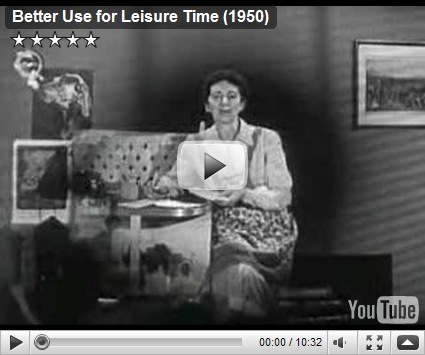
    I believe I presented this short educational film sometime last year on my blog, but I wanted to do so again.

    With the turn of the last century, leisure time was only beginning to become an option for some working/middle class people. And by the time we reach mid century, the Baby Boomers were really the first group in that class system to have so much leisure time. Though I cannot be certain, it might have been the beginning of the teenager moan, “I’m bored and there’s nothing to do”.

    This film is obviously very short and can be seen as silly, but it does make good points. We had really come a long way by the 1950’s in work hour standards and toil for the homemaker. Of course they don’t have the time to get into the varying aspects of class. For example, a middleclass homemaker in 1900 would have had a little more leisure time as she would most assuredly have had at least one servant. In fact, in that time period, you were almost socially required to have at least one servant to officially call yourself middle class. If you were on the lower rung of that social scale and could only afford one maid of all work, than you and your daughters were also a part of the daily housework, but it did alleviate it somewhat.

    But, here in post war America, thousands of people who had been working class/farming families suddenly found themselves with the ability to own their own home and to have the convenience and time to throw parties, shop for niceties not just needed items and have leisure time. The middle class suddenly not only grew, but was really being redefined. The need of hired help had pretty much been lost after the First World War, when many women were given men’s roles and the growing production and less rigid roles for work for women, meant all but the demise of live in servants when a girl could make good money and not have to suffer the strict rules, uniforms and hours of a live in servant.

    So, here we have the returning hero’s of the war and a new restructured middle class. And it is their children, the Baby Boomers, who were the first, in a long time, to have to question themselves with , “What should we do?”

    It must have made some of these new parents angry when their ‘teenagers’ complained so. They were not far enough removed from their own childhoods ‘on the farm’ or ‘in the cities’ where they were always busy with work that needed to be done to keep their home and life going. Yet, they wanted a freer nicer time for their offspring. They wanted a new better America; it was, after all, what they had all fought for.

    So, this concept of sitting around doing nothing or ‘waiting for supper’ as our main character in  this film finds himself at the beginning, is really the start of what we have now. Although, it is true in many cases that we have begun to go in reverse of work hours, that many work OVER 40 hours (especially when you consider both spouses working) there are still those teenagers at home. And  when we are not at work how do we use our leisure time?  I think none of us will be surprised to see that most of it is spent in front of the TV or the computer. Is that bad, not really, because as I have said before THINGS are not good or bad, but how we use them and our own responsibility to ourselves and others is where the ‘good and bad’ come in.

    The upper class and upper middle class had always had leisure time. In fact, in countries outside of the America, an upper-class person could not be so if he had a job, unless he studied law or sat in parliament. Yet, these classes had had generations to determine and to set up the structure of what was to eat up their leisure time. And although we would like to believe the classes above us sat around eating bon bons all day, closer study would find that not true at all. Even an upper class society wife was busy everyday. She had a houseful of servants to manage and maintain, she had a very strict social code of etiquette and parties to follow, there were days of ‘calling’ when you would receive your visiting guests, you moved about depending on the season, in the city in Spring, sailing in summer, in the fall, in the country for the grouse and pheasant and hunting (fox) etc. There was an entire system set up so one was always busy. This work was not ‘making’ money, as they had no need of that, but they also had the social pressure to be ‘doing something’ and often very specifically WHAT is was they were to be doing.

    When the working class suddenly found themselves in the middle and able to allow their children the freedom to not slave away at chores and work, there was no structure in place to fill their ‘leisure time’. They had not social or class pressure to make sure they were doing charity work, or being read up enough to have a good conversation at ‘the club’ etc. So, suddenly we have a new generation born with the freedom from work their parents and grandparents never knew and no guidance as to what to do with that free time. Most parents may have bemoaned their lazy children, but  to the cries, “I am bored” were most likely heard, “Well, when I was your age I had to plow the field and dig ditches etc you should be grateful” and surely they should have been, but is it any wonder they had no guidance and therefore slowly became our generations? The blind leading the blind.

    Even though many families of two working parents may not have much leisure time, what do they instill or ask of their own children? Do they waste away in front of the TV/ computer/cell phone? Have we merely made the new rule of “Be lazy and wasteful now because in a few years you are going to have to work to pay off your college debt, and do what we have to do?” So, is it any wonder that when we busy modern people have our leisure time we do nothing with it? We have been taught and conditioned since then to have that time that is not spent ‘working’ to be spent ‘wasting’ or as we modern people call it ‘relaxing’ Or, “I really deserve this rest, I had such a busy week”. Do we really want to use our time  that is not spent at making money to merely sit and stare? Aren’t  those times between work our real LIVING? And if so, should we start to reconsider how we use it? Should we have busy time so that we can also WORK for ourselves?

    Though it seems to have started with the Boomers in the 1950s, we can hardly blame them. The entire “TEEN” movement was probably a response to the new middleclass youth not having any direction as to how to use their LEISURE time. Therefore, they spent more time together, separate from the adults, and had to make an entirely new social structure based on ‘hanging out’ and ‘their music’ and ‘rebelling against the adults’ because, really, the new middle class parents didn’t know HOW to tell these youths to spend their time. They had come from generations of people who worked from dawn to dusk and fell to bed exhausted and were glad to have two minutes together to read or sew or go to dances with their family.

    Even the very socializing aspect of the two generations were separating more in the late 40’s into the 1950s. While these parents may have gone to a dance WITH their parents, their children, becoming increasingly separate from them, have their own fun time and their own use for their leisure time.

    So, what does all of this mean? Is it just an interesting sociological historical discussing? No, I think when we begin to understand where we came from and why it is we do what we do:how we work, how we view teenagers, how we view our own futures and theirs and our leisure time, we can begin to take more control over our own lives.

    Now, if you are completely 100% happy using your leisure time the way you do, then wonderful no problem. But, for me, I know when I lived more in the modern world, I had much leisure time but often found myself feeling anxious, or aimless, or hopeless. Sometimes the sheer amount of possibilities were so mind numbing, you’d end up doing nothing more than watching TV or going online. I didn’t know until I started to fill my hours with learning skills, reading more, studying and actually LIVING my life, what I was missing was simply proper use of my Leisure time and my Work time.

    As a homemaker it can be trickier as we make our own schedules, but I have found that my ‘work hours’ can indeed be fun. And that what I want to improve on in my ‘work’ I use my leisure time to read and practice those skills and to think and plan to add more such skills to my life. If you are a person who works out of the home, you still have leisure time. Are you happy with how you spend it? If you suddenly took 30 minutes out of your leisure time away from the TV/computer, would you merely sit and stare? Ask yourself, what would you do with that 30 minutes? If you don’t know and you want to know, then that is where you can begin to think about all the things you always think about ‘wanting to do’.

    “Oh, when I win the lottery I am going to do this. Oh, when I retire, I am definitely going to do that. If I had more free time I’d probably get started on that.” Well, time is a finite commodity. The lottery, retirement, and the future may come, but why sit about waiting. IF some of the things you say you would do in those circumstances only involve money, say “If I win the lottery I’d get a bigger/nicer house” well, until you win it, why not think about what it is in the desire or dream that would make you happy? Is it the house size, the cleaner nicer rooms? Because, you can, on a more modest scale, begin to make over your own home. And then you will think, “Well, I’d love new drapes so maybe I should try to sew some of my own.” You get the sewing machine and start learning that. Then, “I’d love a painting here, but I can’t find what I’m looking for, maybe if I get a canvas and some paints, well, I can’t draw or paint,” so maybe I will use my computer to download some pretty images and decoupage them. And it goes on and on like that and before you know it, you are LIVING your life. You are following little paths to new adventures and you still have not retired nor won the lottery.

    Do we only think that the wealthy or the retired have more fun or more control over their lives? They may have more time in a way we do not, but we still have time and brains and drive. Perhaps when we look at what it is of them we covet, we might find things we could do and learn now to have our own version of that.

    Obviously, we still must dream. To imagine or hope for things in the future is part of the drive that makes a life. But, if the dreaming is all there is, if we are happy with our lives merely being an imaginative version of TV or movies, in that we just day dream it up, we may be surprised to find our futures rather different than the dream. Are we simply making excuses of ‘oh, well if I had what she had, or that much money, or didn’t have to work’ instead of saying, this is the money I have the time I have now, lets get to living and how can I get more time and money, if that is what I need. If the answer is spend less, have a budget etc and that sounds too hard, well tough. Having a real life IS work, but it can be enjoyable work, but few things just plop down into peoples laps. Even the very wealthy still have to ‘work at’ things to make their life have meaning and purpose. As much as we would like to think one long vacation of buying things would not a happy life mane.

    We need to work towards our dreams and using our leisure time in work might sound odd, but work you enjoy or for a goal you want or to tackle a skill at your discretion is and can be fun. And though something like ‘building a bookcase’ might seem silly or pointless, you have to remember WE assign value to things. IF we think it not important to care about the little things, embroidering a hankie or making a spice cabinet, how will we value bigger things? And how will we value people and skills? NO wonder we care little for local handcrafted items, who cares, it’s not important.  It might be EASIER to go to Target and buy a bookcase, but isn’t it more fulfilling to build one yourself?

    I suppose the point of this whole post is that I have found my life after I thought it lived out there somewhere in the future. Through some magic haze or some great passionate moment, suddenly my life would be presented to me: Ta-Dah! And I think many modern people feel this way and much of that belief structure is from our media driven society. Movies and TV shows have to, by their very nature, have such moments. Someone is going along and then suddenly, a montage of events, and they cut off all their hair or they throw down that tool and walk out of their job, or some dramatic moment and their life is there, cue ending music. Yet, this is not how real life works. Entertainment is such a large part of our lives, the TV and the computer and movies are so accessible that sometimes they can become more of a reality than actual reality. Our brain doesn’t intrinsically know what we are taking in visually is real or not, so we form patterns in our lives based on fictional characters in fictional cirmcumstances. And then we often find ourselves, we modern people, doing some drastic  thing or taking some dramatic moment, such as chopping off our hair, or quitting that job, or moving again and then waiting for our life to begin. As if somehow that moment will bring forth that life changing moment. I know, I did it so often. The very start of this project was one of those moments, only this time it worked for me because I began to realize that living in 1955 wasn’t just pretty dresses and people holding doors for me. As I began to study more, and read, and then put into practice skills I found I was not play acting any longer but actually ME, the real me ,starting to lead a life. I found that work, yes work in my leisure time was not only fulfilling but actually fun and the desire for tv and such entertainment ALL the time lessened. And then when I did partake of it, it was much sweeter as it was not all the time and I could also put it into perspective of my actual life. Yes, that was  great show/movie, but that isn’t how life really it, but it was fun or sad or whatever, now back to my life.

    I really think that blur of line between reality and entertainment causes many problems in our modern world. We have generations of people raised by TV and they can’t understand why their lives won’t be like that. I think that is why so many younger people can play video games for hours on end, as it is almost a way to plug into what they think life is: it has more reality than reality does. I think, in a way, that is sad for those generations as they are missing out on so much of what they could do themselves. And no wonder grown people in their 30’s wear t-shirts with cartoon characters on it and dress, basically, like a 10 year old boy, we don’t understand the real world. We have been reared and educated through it, we identify with it, it is a sort of security blanket that makes that great unknown future, which we don’t know how to address or how to get there, easier to bear.

    And that is it. That’s the secret to middle class happiness it seems. Start living your life. Don’t waste your life in moments of ‘oh, when THIS happens, then I’ll have fun, be rich, be fulfilled, be happy, be dressed nice, have nice clothes and things, be happy” because what if that doesn’t come or if it does come and you do suddenly win the lottery, do you really think after the initial shock you will be happy? If you still have the same set of behaviors and lessons we all learned since the Baby boomers of wasting our leisure time?

    We need to make structure and to have things be important to us, or we cease to care for ourselves and then those around us. People can laugh and say “OH, how silly to take the time to set the table with different glasses and ironed linen napkins, salad forks etc. WE don’t care about that anymore” but, what do we, as modern people, care about? Are we, our family unit NOT important enough now to have a nice table with dishes and conversation? Only the wealthy people deserve that? It doesn’t matter, but does sitting and wasting time on tv matter more? We have so released ourselves from the need to care of be held by any structure that we often just find ourselves floating about aimless.

    Now, I don’t want negative structures of people knowing their own place to return, or any nonsense about discrimination, but things such as table manners, dressing nicely and for the occasion, courtesy and manners to strangers and family and the Responsibility of the Self. I often am surprised when people are shocked by how children act or how that woman seems so put upon by her husband, but it is all learned behavior based on example. How we live now teaches more than any lessons we can give. IF we have children and they see us busy doing and learning, dressing for dinner, being kind to one another, just being generally good people, caring about the little things because they do give purpose to our days and make others happy, than they will follow suit naturally and so will their children. To think we can waste away in front of the TV, be in debt, eat what we want wherever etc and then suddenly expect our children to not be that way, is ridiculous.

    So, again, to my point. I just want any of us who might feel we can do more or are wishing for a ‘different sort’ of life, that you may be surprised how much control you have over such destiny. Waiting for some magic fairy tale or Hollywood moment will only make us waste our leisure time. The more we dissect and ask ourselves what it is that I want out of my life when “I win the lottery, retire, etc “ then we can set about to finding creative solutions to those problems now. Even if the answer is, “Well, I want to get out of debt” Even that is doable without the lottery. First of all, start a budget! Use cash. And here is the biggest secret of all: Don’t spend more than you have. I am not being glib, but the fact that we are, as a nation, okay with the levels of debt we live in is surely a sign that we are not paying attention to our own lives. And if we are not doing that, than I am worried that we are not getting the most out of our lives. I want all of us, any of us to see and realize our potential and get started on LIVING our lives now and  if we win the lottery or get to retirement, then we will be even more prepared as we will know how to use our LEISURE TIME.

    I don’t want to find blame for why we are, but to understand why we are and to see that, indeed, we can change. I can honestly say that the very nature and quality of my life has improved immensely because I now care about the little things, set about learning new skills and make realistic goals that I then HOLD MYSELF TO  and make myself get done, even when I don’t want to.

    So, you can sit on your bed and wait for supper, as our character was first wont to do, or you can get up and make better use of you Leisure Time, which is really, your Life.

    Here is to ACTION!

    Saturday, February 6, 2010

    6 February 1956 “Planning a Dream Kitchen and some Recipes”

    I found this wonderful film from 1949 about remodeling your kitchen. They performed various tests and studies at colleges to decide the best way to lay out a kitchen by using and studying homemakers. Take a moment to watch it as I discuss it below.

    For some reason the whole movie may not show up, if it does not, then follow this link HERE.

    I have been studying my various homemaker manuals, magazines of the year and keeping my own running list of my ‘wishes’ and ‘needs’ for my ‘new kitchen’. This film does a great job of an overall layout plan. I like when they show how to make affordable lighting for the farmer who has less money (and they use fluorescent bulbs, which might seem not as pretty but really, how green they were then and they didn’t even know it!)

    I think the planning center so important.

    The Cookbook holder in the door in the ‘mixing center’ is pure genius. Such a simple solution and yet, so many times I have had to juggle my cookbooks and how I hate to get anything on my nice vintage books.

    The pull down bins for flour and such are just as they have in the old Hoosier cabinets (which these 1950’s ladies mother’s and grandmothers most likely used)

    Even the spinning corner cabinet has the intelligent move of a smaller shelf on top.

    It’s funny when you think how small, but effective, these kitchens were and how kitchens have grown so LARGE to the present day and yet how many of them sit unused or just to heat up premade foods!

    You can bet I am going to make one of those pull out work centers. It is so nice and would be great when preparing vegetables for canning or peeling apples for applesauce etc. And I like that the worktable can be moved next to her. I wish I knew what she was doing while sitting there. It appears she is ironing some form of plastic that is sealing her food she is preparing. IN the 1950’s freezing food was all the vogue and canning thought rather old fashioned, so the new young wife was all about that. I, however, don’t mind freezing some things, but I prefer the idea of canning, as it will use less electricity than a large freezer and I am sure the ladies back then did not pay what WE pay for electricity today. Does anyone know what product she is using in that part of the film when she is ironing plastic at the work station?

    When I saw the hole in the counter with the bucket underneath for vegetable prep I almost sprang from my chair! Yes, I want that. So smart and makes so much sense. And great, if you like to compost, as you can take your bucket and empty it into your mulch pile. Really wonderful. That is a definite for my ‘new’ kitchen. I like the idea of the potato and onion storage there as well, though I would probably have that much smaller or not at all. I will most likely have a dark space build in my pantry for those.

    I like the bins over the stove (cooker) but not sure if tea and spices should be kept over the heat. I have heard that that can spoil their flavor, yet, it is nice to have them there. Maybe, as they are in little tins set into the wall behind wood, they are protected. I am definitely going to think about it. I have some cute little vintage milk glass bottles of spices (in one of my old blogs from last year I showed how I copied a pattern from my collection of corning ware bowls to decorate them) But it might be nice to buy the spices, empty the contents into a drawer with a little scoop (they sell these scoops at a local store that is a darling old place) and then just scoop as need be, then I wouldn’t have to fuss when the little holes in the jars get plugged from the spices.

    I also like that in this area over the stove there is even a secondary place for flour which is used when thickening sauces and gravies, so well thought out! I also like that the counter space next the stove shares the wall with the dining room and then those dish cabinets have a slider that opens into the dining room. So smart and saves steps for setting the table, clever indeed!

    I love the little cabinet behind the sink for the soaps and things you use most. I hate to have packaging out and sometimes put my dish soap in a cute decanter, but to be able to just keep that away in the closed cupboard but not have to stoop under the sink would be great. This built out area would also afford a great spot to have plants, such as herbs, on a good size sill and obviously to orient the sink towards the sunniest part of the kitchen.

    I like the idea of cutlery and silver drawers being above counter height and that space to dry dishtowels, very smart as well. It would save on having to feel the need to wash the dishtowels more than needed. I would think a well dried dish towel would last a few days and still be clean, as it is just wiping off clean dishes.

    The smaller storage closet would also be a boon to keep your broom and stepstool etc at hand but out of the way, this could really be a fairly shallow closet. I love that all of the cabinets are just built from basic lumber. I am going to have to try my hand at making simple drawers and such, as I want to really specialize my cabinets to MY needs. It will be so much cheaper than buying prefab cabinets, they will be of nice wood and I can finish them how I like! I also want to make space for a kitchen table, or breakfast nook area when I do our kitchen. Now, hubby and I eat our breakfast in the dining room and while it being darker is nice in the evening as you are winding down with dinner, not very good in the morning. Bright light and a view of the garden would be my hope. Maybe cheery white and butter yellow with display for my inherited collection of milk glass.

    The ledge at the kitchen dining area is also so smart. Lately I have been wanting to make room on the sideboard to have the percolator plugged in while we are eating breakfast, but this shelf in the breakfast nook would be perfect and you could have the toaster there as well as the coffee plugged in. And of course some plants and maybe some light reading material to enjoy on a Sunday morning.

    I like that the point, at the end of the film, is that the homemaker, due to the well planned kitchen, can actually sit down and enjoy the meal with her family. So important, I think. Even though I am the one doing all the ‘work’, I really enjoy mealtime with hubby. To be sat down at a nicely set table, linens, water pitcher everything at hand, is really enjoyable. We can sit and talk at our leisure and it really frames out our days together.

    So, I am not sure if any of those ideas would apply to any of you, but I was really impressed with how well laid out that small space was. It definitely helps me to realize I do not need a kitchen much larger other than space for a table to eat and a ‘workstation’.

    Now, that film was immediately post war and meant as a very efficient work space for a farmers wife (though I am going to apply many of it’s suggestions)

    Now, gals, lets look at another film on Kitchen Design, this one is from 1957. You will see some differences, but still good ideas. Perhaps this film will be more helpful to you in your kitchen design. Let’s watch first, then discuss.

    Again, if the movie isn’t showing the whole picture go to this link HERE.


    Okay, first off, I adore her dressing gown! That might have to be one of my monthly dress making challenges, maybe March. And I love her high heeled gold slippers.

    Now, this film is more about concept than actual practical know how like the first film. You can see how in only 8 years things such as washing machines/dryers and dishwashers as well as the kitchen ‘family room’ are becoming typical parts of the middle class American household. Still, some good advice and fun images and what a pretty dress too!

    I found some more interesting films of the time that I will be sharing in future blogs.

    50s countrykitchen  I am beginning to like the idea of wall ovens and a separate stove top. Although I really like many of the vintage stove (combined cooker and range top) I think, especially for me as I am tall, that the stoop to the oven would be nice to leave behind. I also like the idea of storage under the cook top. The only downfall will be that it must be much harder to find vintage separate pieces such as this.

    I have, since I do love cooking so and want to further venture into that area in a more ‘gourmet’ turn, considered getting a modern commercial grade stove/oven, such as this.commercialoven It can be rather expensive and I don’t want it to be overwhelming for my little kitchen, but the idea of 6 burners and double ovens does excite me. However, how often would I need so much cooking space. I most like will stick with something vintage.  So, I think over the next month or so I will include more info and discussion on planning our dream kitchens.

    Now, for what goes on IN the kitchen, some recipes. I promised a few posts back to share one of my pot roast recipes.

    potroast For this roast, what I did was first heat a pan on the stove to VERY hot, but with no oil. Then, making sure you have dried off the raw meat (wipe it with a rag or some sort or cheesecloth). Then I use salt and pepper and thyme some dried rosemary and encrust the raw meat. Then, pan-sear it in the dry hot pan just until it browns. This should not take very long. Just turn it until all the sides are browned, then set aside. Now, into that hot pan with it’s lovely bits of meat/fat and seasonings from the roast, pour in some oil to cover the bottom of the pan (olive or vegetable). Then as that is heating up, cut up onions and garlic to cook in the oil until sweet brown. Now, to this add one cup of tomato sauce and bring to a boil, then cook to reduce it to about half the original amount. (I just eyeball it). When that is done, make a tinfoil boat and fill the bottom of it with half the cooked sauce and then put in the roast, pour the rest on, throw some fresh potatoes in there and tent it up tight. Now cook in a slow over (about 200-300) for a few hours. During the last 30 minutes, I add the vegetables. I don’t mind the vegetables being very cooked as the vitamins will be in the sauce.It is very good this way, I think.

    I always say to save your grease/fat/drippings etc. You can make wonderful things with it. Last nights dinner was ‘stuffed chicken thighs’. I usually by my beat bone in, as then you can boil the bones for stock. I had some leftover drippings from something similiar to the above recipe, with tomato garlic etc that I had cooked chicken in earlier in the week. I just kept the fat in the freezer.

    So, I deboned the chicken thighs (and set these aside to make soup stock). Then I spread them out and pan seared them in the heated leftover drippings until they were lightly browned. I made rice separately and as I had cornbread earlier in the week, I saved the crumbs and bits you sometimes get left in the pan. In the last few minutes of the rice cooking, I threw those in with some butter. Then I layed out two of the thighs, filled with stuffing and set another thigh on top and closed with toothpicks. SO, when I served it I used the toothpicks as little holders for some of the cooked mushrooms. stuffed chicken1I just love little touches like these as I feel they are part of the art of cooking and even if it is quaint, twee, or kitchsy, it seems rather vintage. It also elicits a smile from hubby, as well, and shows I put some thought into tonights dinner.stuffed chicken2This was really just to show how much can be made out of so little. Those bones got boiled yesterday with seasonings and will be soup with homemade biscuits for tonight’s dinner.

      I don’t recall if I ever showed my ‘birthday gift’ in action. Hubby had got me a vintage mixer with all the attachements and I was excited. Although I have two working handcrank meat grinders, the electric one really makes a difference. Here you can see it in action on some pork.grindingporkI am going to get an attachment that will allow me to stuff my own sausages. This grinder is good not only for raw meat, as I have here with pork, but with cooked leftover meat. You can grind it up and make patties or rissoles. For example, cooked pork, bread, apple and onion sent through this mixer to make the base, then form into patties or balls then pan fry or oven bake, so yummy. A mincer/grinder allows you to take leftovers and make so many great dishes.

    I think I have shared my cheesecracker recipe before, but if not here it is. If you have never tried it, you must. They are very easy and you won’t believe the taste. Here they are rolled out and I simply use a pizza cutter to cut to desired size.cheesecrackers1Here are some I cut out longer and made into cheese straws and served with a dinner I had for friends. cheesestrawsThey look lovely on the table and are so good before the meal with salad and straight on through to dessert!

    1 Stick of Butter  at room temperature
    2 Cups Sharp Cheddar Cheese (also good with half cheddar and half Romano)
    1 1/2 Cups All Purpose Flour
    1 teaspoon salt
    1/4 teaspoon  pepper

    1/8 teaspoon chili powder

    1. Preheat your oven to 325°

    2. Mix the ingredients in a large bowl until dough chases itself around the bowl.

    3. Dump the mixture out onto a lightly floured surface and use your hands to bring it together forming a ball of dough.

    4. Roll out dough to 1/8 or 1/4 inch.  If the dough is too loose to roll, toss it into the fridge for 15 minutes.

    5. Once rolled out, cut the crackers.  You can use a knife, pizza cutter, ravioli cutter, cookie cutters, whatever you like. I like the rough texture of the hand cut, but for a tea or something, little shapes from cutters might be more appropriate.

    6. Place the crackers onto a cookie sheet  with cooking paper. You can even butter the paper to make them yummier!

    7. Bake for 11 minutes or until the crackers start to get just golden on the edges.

    8. Place on a cooling rack until the crackers are no longer warm.

    And then be prepared for you family to praise you and ask for the often!

     Search The Apron Revolution