Thursday, March 10, 2011

10 March 1957 “The American Strip Mall and Tell Us About Your Area”

57stripmall This is a wonderful shot of these two ladies ready to shop at their local strip mall in New York really describes the changing landscape here in 1950’s America. The main streets, though still rather busy, are now merely an accompaniment to the strip mall.

stripmall With the automobile’s growth, the increase of roads and the growth of the suburb, America post WWII radically changed. The quick hop down town on a bike or the bus to the local market was being replaced with “Cars for everyone”. A growing middle class, increased wages and the chance for anyone to really own a car now.teenwithjalopy Consider the 1950’s teenager who has the ‘old’ cars of the 20’s as his first car. His parent’s generation didn’t have this in the same number and certainly not his grandparents.

50sdowntown Though the downtown was still the place to be and many shops existed there, the spreading out of families into ever increasing suburbs naturally lead to the strip mall. It was the solution to the increasing congestion of traffic in downtowns. By placing large parking spaces in front, more shoppers could easily park and shop.


1936trolleylines Even much used tram lines were paved over to make more room for cars. Therefore, those who did not have them virtually lost their forms of public transportation, except the buses. They were recently discovered by digging utility workers. uncoveredtrolleylines

Now, I am not certain if this is only a particular American situation. I know we simply had the money and the land post WWII that our allies did not. And we also have no real sense of history as far as preserving historical buildings that Europe enjoys.

schuylermansionFor example, this mansion in Schenectady NY, the Schuyler-Standford Mansion built in the 1760’s, is being torn down to make room for a new strip mall.schylermansion2

I am very curious for any of my international followers to chime in here: What country do you live in and do you have strip malls, did they evolve and how did they affect your downtowns and public transportation.

Now for my American readers: How lively are the strip malls in your area of the USA and are they easy to get to only by car or are there bus services as well. How is your downtown area, if you still have one?

I really am curious to know and I think it will be fun to find out, don’t you?

Tuesday, March 8, 2011

8 March 1957 “Being Green 1950’s Style: or Common Sense”

solar article 2solar article 1I wanted to share this article again. It is from one of my 1940’s magazines discussing the importance of using the sun to aid in heating. It was written during the war years when we were more conscious of money and spending and saving.

I thought I’d just share a few things that were fairly normal in the past that would be considered green today. Really, just common sense and with the thought of thrift and the future. This idea of ‘saving’ or thinking ahead or even planning for the future often seems an alien idea in modern society.

earlyamericanglass[3]Many people of old saved their glass jars. When one purchased something, it was often washed out and used again. If you were poor or furgal enough, there were many jam jars used as water glasses. In the 1950’s they even packaged things in a specifically reusable package.

Though many things were kept and repurposed rather than thrown out. And almost nothing came in plastic, so a good reusable sturdy glass jar with a good lid was valued.

cinnamonshaker1Here is a vintage spice jar I use to hold my cinnamon sugar. I was surprised to see one can buy throwaway plastic containers of pre-mixed cinnamon sugar. Now, that’s pretty lazy to not be able to scoop your cinnamon and sugar together and give a little shake.  glassjars Here are some modern uses of glass jars. jarsshelf  This lovely craft rooms takes advantage of old rulers as decoration and it is still a usable measure, if one holds things such as fabric up to it.

You can also unify jars by painting the lids a single color, making varying sizes and shapes ‘go together’. Also it is easy enough to make up vintage labels for these using vintage clip art or old cards and magazines. Such as this clever crafter did here using old vintage button cards as labels.buttonjars


 50sfamilyatdinnerSomething as simple as using cloth/linen napkins saves so much waste and saves on the pocket book as well. I use a napkin more than once and they all get laundered on Monday with my other things. I save money and make less garbage AND feel like my dinner is special. Here you can see mother has her cloth napkin on her lap.

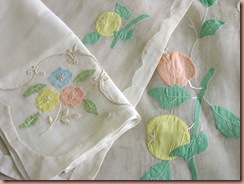
clothnapkins Vintage napkins are so beautiful and really come in so many forms are are SO inexpensive, why not try it out.tealfolkteatowel  Even vintage tea towels/kitchen towels are far prettier and can still be used to wipe hands in the kitchen in lieu of napkins. I use old tattered bath towels cut down and hemmed as my ‘hard duty’ wipe up kitchen towels. It is even better if they are white because they bleach easily enough or come clean if put in boiling water with some soda and left to soak overnight.

womanatsink Did you know that boiling water converts baking soda to sodium carbonate? Why do you care? Well, it’s a great old-fashioned way to clean out the drain: Put One cup of baking soda down the drain and then pour Three cups of boiling water after. This is a great drain cleaner. draincleanerad Though many pre-made products were available in the 1950’s many a frugal homemaker knew these ‘old’ tricks from Mother or Grandmother, or gleaned their skills at the now vanished Home Economics classes.

womanwashinghair Washing your hair in the sink was a very standard procedure in the 1950’s. In fact, the old joke was to get out of a date one would say, “Oh, I can’t go out tonight, I am staying in and washing my hair”.  A 10 minute shower uses between 25-50 gallons of water (depending on shower head which ranges from 2.5-5 gallons per minute). Consider how a once a week bath was replaced by daily showering and hair washing.

It actually is better for you hair not to be washed daily. If your hair is more oil, 2-3 times a week is better. I have ‘normal’ hair, in that I wash my hair usually Friday night and set it for the week. When I shower during the week (some days I simply do a ‘sink wash’) I wear a shower cap. This would have been the more usual water consumption in the 1950’s household.

There are so many easy things we can do to live a more vintage life and in so doing have the happy by-product of ‘being green’ or, as they called it, Common sense and purse sense. After all a penny saved IS a penny earned.

Check your pantry/cupboards now and see if you have product that is ready to be emptied and see if the jar/container could be used for another purpose than the garbage.

Happy Homemaking.

Saturday, March 5, 2011

5 March 1957 “50 Years of Women’s Silhouette”

I thought it would be fun to see the change in women’s fashion silhouette over the past 50 years (1907-57). I have done this before in JULY 1955 HERE.

As a light and fun weekend pictorial I thought we could take that journey again:

First up 1907: The “S” curve shape and the corset has reached its pinnacle of contortion before disappearing somewhat during the first world War years. Corsets were worn in the teens, but they were more of a chemise and in fact much less constrictive than the 1950’s girdle. The waist line also received a combination of natural waist in the back scooping to a lower waist in front, all very held in a lower hip hugging corset. 

1907 1907suit 1907ladies

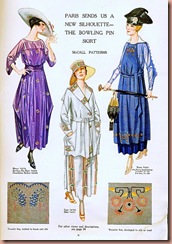
1917: Here we can see that the corset is almost not needed. This was probably one of the most relaxed silhouettes for women. You can see that an almost ‘large middle’ was encouraged. A heavier girl could easily hid her flaws during this period.

1917 This is the more high fashion look at it1917fashion2 While these 1917 shirtwaists and skirts would require a corset (though not as strict as 10 years earlier) The waist was raised from the 1907 lowered front and raised back look of the “S” curve.

1927: many people think 1920’s = short skirt. But it wasn’t until 1925 that the skirt actually reached above the knee. It then immediately began its descent down again. So, here by 1927 we see it just below the knee.

1927golfoutfit 1927fashion

1937: And now 10 years later the hemline has migrated back down mid-calf, almost to the NEW LOOK length. Of course Dior has another 10 years and a war to get through before the look is found. Now the waist is gone and the dropped waist is des rigueur. The straighter boyish silhouette was murder for the fuller figure woman (who would have been the epitome of fashion in 1907) and she often wore a corset type garment that flattened her breasts and padded her middle to match her hips to give a straighter line.

1937 Model, leaning on a square pedestal with white drapery hanging from poles behind her, wearing a dark wool, long jacketed suit with large, figurine buttons, by Schiaparelli, and a black Merry Widow felt hat, inspired by the costumes of Mae West's new film Here you can see the shoulder pad beginning to be introduced and it became very military in look during the war years. You do notice in the 1930’s that the waist has traveled up a bit almost to the 1917 position.

1947: Now the war has ended (and during the war years the skirt climbed back up to knee length due to shortages more than fashion). So the New Look celebrated the new abundance with a sloped shoulder and tighter natural waist and full skirt.

1947diro Though many women did not like the longer skirt length and on average a 1947 woman would still be dressed very ‘1940s’ Joan Crawford look.mccalls1947 But the new look of longer skirt was definitely being embraced as well as can be seen in this 47 Butterick pattern book.

1957: Now as we are approaching the end of the 1950’s we still have the full skirt, dolman sleeve look of the mid 50’s as can be seen in these Speigal dresses.57 

ChristianDior1957 And Dior’s look had moved up the hemline and created the look of the 3/4 sleeve. An almost abridged version of his 1947 New Look 10 years earlier.

 LaurenBacall1957 But, here Lauren Bacall in 1957 is demonstrating the new dropped waist and straighter look that the early 1960’s will run parallel to the full skirted look.

When you consider the change in the past 50 years there have been changes but not to the level and distortion the first 5 decades of the 20th century showed.

What is your favorite period out of these presented? What is your favorite fashion period of any time?

Thursday, March 3, 2011

3 March 1957 “The Queen, Thinking of War Times, and Preparing for the Worse?”

On 13 October 1940 young Princess Elizabeth ( the Future Queen) and her young sister Princess Margaret Rose gave a speech on the wireless during Children’s Hour.
It is a very sweet little speech. And it is amazing that by then, in 1940, many of Briton’s children were being sent out of the danger zone of London and its environs to the safety of the English countryside, Europe and overseas.
Here they are three years later in their Girl Guides uniforms.
This year, 1957, the young princess is Queen. And this year is the very first of her now yearly Christmas Television Broadcasts. That media now becoming more commonplace in homes ‘across the pond’ while in America, it has been quite a part of our lives this passing decade.
It was filmed at Sandringham House in Norfolk. A bit early but still nice, none the less.  It demonstrates the vast change in her life and all of those of the time in under 20 years.
In her talk she mentions the import of ‘modern inventions’ but also warns of people ‘carelessly throwing away old and ageless ideals as if outdated machinery’.
This really has hit home with me and my thinking of this past month. I have been ever haunted by the modern times. They keep poking their head through the vale of my 1957 seclusion. Perhaps the very great changes happening in the past few months are greater than when I started two years ago. Or merely it is my own ever increasing asking and questioning and therefore daily study of how things were and how they are that has lead me to feel this way.
The latest issue of the increasing oil per barrel prices have leaked into my little 1957 Eden. I cannot ignore them and find myself wanting to find out where it might lead us.
I have also come to realize it matters little why we are there. War, Middle East unrest, failing or peaking oil, the ability to drill or not drill for MORE oil, it all really matters very little. Because those decisions are really out of our hands, you and I. And the endless debate as to ‘why’ it is happening or whom to blame seems less important than how do we, the little people, prepare.
I have begun to think more and more about the future. I may very easily,now, slip into a false past but will the increasing costs of food and all that is connected with oil allow me such lax pleasure? I don’t know. I do know that the more I consider what I might want or like to do to prepare FOR such a future as left me with a dichotomy of feeling: Both fear and Hope.
The fear of increasing oil leads to any endless horrid scenarios: Extreme food costs and shortages, the economy failing, Increased unemployment mingled with recession (or Stagflation as it is referred) and the list goes on.
The Hope, then, comes in what I begin to think of when I consider ‘solutions’. I begin to see the things one had to do once during the Depression and the war years. And to even go back further, to before the industrial revolution existed. And in its scary scenario I also see some wonderful outcomes: an increased need for community, the very NEED to grow and manufacture at home in a very small mile radius community. The joy and return to we as individuals within a group and a community, not merely numbers to be advertised to, to become Citizens and NOT Consumers.
Now, surely there could be no worry at all. Oil could drop back down to 40 dollars a barrel and we could go on and on as we are. But, there is a part of me that wonders, why does it MATTER if any of it is true or if we ARE headed for bad times. Because if the preparedness and the outcome of planning for such a future would  be, in many ways, an enjoyable life, why not just go for it anyway! Prepare for the worse but enjoy the good if you have it.
Much of what I have learned from the 1950’s over the past two years has already put me on that path. But lately I have been looking in my 1957 magazines with all the plastic glow and bright promise of things and it begins to feel rather weak or almost false.  40swomen I am striving for more war time ideas of gardening and food on a shortage and a budget. I am curious and hungry for Victorian farming (though industrial still very animal or steam powered). I don’t know. It has left me wondering if 1957 is going to make it to the end of this year, or if I need to go back further?wwIposter
I think, over all, that if bleak and bad times are coming then preparing for them may only make me a better person and in some ways improve my life. If there are no real bad times, then will I really miss being more disconnected to what the modern world really is? I don’t know. I know having got rid of modern TV/mags/advertising has done so much good for me. Perhaps I should continue back with my eyes fixed on the ‘news’ of the day leaving the ‘entertainment’ of it behind as I have done.
What do any of you think? Not rather or not Bad times ARE coming, but rather or night it might be a good idea to prepare for them even if they don’t? Is that too odd of a concept in the modern, instantaneous, now me me world?

 womancarriage moderndriver 1900familyhome foreclosurebuilding 1900familyfarm Pigs confined in metal and concrete pens
familyworkers modernfarm
proud40swoman Can we change? Do we want to? Should we regardless of the futures outcome?

Tuesday, March 1, 2011

1 March 1957 “Cleaning the Bathroom and Tomato Seedlings”

With a continuation of the Daily Lists, I have included today the Bathroom as well as the bit on Halls and Stairs. I hope these help. And, as with any list, they are merely suggestions. One may not need to do all listed or possibly some may even do more. Whatever works for your schedule and time is the ‘perfect list’. I have found, though, that a list of any sort and a routine far outweighs not having one. You will find more time in your day by making a list and getting through it. It will also make the rest of your day almost feel more special somehow. An elation, of sorts, of your ‘free time’.

bathroomcleanlist1 bathroomcleanlist2

blackkrim I have started some tomato seeds early this year. Two weeks ago I started these tomatoes. It is a bit early for some things, but tomatoes can take a good 8 weeks before they are transplanted.

I always like to try some new “old” varieties. This year Black Krim is what I have started. I am excited to try this variety as it says it has a “hint of smokiness”. I also like that it is said to be “Reliable and very productive” which is always a good trait in any plant.
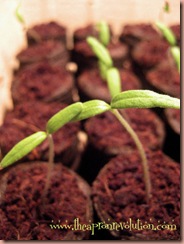
tomatoseedlings1 Here are the little darlings as of today. I loved that these two were “holding hands”, as it were. There is something wonderful about those first few sprouts as they peak their little verdant leaves forth. Spring can be dreamed of, despite cold weather. Though, today, we have mid 40’s and sun. I shall be out this afternoon working on the yard a bit.

The chicks are now a month old and doing well with mother. I cannot believe I forgot to get a picture of their little downy heads peeking out from mum’s wings. But, I shall get some shots of them now with her. She is still happily caring for them, and if I make a loud unexpected noise, she clucks frantically and they race to her hiding under her.

I have never had a hen raise chicks yet, so this is all new to me. I haven’t any idea how long she will care for them before she merely sees them as her flock mates, at which point she will peck her way through them, so they know their place. I am hoping the rest of the flock will be more accepting of them, as they see them all the time, though protected by chicken wire from their inquisitive beaks.

It has been so lovely out today that I let the chickens out and they were so happy to be raking through the leaves and following me about. They are such a  joy to have around. I am lucky in their friendliness and my rooster is the friendliest I have ever had, such a darling and so proud of his ‘ladies’.

Well, I had hoped to reveal my finished kids book today, but I don’t want to share it until it is done exactly as I like it to be. So I am giving myself the rest of this week to really work on it. I shall, though, of course share it all with you.

catinthehat Speaking of children’s books, this month (on the 12th) in 1957, Dr. Suess first book, “The Cat in the Hat” is published.

Theodor Geisel, writing as Dr. Seuss, created The Cat in the Hat in response to the May 25, 1954 Life magazine article by John Hersey, titled "Why Do Students Bog Down on First R? A Local Committee Sheds Light on a National Problem: Reading."

The first “R” is of course, Reading in the big Three “R’s” (Reading, Righting, and ‘Rithmatic) obviously with that old saying, spelling was a consideration.

Since then, more than 11 million copies of The Cat in the Hat have been printed. It has been translated into more than 12 different languages.

I hope all have a lovely day and that you are getting excited about Spring (unless you are my Southern Hemisphere readers of course, then I suppose Autumn is on your mind).

Happy Homemaking.

 Search The Apron Revolution