Tuesday, March 20, 2012

20 March 1933 “Dreams of Summer: Watermelon Rind Pickles and Bicycles and the Tale of an American Company”

It was so warm and lovely yesterday, 70 F (21 C) and it felt like a Summer day. I had tea with hubby and a friend at our local tea shop, their windows open and the breeze of the town mill pond blowing in. I  planted some cold temperature Pansies in my window boxes. My heart flutters for Summer. Therefore I thought I’d post about Summery things.

Let’s start with this lovely recipe for watermelon pickles. I adore watermelon pickles and in our current economic times, the cost of such dear Summer fruit is offset by the use of the entire thing. No waste when one pickles the rind.

Here is the recipe from one of my 1930’s cookbooks with lovely pictures to help you on your way.

watermelonrind1watermelonrind2 watermelonrind3

The warm weather has me eyeing my bicycle as a fun activity rather than just a mode of sometimes transportation.bikecartoonThis fun cartoon from the 1930’s was part of a movement to increase bicycle use to boost the economy. At the time, many families had had to lose or sell their automobiles. They could also be a boon to homemakers or teens who no longer had cars to borrow for outings.

This cartoon also depicts the two wheels as silver dollars, such as this 1934 version.30ssilverdollar In 1933, actually, there were no minted silver dollars. Here is why:

“Introduced in December of 1921, the Peace dollar, designed by medalist Anthony de Francisci, was promulgated to commemorate the signing of formal peace treaties between the United States on the one hand, and Germany and Austria on the other, thus officially ending America's World War I hostilities with these two countries. In 1922 the Mint made silver dollar production its top priority, causing other denominations to be produced sparingly if at all that year. Production ceased temporarily after 1928; original plans apparently called for only a one year suspension, but this was extended by the Great Depression. Mintage resumed in 1934, but for only two years.”

But, they would still have been in circulation at this time. And so make a great foil for a ‘Buy-cycle’ wheel demonstrating a boost to the American economy.

It is of interest to note that these Silver Peace Dollars were, like many silver coins of the time prior to the mid 1960’s, 90% silver and 10% copper. That means in today’s value, this one dollar coin would have the value of around $32.00 at the current price of silver. However, a dollar bill would simply be worth a dollar. And when one looks at inflation, one dollar in 1933 would buy, today you would need $17.50 for each of those dollars to buy the same product. An interesting way to look at inflation and stores of value.

Of course bikes, such as the ever popular Schwinn, were still manufactured in the USA at that time and therefore would be a boost to increase the need for jobs at its American plant.

bike The 1930’s Schwinn, I am happy to say, look rather similar to my vintage 50’s bike. Though the color of my teal blue bike is more 50’s, I can still feel the vintage gal this summer coasting around town and to the beach as usual.

This year, 1933, was the introduction of the first ‘Balloon Tires’. That is a tire with an inner tube, much as we use today. Prior to that date, bike tires were simply just that, the tire you filled with air.

I recall my father telling me that when he was a child in the War years (WWII) rubber was confiscated for the war effort. Thus they filled their tires with hay to keep them firm. Had they simply had the old pre 1933 tires, they would have been able to fill them without need of an inner tube. Though all those tires were probably already taken for the war effort.

The following images and text come from the original 1933 Arnold, Schwinn Company catalog. These models were offered both with and without balloon tires.

Schwinn 1933 Bicycle Catalog

Schwinn model B 10E MotorbikeB 10E Motorbike Fully Equipped

Frame: 18x 22 inches.
Tires: 26 x 2 1/8″ Cord Balloon.
Saddle: No. 1 Bucket.
Handlebars: Chromium finish with brace
Pedals: No. 10 Torrington.
Guards: Chromium finish.
Rims: Deep drop center chromium finish
Color: Black with red trim. Optional red and white or blue and white.
Coaster brake: Optional.
Equipment: As illustrated

schwinn-b-9-motorbikeB 9 Motorbike

Frame: 18x 22 inches.
Tires: 26 x 2 1/8″ Cord Balloon.
Saddle: No. 1 Bucket.
Handlebars: Chromium finish with brace
Pedals: No. 10 Torrington.
Guards: Chromium finish.
Rims: Deep drop center chromium finish
Color: Black with red trim. Optional red and white or blue and white.
Coaster brake: Optional.

Model B 4 CamelbackB 4 Camelback

Frame: 18x 22 inches.
Tires: 26 x 2 1/8″ Cord Balloon.
Saddle: No. 1 Bucket.
Handlebars: Chromium finish with brace
Pedals: No. 10 Torrington.
Guards: Chromium finish.
Rims: Deep drop center chromium finish
Color: Black with red trim. Optional red and white or blue and white.
Coaster brake: Optional.

b-3-ladies-modelB 3 Ladies’ Model

Frame: 18 inches.
Tires: 26 x 2 1/8″ Cord Balloon.
Saddle: Ladies comfort.
Handlebars: No. 5 Chromium
Pedals: No. 9 Torrington.
Guards: Chromium finish.
Rims: Deep drop center chromium finish
Color: Black with red trim. Optional red and white or blue and white.
Coaster brake: Optional.

b-1.5-motorbikeB 1 1/2 Motorbike

Frame: 16 x 20 inches.
Tires: 26 x 2 1/8″ Cord Balloon.
Saddle: No. 1 Bucket.
Handlebars: Chromium finish with brace
Pedals: No. 10 Torrington.
Guards: Chromium finish.
Rims: Deep drop center chromium finish
Color: Black with red trim. Optional red and white or blue and white.
Coaster brake: Optional.

b-1.5-e-motorbikeB 1 1/2 E Motorbike

Frame: 16 x 20 inches.
Tires: 26 x 2 1/8″ Cord Balloon.
Saddle: No. 1 Bucket.
Handlebars: Chromium finish with brace
Pedals: No. 10 Torrington.
Guards: Chromium finish.
Rims: Deep drop center chromium finish
Color: Black with red trim. Optional red and white or blue and white.
Coaster brake: Optional.
Equipment: As illustrated.

1933-schwinn-b-1-camelbackB 1 Camelback

Frame: 16 x 20 inches.
Tires: 26 x 2 1/8″ Cord Balloon.
Saddle: Bucket type.
Handlebars: Chromium finish with brace
Pedals: No. 10 Torrington.
Guards: Chromium finish.
Rims: Deep drop center chromium finish
Color: Black with red trim. Optional red and white or blue and white.
Coaster brake: Optional.

1933-schwinn-r-racer#R Racer

Frame: 20, 22 or 24 inches.
Tires: Racing 28 x 1 1/8 inch.
Saddle: Racing  type.
Handlebars: Racing type, chromium finish.
Pedals: Racing type.
“Designed and built to meet the exacting requirements of racing, this sturdy, easy running wheel will give a good account of itself anywhere.”

Schwinn Built Bicycles…

1933-schwinn-factory“have been nationally known for more than thirty-five years as staunch, high grade, easy running wheels. Their reputation is backed by the long and honorable record of Arnold, Schwinn & Co. Since 1895 these famous bicycles have been built in this huge, modern factory with no change of organization or management. Naturally, this wealth of manufacturing experience is reflected in the quality of the product.”

Schwinn was started in the 1890’s in Chicago by a German Immigrant who received backing from a German American meat Packer. The new company coincided with the new bicycle craze hitting America (imported from our European cousins).  The Schwinn company had thirty factories turning out thousands of bikes every day. Bicycle output in the United States grew to over a million units per year by the turn of the 19th to 20th century.

By 1905 bicycle sales nation wide had been reduced %25 due to the increase production and availability of the automobile.  Many smaller firms were either bankrupt or bought up by the larger companies. Schwinn bought up more small concerns and added a motorcycle division which became Excelsior-Henderson.

With the coming Crash of ‘29 most such companies were bust and almost all the American motorcycle companies were gone, including the new Excelsior-Henderson. So, Schwinn’s son, now running the company, went to Europe to study their more stronger bicycle innovations. He returned this year, 1933, and made the Schwinn B-10E Motorbike. It was not actually a motorized bike, but had an area that looked like an engine and included wider tires with inner tubes, a light, fenders, and a bell. This would eventually become the Cruiser or Beach Cruiser we know today.

In the 1950’s, European import of bikes began to dominate the American market. The lighter weight British bikes made up 95% of those imports. The American Companies were having trouble competing with the lower cost bikes available from war-torn Europe and Britain. So In August 1955:

the Eisenhower administration implemented a 22.5% tariff rate for three out of four categories of bicycles. However, the most popular adult category, lightweight or 'racer' bicycles, were only raised to 11.25%. The administration noted that the U.S. industry offered no direct competition in this category, and that lightweight bikes competed only indirectly with balloon-tire or cruiser bicycles. The share of the US market taken by foreign-made bicycles dropped to 28.5% of the market, and remained under 30% through 1964. Despite the increased tariff, the only structural change in foreign imports during this period was a temporary decline in bicycles imported from Great Britain in favor of lower-priced models from Holland and Germany. In 1961, after a successful appeal by bicycle importers, the Eisenhower tariffs were declared invalid by the Court of U.S. Customs Appeals, and President Kennedy imposed new a new tariff rate at 50% on foreign-made bicycles, a rate which remained in place until 1964.

After Kennedy, however, our country began to change as far as imports and tariffs were concerned. And sadly by the late 1970’s, the continued inflation of our dollar in this country led to labor disputes. High costs of living due to inflation combined with stagnant pay and harder to compete with imports prices, (no longer made competitive and fair with U.S. tariffs) 1400 assembly workers walked off the job for 13 weeks.

Now even lower cost bicycles were imported from Asia and again, no tariffs were in place to make American companies have the ability to compete while giving a fair living wage, the company declined. It moved what remained of its manufacturing to Mississippi where they could be made cheaper. This factory continued to decline until it laid off its remaining 250 workers and closed for good in 1991.

In 1991 Schwinn, now completely getting products from overseas, tried to focus on Brand enhancement and moved into other towns. At this time, the smaller bike shops were filling the Mountain Bike craze and only led to hurt these small shops trying to get off the ground and of course provide jobs for locals.

“In September 2001, the Schwinn Company, its assets, and the rights to the brand, together with that of the GT Bicycle, was purchased at a bankruptcy auction by Pacific Cycle, a company previously known for mass-market brands owned by Wind Point Partners. In 2004, Pacific Cycle was in turn acquired by Dorel Industries.”

Dorel Industries is huge. It continual buys up and abosorbs bankrupt companies, made so by the current system of business as usual. And as an example of how huge such business get, here are the many other brands that Dorel sells under other names:

  • Altra
  • Ameriwood
  • Babideal
  • Baby Relax
  • Bebeconfort
  • Bertini
  • Bootiq
  • Cannondale
  • Carina
  • Cosco
  • DHP
  • Go Safe
  • GT Bicycles
  • InSTEP
  • Iron Horse
  • Maxi-Cosi
  • Monbebe
  • Mongoose
  • Mother's Choice
  • Quinny
  • Ridgewood
  • Roadmaster
  • Safety 1st
  • Schwinn
  • System Build
  • SUGOI
  • Zuzu

Here are the owners and the earnings and worker totals:

Key people
Leo Schwartz (Founder)
Martin Schwartz (CEO)
Alan Schwartz
Jeffrey Schwartz
Jeff Segel

Revenue
increase US$ 2.484 billion (2010)

Net income
increase US$ 127.853 million (2010)

Total assets
increase US$ 2.096 billion (2010)

Employees
4,700 (2010)

That seems a very large amount of money to a few people. We see very few employees yet so much wealth accumulating to a few. All at the expense of a large concern that once created jobs and products in our own country which is simply just one of the many such companies absorbed by a corporation like this. It is news and information like this that makes me understand the 1% we hear speak of so much today.

This is  sad but seems rather a normal tale of the American business and its production. The last of our moves made both by Eisenhower and Kennedy to make a fair playing field with tariffs that would allow our country to compete with larger corporations who had no problem outsourcing jobs. I don’t want to end this summer post on a sad note, but it seems again whenever I follow the line of a story I find myself here again in a world focused more on profit margin than way of life.

It makes me see now how one could be on either side of things like wage strikes. How some would see workers as selfish for wanting more and that they were the cause of a company going under. All the while, the increase in inflation would simply make your current pay really less, as food and fuel costs rise (sound familiar?) and the company could not compete because of the removal of tariffs that supported American business over foreign imports.

The American company stopped being an American company and cared little for the country it was in as it could go to Asia and make it so much cheaper to sell to all of us. And then we happily lapped it up as our own manufacture and thus labor and pay became less due to it.

It is a sad state indeed. Here in the 1930’s strikes and labor rights are not viewed as they were in the 1960’s. There was no ‘oh look at those hippys’ as here it is seen as right and just that those who have worked hard with a company should earn a fair wage. And it is also right that a company should feel the support of its government over overseas competition. But, I am afraid, we are so far removed from that idea with the vast changes and media ideas of what the previous decades stood for that most don’t even really understand the history of how our country once worked. I know, for me, it is continually a contradiction from what I once believed to what actually appears to be the truth.

I don’t want to end on a dour note, but I do want us to be aware of our world and how it once was. Whether or not it can ever be that way again, I don’t know? Every time I seem to go back a bit further it becomes a bit clearer. Who knows next year I might have to travel back to pre 1913 which is when the inflation of the American dollar began. That would be quite a journey.

I’ll close with this fun little movie advert shown at the pictures of these Swell Speed-O bikes as demonstrated by Spanky of Our Gang the Little Rascals. Happy Dreams of Summer and Happy Homemaking!

Friday, March 16, 2012

16 March 1933 “Gelatin Salads and Molds: From Calves' Foot Jelly to Jell-O”

gelatincover Yes, even here in 1930’s the gelatin molded salad and side dish exits. In the 1950’s we often saw such salads and easy to make ‘aspic’ with canned tomato soup, powdered gelatin and the like.

However, the predecessor to this type of instant gelatin was calves' foot jelly. Even the gelatin (such as Jell-O) of today, is still made with parts of the feet of cow/pig and sometime chicken.It is a protein produced from collagen extracted from the boiled bones, connective tissues, and intestines of animals. Its taste and wholesomeness is a far cry from our Victorian Sister’s version. Theirs contained carful boiling of whole split feet, while ours is hoof scrapings and mainly by-product of the leather industry.

Even in the Victorian times, one could buy sheets of gelatin, rather than boil down feet to derive it. However, it needed to be boiled down and purified and was expensive and therefore more used by the wealthy. The act of boiling the feet down, skimming the top of fat and letting it set, was all that was required to create gelatin from scratch.

In 1845 the American Industrialist patented a powdered form of gelatin, but had trouble marketing it. It was subsequently sold a few times and during the early 1900’s ads were placed in Ladies Home Journals describing it as “America’s Famous Dessert”, though it was not, and sales were still rather low.

Then Genesee Food company, who now owned it, sent out en masse salesmen and door to door free booklets and samples. By the late 1920’s they began adding fruit flavors like cherry and even chocolate (where before it was simply the solidifying agent to which you added your flavoring) and it took off.

By 1930, there appeared a vogue in American cuisine for congealed salads, and the company introduced lime-flavored Jell-O to complement the various add-ins that cooks across the U.S. were combining in these aspics and salads. By the 1950s, these salads would become so popular that Jell-O responded with savory and vegetable flavors such as celery, Italian, mixed vegetable and seasoned tomato. These savory flavors have since been discontinued.

In 1934, sponsorship from Jell-O made comedian Jack Benny the dessert's spokesperson. At this time also was introduced a jingle (created by the agency Young & Rubicam) that would be familiar over the next several decades, in which the spelling "J-E-L-L-O" was (or could be) sung over a rising five-note musical theme.

Therefore, next year 1934, Jell-O will become an everyday part of the homemakers life.

A bit more about how gelatin was once made. The key component in gelatin is collagen (a protein found mainly in connective tissue, in which feet abound.) Collagen makes meat tough, but it also makes the same cut, after stewing, silky and rich.  That is why if one were to boil chicken’s feet in the making of their soup, they will find it has extra body and taste. Therefore,  collagen that is hot will impart richness to dishes while when it is chilled, it turns to gelatin.

This link HERE will take you to a great old British recipe to make your own calves foot jelly. Caster sugar, for we American’s, can be harder to come by. It is sometimes sold in small boxes at larger grocers. If is not as fine as our powdered or confectioners sugar. So, you can make your own by simply taking normal grained sugar and putting it in a food processor or electric coffee grinder. If not, you can use regular  sugar, only it will take a bit longer to dissolve.

The mass production of gelatin today is not made of these nicer connective tissues and are, as I stated, mainly a by-product of the leather and meat industry.  Here is a chart of the make up of modern gelatin gelatinchart

Besides Jell-O and other powdered forms of dessert, Gelatin is used in many things on the market. Low-fat yogurts, marshmallows, candy-corn, jams, cream cheese,  and margarine to name a few. It is used in almost all ‘low-fat’ foods to give the product the ‘feel’ of the fat that is not actually used. It is also used in the clarifying of fruit juices. And in prescription drugs and vitamins, the plastic type gel-caps are made of this same commercial grade gelatin.

As I discovered what goes into modern gelatin, which is used in many more things than Jell-O, I had to laugh at people who are squeamish about ‘old recipes’. To many the idea of using the collagen boiled out of an actual calves foot as a base for food is disgusting. Yet, the literal floor scrapings of the modern gelatin production seems to me to be far more likely to contain unknown agents. And the flavor is not there with the contents of modern gelatin production that a slow boil of wholesome and whole food would produce.

But, here in 1933 we do have pre-packaged powdered gelatin. I have a feeling its production is a bit more ‘whole’ than it is today. And it is readily available and still prized by homemakers. We must remember the rainbow colored overly sugared versions that become the laughable memories of today that once graced the tables of the late 50’s into the 1970’s have not as yet been invented. Today in 1933 the idea of an aspic or a jellied savory or dessert is still a prized showpiece for the homemaker’s table.

So, here is an article with some recipes from my 1930’s Hostess Handbook. Click image to read full size.

moldarticle1

moldarticle2

Knox and Jell-O were both readily available and here we see the cover of a book I might have had in my kitchen library.jellobook

knoxrecipeThis lovely salad with asparagus, to me, seems a lovely treat I’d be happy to serve at my table. And I find I respond with more anticipation at the savory aspects of this form than I do the bright red dessert version covered in whipped cream. Though, as a dessert, unflavored gelatin to which you add fresh fruit juices and fruits and sparkling waters, makes a lovely dessert.

Let me close with a Jack Benny radio program from 1938 for Easter. It is sponsored by Jell-O and you can hear the advertising as well as the funny Jack Benny program. Enjoy it!

Any way you slice it, and I mean that quite literally, gelatin has been around for awhile. And the mass produced easy form is very much a part of the homemakers kitchen here in 1933 as it will increasingly become by 1955. I need to try and make more gelatin inspired dishes. Have you any favorites or are you put off by the wobbly form of food?

Happy Homemaking.

Tuesday, March 13, 2012

13 March 1933 “Fly the Friendly Skies?”

deltaairlineposter Today a quick post about airlines. Yes, here in the 1930’s, we do have air travel. It is a new concept certainly, but boosted greatly by the Great War (That is WWI as we have only had one war so far here in the 1930s!)30splane

What I found out and was rather shocked by is that airlines, since their inceptions, have always been subsidized by tax payers. I did not realize this. They have never, except a few years, made any actual profits.

In the 1970’s there was a deregulation of the airlines in an attempt to rectify this circumstance, but oddly enough, it only lead to even more government money going to support it.

I was shocked how much money we all pay to the airlines through our taxes. Here are some of the statistics:

“From the first days of flight up until the 1970s, taxpayers, through the federal government, provided more than $155 billion in direct support for the aviation industry. Even after deregulation, federal and local governments have continued to provide infrastructure support, tax exemptions and low-cost financing. For example, the government has provided $4.64 billion in taxpayer funds for cash grants and $1.65 billion in loan guarantees in case the airline loan defaults.

After September 11, the industry received approximately $8 billion in federal assistance that continued even after most airlines returned to profitability. Furthermore, the federal pension reform legislation that was passed in 2004 and 2006 provided relief to the airlines valued at more than $3 billion. (Yes even after they began making profit, the government money still continued to it and still does to this day)

Since 2002, in California alone, the airlines received approximately $487 million in state and local subsidies that included tax exemptions and low-interest bond financing. For example, the airlines are exempt from state sales taxes on jet fuel purchases for some flights. This exemption for international flights cost the state and local governments more than $800 million from fiscal year 2005 to 2009. Despite this, the airlines still expanded the exemption for out-of-state domestic flights.

In days past, the airline industry provided jobs for the middle-class. It allowed the workers to provide for families, receive healthcare and a good retirement benefit. However, since 9/11, the airlines have turned to contracting policies, which drive down wages and benefits.

When current airline workers earn less than the living wage and are unable to afford healthcare or aren’t even offered healthcare, they rely on government assistance programs. As taxpayers, we bear that cost as well.”

I continue to be amazed at how vast the reality of what we are told about improving economy and things trying to be done to help the world to what is actually going on. In addition to this, the jobs and pay of the airlines are truly below living standards. I had a friend who even in the 80’s lived a comfortable middle class life from her Father’s job (mother with no job) working for the airlines, and he wasn’t a pilot. Such opportunities are very rare today.

One could almost be less angry with such government support if it at least continued to provide a good work base for American’s to have a comfortable life working a decent job for a fair wage. But, I digress.

This 20 minute film is rather fun and is from the 1930’s. It shows the sort of advertising we would see at the pictures for the new business of air travel. Fun images and fashion as well.

I again must beg forgiveness in my posts frequency. But, Hubby and I are going to be officially listing our house for sale this week. I have been working like crazy painting, rearranging, building and working with a friend to do odds and ends. So, with my already busy schedule I have had that added to it, so have not had as much time for my posts. I have not wanted to mention it prior to this as we were still trying to make concrete decisions about our future, a tough thing to do in these troubled times.

As soon as we are officially set up and listed, I can again return to focus on my posts and blog. I can’t wait for that. I also hope we are able to sell our lovely little home for a fair price in this uncertain market. Wish us luck!

Happy Homemaking.

Friday, March 9, 2012

9 March 1933 “Children’s Clothing: The Long and Short of it”

Mickey Rooney 1930 A young and smiling Mickey Rooney in the 1930’s. His cap and tie may seem formal today, but would have been normal school wear or to go shopping with mummy.

Sears ad, 1935We can’t mention children’s fashion of the 1930’s without mentioning Shirley Temple. However miss Temple will not make her debut until next year, 1934, but after that everything with her name and image will sell like hotcakes.

30sgirlsdresses Little girls dresses and clothing in the Depression era were rather short. Young girls coats, dresses and skirts surprisingly were mini in length. Much of this may have been the dictate of simply wearing your clothes longer (you grew up and out of your dresses length) as well as a hold over from the shorter women’s clothing of the 1920’s.

While ladies dresses had a return to the waist and a much longer hem than the 1920’s girls dresses did not reflect that.shirleytemple I also recall Shirley Temple outfits where matching pants were worn as when she crawled onto laps her dresses were so short her panties would have shown. Here we see a great expanse of bare leg and dresses not longer than a long shirt.girlsdresses Even this older girl, most likely 14 or so on the left, is wearing a rather short dress.30sgirlsshortdresses One can see here the dresses in some cases are almost like just wearing a shirt. And full legged stockings have gone out and simply rolled down ankle socks and bare legs accompany these dresses. This length again will not be seen until the late 60’s.60sdresses And, oddly enough, the vogue of opaque tights would actually cover more of their skin in the 1960’s than their 1930’s era counterparts. boysshorts Even young boys short pants were rather quite short.

Someone had mentioned to me Kitt Kitteredge American Girl doll and that there was a movie being made. I was surprised, when I googled images for it, that they had her dresses and skirts so long.kitt These girls outfits are odd to me. The heavier child on the right looks to be dressed more like an older lady in the later 1920’s. And the center girl’s sweater is far too long and her skirt is also more a later 1940’s length. The first girl, again, looks as if she is wearing her mothers dress. I suppose it is simply a modern take on the look, but after seeing and viewing actual 30’s children’s fashions and images in magazines, online, old photos and then seeing this, it almost made me laugh. They are adorable outfits, don’t get me wrong, but I don’t think very atypical of a little girls outfit in the Depression. If they were meant to be teenagers, I could see it, but not children up to and even including 14 year olds.

Now onto the boys:

fauntleroy1 Continuing into the early part of the 20th century, boys continued to be dressed in terms we would consider today feminine. Clothes for boys were a specific style and in no way mimicked their adult male counterparts. Long hair and curls was prevalent as well from the Victorian period on. This little fellow here in his little Lord Fauntleroy suit proudly bears his rows  of lace. frankroosevelt Even President Roosevelt's childhood held feminine clothing. It was simply the norm of the time. Here he is looking by modern standards like a little girl. I wonder if part of the feminine quality of young boys in the nursery was that they had not as yet moved on to manhood so were simply thought of as different creatures. When, you think of it, they certainly are. Little boys and girls may act a certain way, “Oh he’s a typical boy, or she’s a girlie girl” but that is most likely our modern perceptions of those roles being noticed in some traits. A great difference, however, from the little boys of the President’s childhood to the 1930’s.

20schildren Here we see Post WWI by the 1920’s little boys dressed like miniature version of men. Though often at this time, young boys wore short pants still, their top half were often a small version of a gentleman’s suit/vest/tie combination. This young fellow even has a lovely handkerchief in his suit coat pocket.

30sboysuit A typical 1930’s little boy’s suit.

30sboys And boys typically wore long pants even as school clothes up until after WWII, when mass production allowed for more clothing per child cheaper as well as styles being reflected by the new TV media.

In some ways we can see this ‘growing up’ of the little boys clothing as a sign of the changing times. After the trench warfare of WWI, the innocence of old warring was lost to the world. No longer was war campaigning an organized system with rules and almost a chivalric code. Now, we have deadly gasses, bombs from planes, it was take any advantage you could get. The innocence of the old world was gone and the little boy in the nursery was no longer to be considered a little darling, similar to his sister, but in a way hardened for the new world. To be the tough ‘little man’ that the modern world required of him. In a way, to me, it seems rather sad.

Today, of course, we see children’s clothes versions of adult clothes. And many adult clothes are simply easy and rather sloppy and some are rather inappropriate for young girls, but it is the style. I am not sure what that says about the modern world. I do know that the easy to buy cheaply made clothes of today are certainly reflected in the amount of clothing and shoes owned by children.

As I have said before, even a rather poor child today would seem insanely rich in clothing to his 1930’s counterpart, who may have had simply one good suit, a few school short pants and tops, and a set of play clothes. And two pair of shoes, if he was lucky. Some were poor enough to simply not wear their shoes when they were playing to save the wear and tear.

I think one problem or misconception we have when we look back at the Depression and say, “Oh they had it much harder” can be misleading. It would be true they simply would not have shoes sometimes or clothing, but there was no Old Navy or Payless down the street. They also did not have credit cards and the debt that went along with it. I only hope the odd network of things we seem to take for granted as simply ‘the way it is’ doesn’t disappear over night. We all live on a very thin line of complete poverty and what we think of as plenty. And we also pay much more of our income in housing costs, taxes, fuel, insurances and so on. As I have said before, it can be scary to live in such a constant state of flux.

I will return to more posts on recipes and the home, I promise. I simply have been allowing myself more time to work on other things and have not been as diligent a blogger as I would like.

What do you think about children’s clothing today? Do you think it is good we have so many cheap things to buy or do you think more is not always better? What about quality? Do you think any of today’s children's shoes would last for generations to wear?

Happy Homemaking.

Tuesday, March 6, 2012

6 March 1933 “King Kong Opens, FDR becomes President, Bank Holiday, Gold Confiscation, and Fireside Chat.”

kingkongposter The film, King Kong, starring Fay Ray was released and premieres at Radio City Music Hall and the RKO Roxy Theatre in New York City.

This concept of a large animal that could embody evil seems a fitting monster during this time. A large easy target to attack and put one’s force of good toward. Such a monster would have seemed a blessing during the Depression. A clear cut bad guy to attack as a conglomerate of good to fix the hard times. Though, there was no one specific monster, at least not visible to the general public. In my own bad little way I’d like to see the ill used Stock Market and the Likes of the then large banks and Traders as the Gorilla, only one problem. King Kong appeared to have heart and was trying to save Fay Ray. In this, of course, is the rub. The clear cut case of a presentable evil to fight often has complexities.

wwiposter I think this WWI U.S. Army enlistment poster rather interesting in connection with King Kong as well. The ‘brute’ Keiser Wilhelm is seen as a savage ape intent on destruction. One wonders, then, were there subtleties to Germany then as it is sold as the ‘bad ape’ others will happy rail against?

Here is a preview of the movie. It is rather amazing in its production when one considers it was less than 10 years prior that movies did not even have sound.

On the 4th of this month, 1933, Herbert Hoover officially hands office over to Franklin Roosevelt. This is the last time that March 4th is used as the inauguration date. Here is also the first time that a sound movie recording is made of an inauguration as well. This original footage shows some of that famous speech.

This link HERE will take you to a transcript of that speech that you may read if you are interested. I have to say I rather like this bit of the speech here:

Recognition of the falsity of material wealth as the standard of success goes hand in hand with the abandonment of the false belief that public office and high political position are to be valued only by the standards of pride of place and personal profit; and there must be an end to a conduct in banking and in business which too often has given to a sacred trust the likeness of callous and selfish wrongdoing. Small wonder that confidence languishes, for it thrives only on honesty, on honor, on the sacredness of obligations, on faithful protection, on unselfish performance; without them it cannot live.

These words would be well received today, I think. And I am rather shocked when I have heard people compare our current president to FDR. Particularly when the very root of what FDR is wishing to root out, the large monopolized monied interests, are who currently provide campaign money for both the current president as well as his opposition.

I have been accused by commenter before of various political beliefs. Perhaps some feel I am simply a staunch Democrat because of my living in the North East. Yet, I have no specific political leanings. And, if anything, have learned to question both sides now to the point that I wonder if there are indeed sides at all. Or merely a wonderful produced entertainment field meant to pander to a dichotomy made up by these groups themselves. As the saying goes, United we Stand Divided we Fall. There can be no United if we need to stand on either sides of a Red and Blue fence and shout at one another.

I used to think differently about FDR, but just what I am beginning to read and understand of speeches and things this year, I am beginning to see things a new way. And, again, it makes one rather sad too see what one thought was random events somehow tied together.

I was even, up until recently, angry at the act this 5th of March 1933 Executive Order 6102 that forbid the ownership and hoarding of gold and the confiscation of gold. This was an affront to me at first to think, we are having our gold stolen. I had even heard of banks having to hand over their safe deposit boxes under this law. The actual law, however, never enforced IRS officers with armed guards to take gold from private citizens safe deposit boxes. This, then, makes me wonder about that belief today.

In fact, the confiscation of gold would not affect any little person who had a few coins stashed in a cigar tin in their attic. In fact, they could happily leave them be and their value would increase. And also, many of the very poor and the hurting middle class wouldn’t have had any gold except of course any simple gold money currently in circulation and of course jewelry, which was not affected by the order at all. It seems it was a means to force the banks to show that they were not in fact keeping money of its customers but simply using it as investing for their own profit and often not having even portions of what many average person thought was safely held by them.

Here is that first Fireside Chat of FDR for you to listen to and decide for yourself what is happening at the time.

This year is really starting to unravel what I believe in the make up and accepted idea of what ‘America’ is. Here I see FDR saying in his speech that the American Dream should not be to try and be a few of the very powerfully rich, as how could that even be possible? And, when many came to this country, they simply wanted a simple life of freedom and the right to do as they please. This modern concept that we all want to be billionaires, live a jet set lifestyle and be draped in diamonds and furs is not only false and unreachable for the majority, it is also not necessarily the dream shared by all!

I am afraid this year, there will be many more unraveling of what I think and believed once of our country. The more I travel into the past the more I begin to see how much we are fed or simply ‘taught’ about what America is suppose to be. I hope such ramblings will not become tedious.

There are SO many things happening right now I find it hard to even touch on everything in my posts. There is still more to discuss of the Bank Holiday FDR enacted two days ago. But, for now, I shall close here. I have to get out and enjoy the sun while I can. Hubby is off today and we are looking forward to having a good burn and clearing up the winter’s debris of branches and old brush.

The daffs and crocus are so early this year, that their bright little heads our nodding in the cold sharp sunshine and beckon to us. Amidst the chaos and disorder of our current world we still must want to make happy homes. But, I fear, we are coming to times when we will need to consider ways to stand up for our rights to keep and maintain such a way of life.

I need to find and share more homemaking tips and tricks from this year, but there is simply so much going on in the news that I have to try and keep up.  And have been bad with comment questions as well concerning various questions. I shall try and touch on these in future posts. And also to apologize for my horrid grammar and editing. I am a wretch when it comes to grammar and almost never edit. I shall plead the large amount of things I must do each day as excuse, but am most likely simply far too lazy to be bothered. You can see what a horror of a writer I am, but you must all take me as you find.

If you get a chance today go outside, smell the coming Spring, and think of happy times. Much as our Depression sisters did, we shall persevere and our homes shall be the refuge we all need.

Happy Homemaking.

Saturday, March 3, 2012

3 March 1933 “Reichstag Fire & Decree, Bisquick Recipe Booklet, and Bessie Smith”

reichstagfire I don’t want my posts to seem to be too negative. But, I am not sure I was aware what I was getting myself into when I decided to journey back here to 1933. Innocently enough, I chose the year based on the number 33 (in a nod to 55 my first time travel year) and each day the news does not get better. And, of course, I increasingly see some of the bad news oddly mirror our own current situations. It is hard for me not to draw comparisons. Perhaps, it is simply my way. It may be far too many years studying things in an analytical way of compare and contrast, but there do seem to be rather many parallels popping up this year.

In an effort to not be too dark, yet still needing to share what is actually happening here in 1933, I shall try and counter such posts with useful or fun thing of the year as well. Today, after our discussion of the Reichstag fire and Decree, we can enjoy some fun recipes from a new product available here, Bisquick.

Now, the fire: On 27 February 1933 at 9:15 p.m. the Reichstag building in Berlin, their house of Parliament, was reported ablaze. The fire burned into the night and the building was essentially gutted destroying all paperwork and leaving only a shell.

The fire was blamed on a sole individual, the Dutch Communist Van der Lubbe.

The next day, the Prussian Press Service reported that "this act of incendiarism is the most monstrous act of terrorism carried out by Bolshevism in Germany". The Vossische Zeitung newspaper warned its readers that "the government is of the opinion that the situation is such that a danger to the state and nation existed and still exists"

Prior to this fire Hitler, the new chancellor, wanted to secure the position for the new Nazi party and to put down the current government. He was unable to do so, as the number of elected officials who were against it out numbered his own party. So, therefore, a convenient fire, which many believe today was part of a Nazi plot, was started. This was blamed on five people, brought to trial and only Van der Lubbe was found guilty.

Hitler had been trying to stir up fear of a Communist take over for some time. He previously, prior to his election as Chancellor, was actually less concerned with this and only took this up after being backed by a group of German Corporate leaders who helped put him in power.

The resulting fear stirred up, as stated in the papers, a fear of terrorist activity. The talk of terrorism and that of fear and danger to the state and nation rather scared me with its similarity to President Bush’s speech which lead to the signing of the Patriot Act, not dissimilar to the Enabling Act which will be signed this month in Germany in 1933.

What made me most shocked was the similarity between this act, the Reichstag Fire Decree and our own NDAA act signed into power 31 December 2011. They both remove personal freedoms of the citizens of the country. Create the ability for leaders to take citizens without the right of trial if they are considered terrorists. And terrorism, of course, being an open definition to be determined.

This act so worried many Germans, that those who could afford to do so, literally left the country.

Now, I don’t want my readers to think I am trying to say that our current U.S. is akin to Nazi Germany. I am simply stating two facts that, in my view, seem to hold a similarity. One, rather a planned or actual act of terror, conveniently lead to an act that removed the obstacle of democratic freedoms to a powerful government, such as the Patriot Act following 911 did. Second, that the eventual signing of the Enabling Act by the German people holds very similar wording and power as the NDAA act signed into service by our current President on 31 December 2011. As I state so often, history is there for our use. We have free access to it and can use it as a crystal ball to our own futures. Learning from others mistakes is perhaps the most important element to history.

What does this parallel mean? I wish I knew. I only know that I stumble upon bits of history as I simply follow along a timeline, this year happens to be 1933. And boy, what a year! I think of the middle and working class people in Germany. How many people just wanted to live there life and cared little for the general comings and goings of the government. And, in many respects, had little power or sway (and less as these acts were signed) to affect any change. Today, many people simply associate all Germany with the attrocities of Nazism, but there were countless German citizens who did not want what was happening to happen. But, what could they do? Where could they go? This, I think, scares me the most. As it makes me feel for them in my own confusion. Sometimes I do not agree with the direction my own country is going, but what matter I? What can I do and if I do try, now I have the fear of trial-less arrest? It can see how quickly one becomes silent out of fear for ones own safety and that of their family.

Perhaps I am simply becoming paranoid, I do not know. I only know that even writing this post makes me feel nervous. And five years ago such thoughts would never have even entered my mind. Freedom of Speech was simply accepted as a right. Today, I see, even those who protest are quickly put down. Rather one believes in what one is protesting, should they not be allowed to do so? Our not agreeing with one another, yet getting along is what freedom is about. I might want to march a protest against people wearing yellow hats and others might think it stupid or say, “Why don’t you go get a yellow hat like the rest of us” but should I know be allowed my own opinion and the right to want to demonstrate it?

Our religious and personal freedoms were born out of this notion that we each, as individuals, have rights contrary to what the popular notion may be (such as a monarchy) in which we formed a nation against. And the freedom to worship in a way we chose and not what was told to us by a government/monarchy.

Who knows what the future brings? But I know what the end of 1933 brings, us closer to a new World War, more hard times, and suffering of innocents. I want, however, for us to help each other and to possibly come to conclusions that can be good for our community. What changes can we make to better improve our life in these hard times?

I know that being frugal and learning to be more self-sufficient are good, but at the higher levels, what if the freedom to do those things, grow our own etc, are also up for appeal? Are there solutions for the small people are are we just the flotsam and jetsam to be tossed ashore by the decisions of those far above us and far more powerful?

What do any of you think? I will be happy to be proved wrong about the dire straights of our world. And would love to believe what I hear, that our economy is getting better and more jobs are out there, though in my own life I see the very opposite. The cost of fuel and food, at least in my area, continue to rise. I know of people still looking for work after losing careers. There is no interest rate worth having for savings or in CD’s, so even saving money is an issue. People laugh at others stuffing money in their mattress in the Depression, but with the rates to keep money in a bank and yet almost no interest paid, it is cheaper than having a savings account.

Now, to end on a happier note, to the kitchen:

bisquickad Bisquick was introduced to the General Mills line of products in 1930. The story of its invention goes that a General Mills executive complimented the chef on a train journey for his biscuits (American biscuits aka savory scones not English biscuits, our cookies). The chef told him how he made up a pre-mix mixture to keep on hand to make baking them easier and quicker. This ‘insipired’ the exec to put this into action at General Mills.

The train chef’s version contained real butter and was stored on ice. General Mills wanted one with a shelf life longer and no need for refrigeration. So they substituted the butter with hydrogenated oils. Back in 1933 the oil was Sesame Oil and was labeled on the package as ‘Ingredient S’.

Now, I don’t use Bisquick. I make a version of premix for myself, but simply omit the fat. You can make it with good fat, such as butter or lard, and keep in refrigeratored for up to 4 months. The reason I don’t use the hydrogenated fats is because of how they are created.

Hydrogenated fats/oils are made by heating vegetable oils to over 400 degrees in the presence of an aluminum or nickel catalyst and bubbling hydrogen through the super-heated oil for about six hours. Thus, trace elements of these chemicals are picked up in the oil as the chemical reaction occurs. Aluminum is not a healthy thing for anyone, so I try to avoid such oils. Oddly enough, this increase in the use of such vegetable oils begin to really appear here in the 1930’s. Just thirty years ago, in the 19th century, people use animal fats as their main source of fats, and yet there was essentially no heart disease or talk of cholesterol, but I digress.

My recipe for homemake Bisquick is as follows:

  • 6 cups all-purpose flour, sifted
  • 3 tablespoons baking powder
  • 1 tablespoon salt

Then I simply add cut cold butter to any recipe with it until it becomes crumbly. I start with a few tablespoons and go by look and feel. But if you want it to be more exact simply add 1/2 cup butter to the above, mix it all together, and store in a sealed glass container in your icebox (refrigerator). This will work as a substitute for any Bisquick recipe including these that follow.

bisquickbookThe first promotional cookbook for the product came out this year, 1933.  It featured recipes with photos and testimonials from movie stars and socialites such as Mary Pickford, Claudette Colbert, and Gloria Swanson.

Here are a few of the recipes from the book to try out.

Fresh Fruit Rolls

4 medium sized apples (or 3 cups berries or other fruit)
1 1/2 cups sugar
2 cups water
1 tablespoon butter
Sugar and cinnamon

Prepare syrup by putting sugar and water in a 6x12 inch pan 2 inches deep. Cook about 5 minutes over a slow fire. While syrup is cooking make up the biscuit dough. Roll dough into an oblong shape, 1/2 inch thick. Spread with finely chopped apples or any desired fruit and roll up like a jelly roll. Cut this long roll into pieces, about 1 1/2 inches wide. Place pieces cut side down in the pan of hot syrup. Dot with butter and sprinkle with cinnamon and sugar. Bake in a hot oven (450 F) until the crust is golden brown, about 25 minutes. Serve the slices of roll with some of the syrup and with cream also if desired.
Note: Fresh cherries, blackberries, raspberries, blueberries, cranberries, peaches, are just as delicious as apples in this dessert. Canned fruit may be used by draining it and adding the juice to the syrup. Amount: 10 to 12 servings of delicious dessert.

Fruit Puffs

3/4 cup berries
6 tablespoons sugar
1 cup Bisquick
1/2 cup sugar
1 egg
1/2 cup milk

Grease 6 little custard cups or pudding molds well. Place 2 tablespoons berries and 1 tablespoon sugar in the bottom of each mold. Combine Bisquick with sugar and mix well. Beat egg and add milk. Combine with Bisquick mixture. Pour batter over berries in molds, filling each cup a little less than 2/3 full. Tie waxed paper over the top of each cup. Steam 1/2 hour. Serve with cream or any desired pudding sauce. This makes 6 individual puddings.
Note: Blackberries, raspberries, huckleberries, blueberries, cherries or sliced peaches may be used.

Impossible Cheeseburger Pie

1 lb ground beef, browned
1/2 onion, chopped
1/2 tsp salt
1/4 tsp pepper
1 cup shredded cheese
1 cup milk
1/2 cup Bisquick baking mix
2 eggs

Heat oven to 400. Mix all ingredients with a fork until blended. Pour into pie plate. Bake at 400 degrees for 30 to 35 minutes.


Impossible Chicken Broccoli Pie Recipe

2 cans chunk chicken drained, or 1 cup cooked chopped chicken
1 pkg frozen broccoli 10 oz - thawed
1 1/2 cup shredded Cheddar Cheese
1 cup milk
3 eggs
1/2 cup Bisquick
1/4 tsp seasoned salt
1/4 tsp pepper
1/8 tsp dried thyme leaves

Heat oven to 400. Layer chicken, then broccoli and then cheese, in a greased 9 inch pie pan. Beat remaining ingredients except topping in a blender on high for 15 secs.
Pour into pie plate and bake 20 minutes. Sprinkle with the topping below and bake till center comes out clean, about 15 to 20 min. Cool 5 min.

Here's how you make the topping. Mix 1/2 cup Bisquick mix, 1/4 cup chopped nuts, 1/4 cup grated Parmesan cheese and 1/8 tsp garlic powder. Cut in 2 tablespoons of margarine or butter.


Coconut Gogetters

1 cup butter
1 cup sugar
1/2 tsp. salt
4 beaten egg yolks
1 cup sugar
3 cups Bisquick
1/2 tsp. soda
1 tablespoon cream of tartar
1 tsp. vanilla

Cream butter and sugar, add beaten egg yolks and salt. Add 1 cup sugar. Mix soda and cream of tartar with Bisquick and add to above mixture. Add vanilla. Form into small balls. Make a depression in each ball and fill with jelly, then cover with coconut. Bake 10 minutes in quick, moderate oven 375 F.


I hope you enjoy trying out these recipes. Be sure and share your results if you do try them.

Now a fun song from this year 1933 sung by Bessie Smith:

Happy Homemaking.

Tuesday, February 28, 2012

28 February 1933 “Shoes: The Latest and the Most Lasting and Fewer Clothes but More Style”

arpelshoe1 These very futuristic shoes are from the 1930’s, designed by Steven Arpad. The forward thinking designer played with many styles and ideas that seem ultra modern even today.

arpadshoe3 I like the tongue in cheek of the ram heel of this pair.arpadshoe4 The Lucite heel of these are reminiscent of ice cubes in a modern cocktail.arpadshoe5 These look like a shoe a modern Pop Glam star would sport.

arpadshoe2 Most of these were made for the fashion house of Balenciaga through the 1930s. Such shoes would certainly be worn by very few. Even among those wealthy enough to own such shoes would have to be the adventurous type who would want the latest. These were for the very latest and modern take on fashion.

shoead Of course most ladies, particularly in the early 30’s, as here in 1933, would still be wearing their serviceable late 20’s shoes. In fact, these advertised here in 1920, would be appropriate for the Edwardian Period right through the 1930’s. It shows, certainly, the pace at which shoe design changed. Here we see looks that have a multi-decade sensibility yet lovely style and look.

 edwardiandressesphoto They would have looked adorable when they peeked out for just a glimpse under a long floor length hem of an Edwardian dress.  
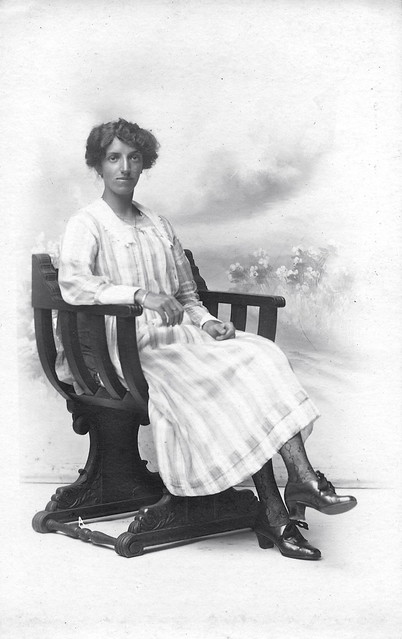
photo1910s

WWIcouple They would have been very similar to those accompanying the ankle length looks of the First World War.

 1925 They would have been even on the most modern and daring looks of the shocking above the knee length of 1925.

30sshoead30sfashion 30sfashion230sfashion3 And such shoes would look right with the longer skirts and return of the waist of the 1930s.  That’s quite a bit of wear out of shoes. And of course these shoes were made to last and leather soles were always redone. The cobbler was in every town and happily repaired and re-soled shoes. Today, of course, we see many shoes, even those supposedly ‘well made’ really just shabbily stitched and soon to fall apart. Things are definitely not made to last in the same way.

It is interesting to me to think that ladies of the time, though they had easily a quarter of the clothes and shoes we have today, looked more put together and smart. In old photos, even gardening or casual family shots, men in ties, ladies in dresses and such shoes as these. And, most likely, their wardrobes were really very sparse. Yet what they did have was stylish, well made, and easily accessorized. Today we throw out clothing and have piles of the stuff clogging up closest, bureaus, armoires. We have the need to run our laundry machines every day and yet, when it comes right down to it, how much style is there really in the day to day? White and bright colored tennis shoes, jeans jeans, and more jeans, leggings, and t-shirts seem to be all most people wear. How can we all look so sloppy and yet have so many more things?

One of the main side affects I have found since living in the past is the vast reduction in things. I did not set out to reduce my garbage or my wardrobe. It simply happened. I have less clothing, so less laundry easier to maintain, yet almost always get compliments on my outfits. Surely I will wear the same skirt more than once in a week, but one day it is topped with a blouse and the next worn with a collared shirt, scarf tied as a tie and a sweater vest (I am really loving the men suit inspired looks of the 1930’s).

Now, I only do my laundry one day a week and so washing every day isn’t really an option. If I had children this might be different, yet at the time, wash day was often one day a week. And the children would have far less clothing as well. I think dirt on play clothes would have been overlooked more than today, because if they were then to go into town, little Bobby or Susie would put on their better school clothes. And the messiness of food was not the same in that children more often than not ate at the table. There was no wandering about the living room with handfuls of chips or dripping peanut butter and jelly sandwiches as they mindlessly stared at the TV screen. Surely, there was mess, but one had a napkin tucked into the shirt and even older children often wore a sort of bib at the table for luncheon or dinner, to protect the clothes. And you were to focus on what you were doing, eating, and not eating as a secondary act to accompany watching the tele.

poorchildreneating Even the very poor often ate at table. Despite this family having very little, the children, most likely in their only clothes other than one nice set set aside for Church and school, are enjoying their repast at the table. The littlest is standing up on a crate, but still at the table.30sfamilyeating This family seems to have very little and are most likely poorer farmers or city dwellers, but the whole family shares their meal at the table, mimicking mum and dad and trying not to make too much a mess.

workingclassfamily A working class family shares a meal at table. Mother’s outfit protected by her pinny while Father shows little Johnny how to use his silverware.

depressioneating Even those hit very hard by the Depression and having to share their homes and meal with extended family and neighbors still gathered at table. Here the table almost serves as an alter, as it is far too small to be used by the vast majority of the diners, but all gather together in the act of eating. Even in this photo of obviously hard times, notice how the ladies hair is done, girls in skirts and dresses. The act of normalcy or the importance of gathering together, even when there was little to eat, was important. It is sad that TV and Computers in many ways has taken this away from family and friends in day to day life.

In a middle class household, however, you would most assuredly been at the table with a napkin on your lap. You would have been expected to wash and dress for dinner as well. Not the black tie evening dress of the upper class, but possibly a clean sweater/jumper for son and simply taking off your apron for little Sis and mum and some lipstick and comb in the hair.  And in the upper middle and upper classes, well into the 1930’s, children often ate their evening meal in the nursery with nanny so they were certain to eat properly at a table with a stern eye watching their table manners.

If you were enjoying a treat it would be on the back steps by the kitchen or away from the nice furniture in house. And most likely you would never have food in many rooms, such as bedrooms and the nicer living room used for company.

This odd tangent from shoes to children's clothing does have a point of sorts. It is this: Less but better makes one’s life easier and more cost effective.

I will not and try not to ever give advice to people with children. I have none of my own and would never presume to give advice. There is probably no job harder nor more challenging than being a Mother. But, because of that very fact, maybe less clothing for lil Bobby or Susie would make some of the day easier? Maybe less clothing but specific to purpose, such as play dungarees and a few t-shirts for play, two pair of nice trousers for school and church with a few dress shirts, would be all is needed. And a good bib and apron for eating, even for an older child, and more eating at the table rather than eating while walking about or in rooms such as the living room. I don’t know, as I said, I know it must be incredibly hard with children. I only know that were I to have a child I think that would be at least how I would like to plan it. Of course, planning is often upset and it is easy to buy cheap clothing for a few dollars at places like Old Navy, but why make more work for oneself? And even for adults, less clothing more stylish means less money spent, less laundry and less repairs needed. And a good solid apron for working around the house and grabbing your quick lunch at the kitchen table.

This, then, is true of shoes. If you have styles you like from a specific period, than buy a few pair of well made shoes that can be re-soled in leather at a cobblers and they will last forever. They will also be stylish. I am not sure when the endless need for ‘sports shoes’ in everyday life first arrived, but it does baffle me now that I wear vintage or vintage inspired shoes. Am I uncomfortable when I shop or walk? No. Even when I exercise I simply wear flats or simply no shoes at all, when I am in the house. If one is running and playing tennis, surely your shoes should reflect that, but I think it is funny how there are little sports shoes for babies who cannot even walk? In the past, children wore a very similar leather lace up shoe for most of their childhood, one pair. And these often were resoled and passed down. I have a pair of shoes that my husband wore as a baby that were his great-grandfathers. These now act as decoration in our house, but had we a child, you can bet he’d wear them until he grew out of them.

I am finding that less with more style is simply a better way to live, at least for my little family. And as we live in an age where one can also easily get the old quality of the past by simply buying the actual antiques locally or online, we have little excuse not to surround ourselves with less things that work better, use less power and last longer. I think in today’s fast paced world of two income parents, less to own, less to clean would make the limited time families have together more joyful.

What other ways can we reduce and make do with less?

Happy Homemaking.

 Search The Apron Revolution